This Saturday (3 September) as part of theVision Sound Music Festivalat the South Bank Centre is London is theSound of Fear. Quite related to a link I mentioned earlier on sound/music/affect in horror films (actually it’s a topic that keeps coming up more and more). The scoop is below and, oh yes indeed, John Carpenter is included!
Sound of Fear is an epic two-part event featuring an international cast of artists, critics and composers brought together in a celebration of the music and sound design of the horror film. Through live performance and discussion, Sound of Fear explores the musical universe of horror, with its supernatural soundscapes and shrieking string arrangements, and pays homage to the masters of musical menace who have made the horror movie soundtrack a melting pot of opposing musical cultures.
Tracing the historical developments and cultural significance of music set to horror films, Sound of Fear looks at the introduction of the European avant garde into popular culture via the Hammer pictures of the 50s, Bernard Herrmann’s redefinition of how horror was heard with his revolutionary score for Hitchcock’s Psycho and the influence of cult director John Carpenter’s atmospheric genre scores of the late 70s and early 80s on a new wave of musicians working today.
Artist Vicki Bennett’s (aka People Like Us) will be screening Horror Collage (2008) on Saturday 3rd September, Part 1 6pm-8:10pm and Part 2 8:30pm – 10:30pm. Watch a clip here.
As summer winds down and I get ready to kick this blog back into high-gear for autumn, here are some art/horror/curating links from the past couple of months:
James Morgart’s Hostile Rebirth of Horror: The Morality of Eli Roth’s Hostel 1 and 2 on Horror News.net Many of us in the horror academia biz love to look at the classics (Night of the Living Dead, Halloween, The Texas Chainsaw Massacre, etc.) and with good reason: these films changed the course of horror forever and are still relevant works. However, it’s important to realize that they were made over thirty years ago and the political/social/culture relevance we ascribe to them is in retrospect and not pointed to our moment of now. Some have argued that horror today (at least American horror) doesn’t cut the mustard and, hey, maybe they’re right. Still, it’s critically important that we (and by we I mean all of us fascinated with horror film) to put into context movies of the past decade. And Morgart did that with Roth’s Hostile films quite well. It’s a much needed and appreciated beginning.
Mario Bava Week on Network Awesome: Speaking of Mario Bava, Network Awesome did an, ahem, pretty damn awesome series on the influential director claiming it “Mario Bava Week”. I’m going to publicly declare that it should be a celebration of “Mario Bava 24/7/365” because where would horror be without him? There would be no American slashers or John Carpenter (wait, maybe that would be a good thing). Regardless, endless credit needs to be given to Bava in scholarly horror history and props to Network Awesome for stepping forward with insightful articles and free-style online screenings of his classics like Danger Diabolik and Rapid Dogs (his last film and a true gem).
Kim Newman and Mark Kermode in Conversation at the British Film Institute: I’ll be honest, one of the places that I miss most in London is the BFI. There’s no better place to go in the world on a dark and rainy afternoon to see The Picture of Dorian Gray, Repulsion, or Eyes without a Face. I’ve even seen bizarro wonders like Miss Leslie’s Dolls to much loving fan-fare on the big screen there. BFI definitely celebrates horror history in a respectful manner. That’s why I wish I could’ve seen this conversation in person, one celebrating the launch of Newman’s “essential horror tome” Nightmare Movies: forty years of fear. Both Newman and Kermode are such visible fans of the genre it becomes infectious.
Ian White’s Invisible Cinemas on LUX: Ian White talks about the movement of film (artist film and video) from the context of the cinema into the museum saying, “In my experience as a writer – which I think is also shared by some of those in academia, probably to a greater profit – it’s not ‘cinema’ but the museum that is publishing monographs and catalogues that are invaluable resources for research, career enshrinements and a decent contributor’s fee.” For me, I am increasingly attracted to the idea of encountering a film or video as you would an artwork – sometimes half-way through the story but this fractured exposure can break itself open to new readings and increased interest.
Scala Forever film series: Speaking of London love, how am-az-ing is this multi-month long homage to Scala Cinema? The fact that they use Big Black in the video promo is simply icing on the awesome cake. Sigh. Began 13 August and runs through 2 October.
Maureen Dowd’s Washington Chain Saw Massacre in the New York Times: It’s interesting how horror is not just a political commentary in-and-of itself but also a comparative tool in which to talk about today’s politics. But as I mentioned above, I think it’s a little tricky to relate what’s happening in the present with films made 30/40/50 years ago. Those films still have resonance but relevance needs to be found with what’s being culturally produced today. It takes more work but it’s going to have more urgency in meaning. Still, Dowd referencing horror is a clear indication of horror’s relevance within popular culture.
Look and Learn in Frieze Magazine: In celebration of its twenty year run, Frieze Magazine is talking about art world developments during this period. This conversation with Alex Farquharson, Sofía Hernández Chong Cuy, Anthony Huberman, Christy Lange, Maria Lind, and Polly Staple on the proliferation of curatorial programmes addresses – but appropriately doesn’t solve – the emerging, evolving, contested, and diverse role of the curator since the 1990s. What stuck with me: How do you want to articulate what you stand for and how do you want to share that with the world? To me, that statements strikes on the core of what being a curator is.
On that note I will leave you with the funniest discovery of my summer: a horror/curator convergence featuring none other than Shaft…
Today is the birthday of the amazingly charismatic Bruce Campbell. An icon from 1980s horror cinema, Campbell’s career has been prolific (in addition to tv’s Burn Notice he’s been featured in almost all of Sam Raimi’s films) but he’s firmly cemented in the horror lexicon as ‘Ash’ from the incredibly funny, scary, and entertaining Evil Dead series.
While filmic montage is prevalent amongst those contemporary artists appropriating horror movies, New York based couple and artistic collaborators Jennifer and Kevin McCoy utilize and approach Rami’s Evil Dead 2(1987) in a very performative way. Inspired by the film that was itself a literal re-make of Evil Dead(1981) – including the same director, plot, and main actor only with a bigger budget – the McCoys’ Horror Chase (2002)is a live computer driven video installation where a series of digitized chase sequences from the film are re-edited and re-presented in real time via the electronics housed in the black suitcase.
Despite the technological inclusion, the work has a tangible architectural and structural element to it as the depicted chase scenes have been laboriously re-constructed by the artists. Replication takes place is many forms. There is the re-made interior of the quintessential ‘cabin in the woods’ in Evil Dead 2 with Kevin McCoy actor Adrian LaTourelle re-enacting Bruce Campbell’s part, the obvious mimic of the movie’s scene/implicit narrative, and then the various random looping supplied by the computers. Of course this re-appropriation is interesting in relation to Evil Dead 2 being a recycled/updated version of the campy original making apparent that Horror Chase uses, re-affirms, and re-projects that compartmentalization in the horror genre by highlighting some of its tropes.
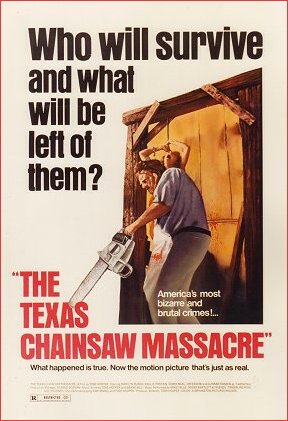
Talk about a shift in medium and audience: check out this new video that filmmaker/musician Rob Zombie made for Woolite that pulls from the “torture porn” films popular in the 2000s (and of course from the 70s, most obviously”Texas Chainsaw Massacre”). What’s interesting about this ad is that it pointedly references our cultural collective knowledge about recent horror film and the political implications torture entails. Now, thanks to Woolite and Zombie, monsters can now be found in your washing machine.
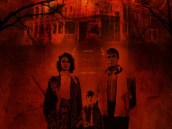
The Birmingham art space TROVE has put out a call for short film works based on the catalogue of legendary filmmaker James Whale. Side note: my favorite Whale film is The Old Dark House from 1932 (see image – that’s Karloff’s hand!). See the call below and also see a previous post on The Girl Who Knew Too Much about Spanish experimental filmmaker Ivan Zulueta’s seminal time-based work Frank Stein (1972).
TROVE is an independent art space in Birmingham, UK. They run a monthly changing programme of contemporary art.
This August (5th-7th August 2011) TROVE will be holding a mini film/performance festival based on the works of James Whale. A film Director born in the Black Country (Dudley, West Midlands) who moved to Hollywood, USA, and made several of the worlds most famous horror films, including Frankenstein (1931), The Bride of Frankenstein (1935) and The Invisible Man (1933).
TROVE are inviting you to submit either proposals for or examples of finished short film pieces that fit the themes James Whale explored in his film back catalogue.
Please send DVDs, CV and a short personal statement by July 15th 2011 to
Kate Spence
TROVE
c/o 229 Dolphin Lane
Acocks Green
Birmingham
West Midlands
B27 7BL
For further info please contact TROVE on info@TROVE.org.uk
And see our website http://www.TROVE.org.uk
There is equal pleasure, both inward and outward, in the creation of a work of art and in the struggle by the audience to be at one with it…that is, to attempt to comprehend the artist’s meaning, and yet to retains one’s own emotional identity with it.
From I like what I know: a visual autobiography (p. 247)
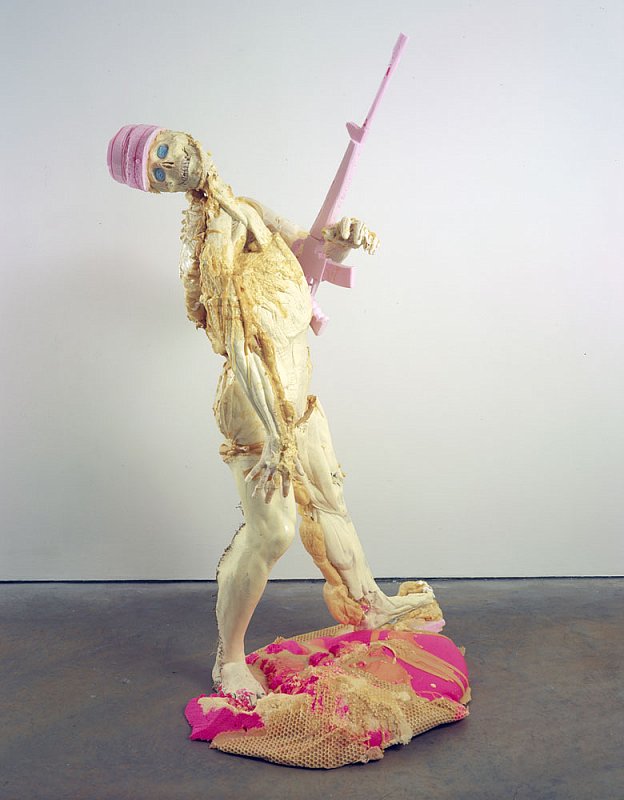
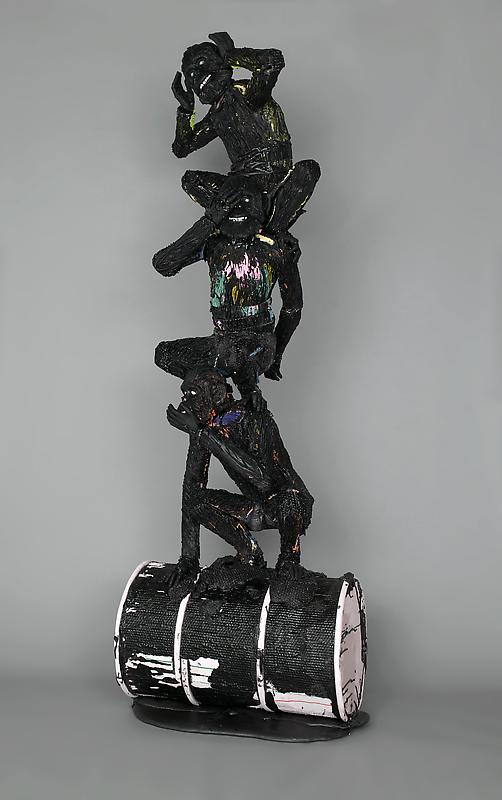
Dutch artist Folkert de Jong’s sculptural works are a grotesque and playful representation of international social histories. He establishes new narratives through the deconstruction of the past (referencing art history, warfare, colonialism, assassinations) assembled in figurative forms so that the viewer can recognize and remember our collective history.
His characters emerge through the time barrier like tarred ghosts, an evocation of negative energies brought forth to enlighten and entertain. These sculptures aesthetically ooze with attraction and repulsion; this push/pull creates a rupture that becomes our portal into an at once familiar and foreign struggle. Carnivalesque costumes, sickeningly sweet colors, and devilish grins are accompanied with barrels of oil, decapitated heads, and rifles. Humor is used to translate the horror and make it palatable. As the bad twin to characters in a Disneyland ride (think Haunted Mansion and Pirates of the Caribbean) De Jong’s figures urgently perform and unfold the history of human drama. These ‘tableaus’ are dropped directly into our present – the gallery, the museum, the studio are the background settings. Here is where time and space collapses as the past merges seamlessly into the now. These are not the desolate and isolated wastelands of Ed Kienholz, they are frighteningly alive ghosts beckoning us join their ‘danse macabre’.
As sheer material form, the sculptures are wholly hand-made and consist of Styrofoam, polyurethane foam, and occasionally clay. The usage of Styrofoam is significant beyond its easily modifiable form; it’s the same medium used in the film industry for architectural and stage design and it’s also produced by the same company who manufactures Napalm (that deadly chemical agent used prolifically in military operations). This subversive combination of fantasy (film) and reality (warfare) makes de Jong’s works resonant with power; an explosion occurs between representation and the acts being represented. And it’s within this space the horrors from the past emerge to haunt our present consciousness.
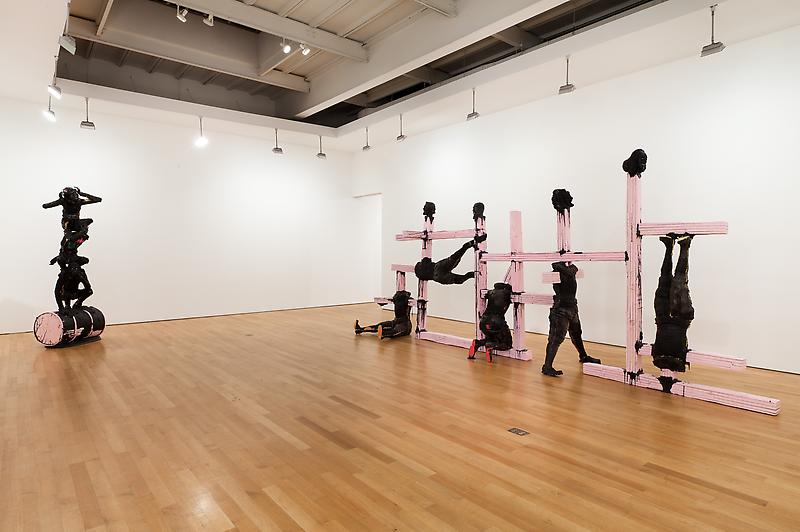
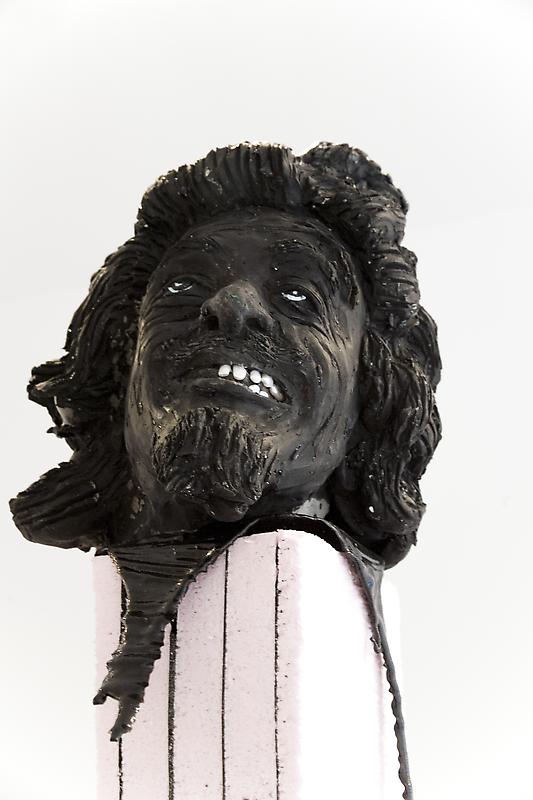
De Jong gives the viewer an arsenal of information. With just enough bit of candy coating, he coaxes us into our historical tales of terror that do not exist within the confines of film set but have been living amongst us within our everyday world. In his latest exhibition at James Cohan Gallery brings this forth via newer and older works including the large-scale and ominously fragmented Operation Harmony (2008). Titled after the contradictory name given to Canada’s 1992 military mission in Bosnia this sculpture references another political invasion, the lynching of Dutch political figures the DeWitt Brothers in 1672. Depicting five headless bodies strewn across the vibrant pink scaffold, only four heads (smiling, direct, sinister) look out at us. They represent men involved in various political assassinations and genocides. With title and source separated by hundreds of years we bear witness to the fact that “progress” often involves a sacrificial death. The conflation of these different historical events and geographical locations together with the present day makes for a curiously charged experience. These men are long dead but their stories have been re-animated.
A newer installation is The Balance II: Trader’s Deal 6-9 (2010) featuring a vignette of proud Dutch traders prance with their treasures of beads and whiskey from Manhattan’s Native Americans. Place in the front portion of the gallery and directly facing the street, these men beckon viewers to share in their spoils. However unlike the charm from the buccaneers in Pirates of the Caribbean, we are more suspicious of these fellows and their inviting presentation of swindled goods. Other works like Business As Usual: “The Tower” (2008) the “No Evil” or “Morality Monkeys” remind us of our ability to look the other way and even perhaps America’s obsession with eliminating anything sad from our thoughts.
Seeped in the significant role art has played in the expression, sublimation, and manipulation of war and terror, de Jong continues the art historical tradition of bringing atrocities to light. In this sense he also acts like a skilled horror film director whose purpose is to manipulate reaction and produce affect. Tackling a myriad of historical traumas, like horror cinema, de Jong exposes universal truths to engage the viewer in a proactive remembrance.
Images (top to bottom): Halleluja, 2007 Installation view: Operation Harmony (2008) and Business As Usual: “The Tower” (2008) Detail view: Operation Harmony (2008) Installation view: The Balance II: Trader’s Deal 6-9 (2010) Business As Usual: “The Tower” (2008)
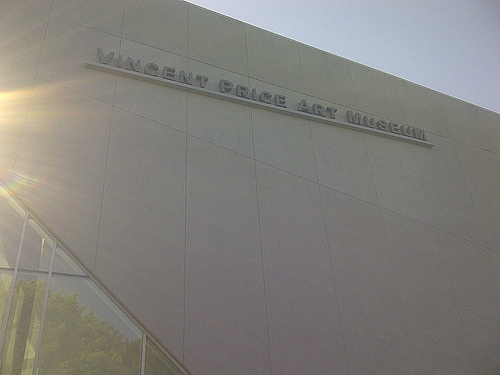
While recently in Los Angeles I had the pleasure of taking a sneak peek at the insanely big and beautiful Vincent Price Art Museum as well as meeting with Director, Karen Rapp. You’ll find out all about the museum, its first series of exhibitions, and Price’s infectious mission to get art into the public arena on my piece for Rue Morgue – Vincent Price Art Museum set to re-open.
Auschwitz. Hiroshima. Vietnam. These are names associated with specific places and occurrences [of historical trauma] but they are also wounds in the fabric of culture and history that bleed through conventional confines of time and space. – Adam Lowenstein ‘Shocking Representation’
One of my research strands on the influence of horror cinema and contemporary artists is looking at how artists manifest historical trauma within their work. By using the structure of the horror film as a guide and in considering Deleuze and Bergson’s notion of the now as an “ever shifting amalgam of past, present, and future”, I’m exploring the idea of a haunted present and possible recuperation seen in the representation of trauma in contemporary artworks.
This particular project (which I plan on realizing in exhibition form) is being called On the Desperate Edge of Now, titled after the first episode of British filmmaker Adam Curtis’ documentary series The Living Dead. In a visual mash up of archival footage, interviews, and appropriated images Curtis describes the relationship between history and memory in the context of World War II as both an individual and political construct that is never fully resolved – a ghost always haunting the present or an omniscient zombie walking the earth. This collision of the past and the present that Curtis outlines makes for an explosively charged ever-present “now” particularly as it manifests itself into representational forms such as film and visual art.
Horror films are subversive and often entertaining social commentary reflecting the cultural and political issues relevant to the time period in which they are produced. Wes Craven’s Last House on the Left (1972), Tobe Hooper’s The Texas Chainsaw Massacre (1974), and Bob Clark’s Deathdream (1974) are all reactions to the traumatic experiences, personally and culturally, of the Vietnam War. Many horror academics also view newer films like Eli Roth’s Hostel (2005) as a reflection of America’s torturing of political prisoners at Guantanamo Bay. On the Desperate Edge of Now looks at how artists tackle similar histories through a knowing employment of strategies and signifiers found in horror cinema: humor, the family, death in life, societal repression, spatiality, allegory, and the corporeal.
Like their filmmaking counterparts, the artists I will be writing about attempt to confront history more than compensate for it. They are: Folkert de Jong, Heather Cantrell, Sue de Beer, and Gert & Uwe Tobias.


 This Saturday (3 September) as part of the Vision Sound Music Festival at the South Bank Centre is London is the Sound of Fear. Quite related to a link I mentioned earlier on sound/music/affect in horror films (actually it’s a topic that keeps coming up more and more). The scoop is below and, oh yes indeed, John Carpenter is included!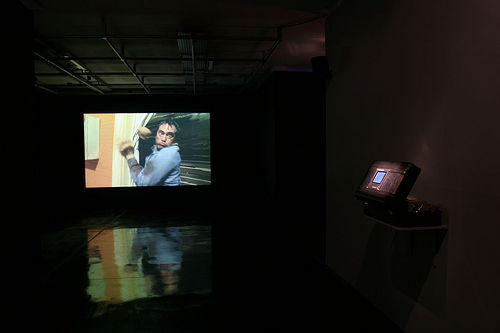






 THE GIRL WHO KNEW TOO MUCH