TGWKTM Receives Creative Capital/Warhol Foundation Arts Writers Initiative

The Girl Who Knew Too Much has been awarded a 2012 Creative Capital/Warhol Foundation Arts Writers Initiative grant. I am extremely grateful and honored for their support.

“Taking the horror film as our guide we can and should begin to rethink the nature of ‘influence’ and ‘imitation’ and the meaning of ‘genre’ and ‘formula’ in contemporary popular culture – in so doing we inevitably rethink our own understanding of horror as well” – Gregory Waller

I set the tone to this blog when I included the above quote by Gregory Waller in one of my very first posts in 2010 and I find this statement to still embody my mission. Aiding in the ability to travel to meet artists, filmmakers, scholars, and curators, the Arts Writers grant will undoubtedly assist me in furthering my obsessive research, writing, and exhibition making as well as provide me with the opportunity to have the technological means to do the savvy online things I’ve always wanted to do. It will also foster a new avenue of interest for me: the role of architecture in horror film and contemporary art. 
I hope that you’ll continue (or start) to read The Girl Who Knew Too Much as I go on this journey exploring the unknown…

Gary Simmons – Metro Pictures


Gary Simmons – Metro Pictures (November 29, 2012 – January 19, 2013)

Simmons_Install_050

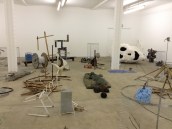
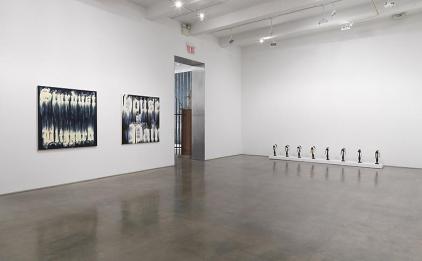
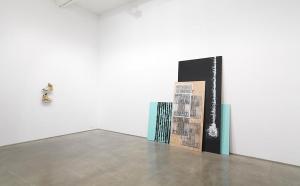
Gary Simmons’ mini-survey featuring selects works of the last twenty years at Metro Pictures reveals a complicated history of race and culture in popular culture (cinema, sports, music, painting). That America’s culture industry can simultaneously perpetuate and challenge stereotypes, politics, and society through representation is the provocation here. I associate Simmon’s work with ghosts and it’s because they evoke the familiar, foreign, forgotten, but ever-present past. The power contained within this sort of representation can bring forth a critical understanding of the effects not only of occurrences on the scale of war but that of the everyday America; its contributions and confrontations. Like the horror film, this work is subversive in nature but revelatory in its origins.

Simmons_Install_030It’s not simply about popular culture but our complicated societal culture as well, including lynchings. The entrance gates, with an inversion of the racist connotations of the “law n jockey” by replacing the figures with the Klu Klux Klan, are an imposing welcome to Gary Simmons’ works that conflate popular culture imagery with their historical associations. Particularly on point is Fuck Hollywood, a row of shoeshine stands with beautifully embroidered towels of celebrity figures like Elvis. The entertainment industry is built upon the mining of others (an issue still very much relevant today) and this work bluntly pits the representation of the black working class against a system that simultaneously exploits and neglects.

c14006a6-lgSimmons’ ghostly, vibrating, cinematic paintings are a personal favorite of mine but when combined with other media, their qualitative power compounds greatly. His dark paintings that are static moving images, caught in an in-between state, in-between frames and movement, the haunting ghosts of American history reemerging and reconfigured as a critical reminding marker of where we have been and where we have yet to go as a nation. The erasure technique that he applies to create his simultaneously static and moving imagery recalls the smoke of ghosts, like faint hands from the past reaching out, through the scene, through the canvas, into the present. One painting screams “House of Pain” with skulls behind it while the painting of the cinema (Bonham Theatre, 2010) stilly spins; a static film still of itself. History never goes away in the promise of a new day.

The embalmed objects of our cultural past are on display as memento-mori: a moonshine set up, boxing gloves, and boom box with record crates. They are starkly white and completely immobilized relics of the last century. But it’s his latest piece, a multi-panel plywood sculpture mounted with drawings of 1930s fight posters, that near perfectly conflates all sorts of media (sculpture, paintings, Simmons_Install_060design, sports) and encapsulates the message contained within this exhibition. Significantly, this work includes a painting of a dangling old-school boxing microphone so elongated and furiously still. This mic looks like a backbone, in fact it is a backbone, a stand-in for the sport, racial and political history, and the artist’s oeuvre to date. To me, this look back at Gary Simmons’ own past is actually quite an exciting look into the future (his, ours, America’s).

Installation views, 2012. Metro Pictures, New York.

Sean Higgins Interview

HIGGINS-images“The biggest influences on my work in the beginning weren’t necessarily other artists. It was Tarkovskiy films and Alphaville. I was always more interested in that in terms of influence of subject matter.”

Sean Higgins’ work appears to be photographs of the natural world – land, seascapes, space, explosions – but they function as hermetic spaces of unknown origin, depopulated vistas. Higgins’ practice destabilizes source photographic imagery through technological and handcrafted interventions. These particular works, titled after Joy Division songs, embody the exhibition’s idea of collapsed spaces with pools of endless blackness.  

Sean Higgins, a Los Angeles-based artist who is included in my upcoming exhibition about post-apocalyptic voids is interviewed in LA, I’m Yours. Includes great studio shots. Enjoy the blackness…

Sing Me a Western Song on MOCAtv

It’s no secret that Marnie Weber is much loved on this blog so it’s with great excitement that her 2007 16mm film Sing Me a Western Song (featuring another afterlife tale by the Spirit Girls) is available to watch on MOCAtv as part of their West Coast Video series. Includes a personal introduction by Weber to boot!

Support Bruce LaBruce’s “Gerontophilia”

Toronto-based artist, filmmaker, writer, and photographer Bruce LaBruce is currently in production for his 8th feature film, Gerontophilia, and he needs/deserves your support. You can learn more about the project and donate funds here.

DIRECTOR’S STATEMENT
While it might not in any conventional sense be considered science fiction, Gerontophilia is at its heart a time travel movie. It takes as its subject a love affair of sorts between an eighty year old man and an eighteen year old boy: two old souls who, had they met each other somewhere else along the space/time continuum, might have become the perfect couple. The old man, Mr. Peabody, lost the love of his life, Smitty, when they were both in their twenties in a swimming accident. Alone for most of his life, and finally abandoned in a nursing home, the old man succumbs to the cruelty of the institution where he is confined, overmedicated with psychotropic drugs and sometimes tied down with restraints. His only consolation is the memories he has of Smitty that come to him almost like hallucinations as he drifts in and out of consciousness, particularly one in which the couple spend a summer’s day on the beach at the Pacific Ocean. Here it’s almost as if he’s time traveling, too.

Bruce LaBruce was a contributor to the third volume of Incognitum Hactenus, Living On: Zombies. Click here to read the original script for his amazing genre film, Otto…Or Up With Dead People.

Fango Flashbacks

In November, the VHS Vault program I co-curate at Nitehawk Cinema co-presented a series of real “turkeys” with Fangoria in celebration of the Thanksgiving holiday season. In conjunction with this program, I wrote briefly on each of the films for Fangoria’s “Fango Flashback” which is their ongoing series that looks back at the “classics”. It was a bloody good time.

Fango Flashback: BLOOD FEAST (1963)
Horror cinema has many Godfathers. James Whale, Val Lewton, Mario Bava, and George A. Romero have all laid down the foundation of what we collectively consider to be the “horror film.” Mixed in with these founding forefathers of horror is the varied bunch of “B” geniuses: Edgar G. Ulmer, Roger Corman, and…Herschell Gordon Lewis. As the crowned “Godfather of Gore” and the near antithesis to Mr. Lewton, Lewis created the “splatter” subgenre in his over-the-top movies that would set the wheels in motion for future generations of American horror filmmakers. On the cusp of its fiftieth anniversary, Nitehawk Cinema and FANGORIA revisit Lewis’ first filmic foray into horror by presenting the VHS version of his cheap and charming 1963 flick, BLOOD FEAST. READ THE REST

Fango Flashback: BLOOD FREAK (1972)
Although many films in the 1970s dealt with the horror of the Vietnam War and the affected soldiers’ difficult return to “normal” life in the United States (LAST HOUSE ON THE LEFT, DEATHDREAM, TEXAS CHAIN SAW MASSACRE), BLOOD FREAK certainly isn’t one of them.Vietnam vet / motorcycle rider Herschell certainly has some demons in his closet but this movie doesn’t really take us there with him. Providing a ludicrous quasi-morality tale on consumption (drugs, the bible, turkey, women), BLOOD FREAK is not exceptionally gory or gratuitous or even offensive. It is, however, horribly produced, horrendously acted, and has appalling dialogue. Yet still (still!), BLOOD FREAK is so damn entertaining that to revel in its kitsch should be a horror fan’s inalienable right. There is some indefinable quality here that makes this tale, one of a muscle-man-turned-drug-addicted-killer-turkey-man, one for the ages. READ THE REST

Fango Flashback: HOME SWEET HOME (1981)
Lovingly low-budget and certainly “inspired” by HALLOWEEN, HOME SWEET HOME occurs around what we can only gather is a Thanksgiving celebration at a failed music producer’s country home. It brings together all sorts of ambiguous relationships (who, exactly, is with whom?) that includes a small child named Angel (played by future EYES WIDE SHUT and THE HILLS HAVE EYES reboot star Vinessa Shaw), a wailing Latina, a mime/magician/guitarist, two over-sexed friends, a horny couple and the aforementioned producer. And all, save the two obligatory final girls, will perish in fairly comical ways by the ridiculously beefy unmasked version of “The Shape.” READ THE REST

Marnie Weber – The Night of Forevermore

If it is said that Hieronymus Bosch draws with his brush, then Marnie Weber films with her sculptures.

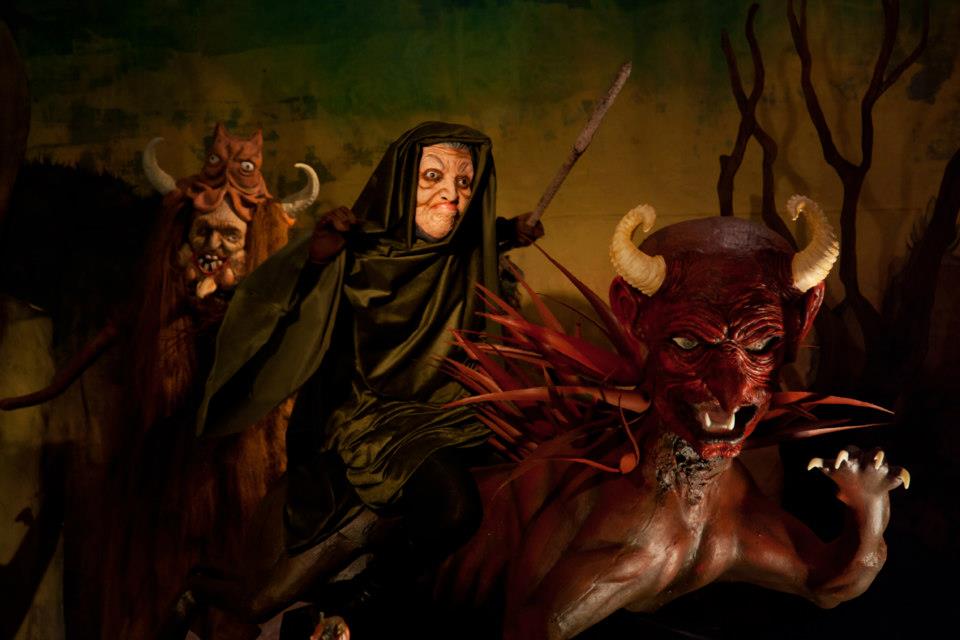
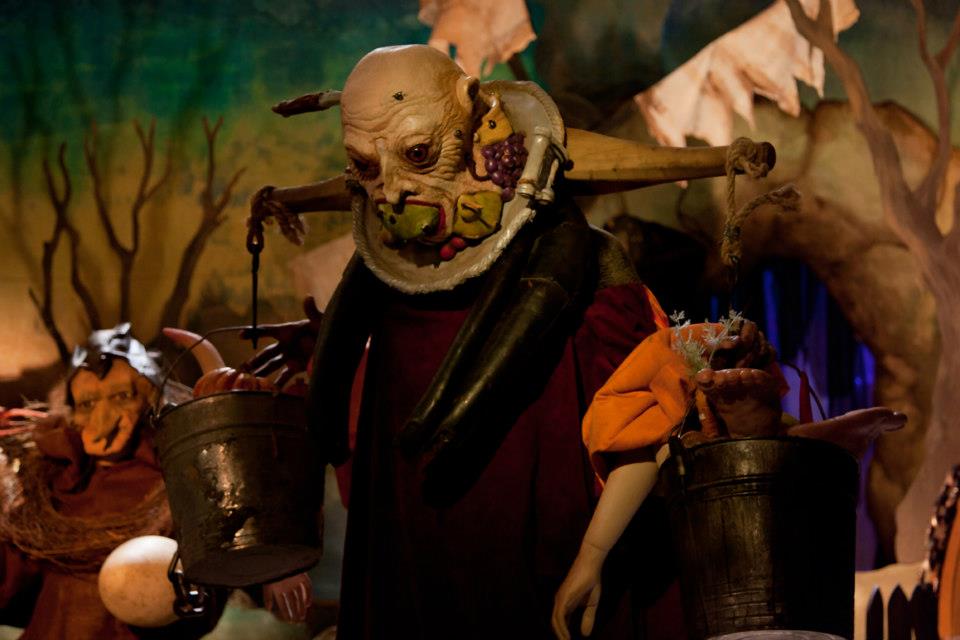
Marnie Weber’s The Night of Forevermore is a static space housing monsters, demons, witches, human-animal hybrids; all of which come alive with slow, repetitive gestures and sound. It’s a Hieronymous Bosch painting brought to life, a haunting world with creatures familiar and strange, each with their own woe, purpose, and revenge. Bosch’s paintings are infamously crowded, layered with forms of life and death co-mingling in this liminal boundary between heaven and hell. It is an area of foretold ghosts. And retained within the picture plain and filmic frame, Weber’s animated sculpture remain spread across the entire tableau but firmly placed on an individual stage.
Of course, the activating power that elevates the concept of a painting into a moving image in The Night of Forevermore is the camera itself. Through the all-seeing eye of Weber’s lens, the viewer is shown this world of dreams and nightmares beginning with a static shot where movement begins individually, slowly, and then all at once. This overview pans away, purposefully, to show the action and the function of each creature – the musician, the crying pig, the riding witch, the executioner – giving the audience privileged mobility. It’s the opposite of Bosch’s chaotic evocation of confusion where our eyes dart maniacally across the surface. Weber’s calculated pacing lends the bizarre, gruesome, and monstrous scene an elevated other worldly aura. The strangeness becomes tactile.
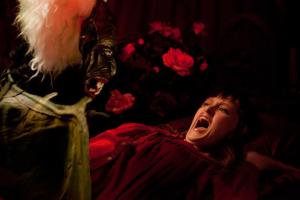
Weber’s films themselves are like dreams, with images floating from space to scene in non-linear time as her representational figures suggest eternal ramifications for questionable deeds. The protagonist in The Night of Forevermore is a young and innocent girl (played by Weber’s own daughter, Colette Rose Shaw) shown her own dreamlike/nightmarish journey to escape the darkness. She is the only one with the freedom to move, her ability traverse through these alternate realms only being because she is still fighting the evil damnation the witch (played by Weber) has subjected her to. Hers is an unexpected reality, confronting a devilish figure, escaping the witch’s clutches, waking up in strange alternate universes. Similar to the horror film heroine (aka the Final Girl), her experience is a visualize metaphor living through life into adulthood. The Night of Forevermore is a late 15th century morality tale made contemporary through the influence of moviemaking.
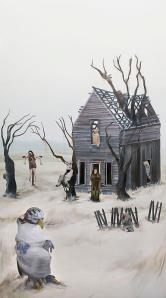
However, as is typical with Weber’s tales, her monsters are not safely relegated to the spiritual (film) world. Instead, the gallery space functions as a portal through which Weber brings forth these beings through objects. The painting and collage on wood works (a first) provide a literal weight to what I’ve always associated as her unique version of film stills. Furthering the narratives in the film and withholding the freedom of movement the film provides, these collage pieces segues perfectly into the sculptural versions of select characters. Haunting us with their presence, the old witch sits still in a rocking chair while watching us watch the film, a bed of fruitless trees lurk nearby. One almost expects them to begin moving, just a twitch, as the film has shown us that even paintings, even creatures in the night, can come alive, seek us out, and steal our souls.
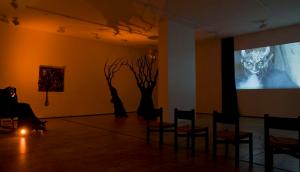
Marnie Weber’s The Night of Forevermore at Marc Jancou Gallery (New York, September 13 – November 3, 2012) 
Sinister walls: representation and repetition

In continuing the exploration of the slipages that occur between imitation and homage in contemporary creative forms, here is an interesting correlation of imagery from the new “home video discovery turns to haunting” film Sinister with Stan Shellabarger’s 2005 performance at the Museum of Contemporary Art, Chicago and Paul McCarthy Face, Head, Shoulder Painting – Wall Black Line (1972). Shellabarger and McCarthy’s embodies these prolific similarities of reference between horror cinema and visual art as their work deals with repetition, endurance, and a relationship to the space that surrounds them.

Thanks to Scott Speh at Western Exhibitions.

Related in the series: Cabin in the Woods and Peter Doig’s 1990s cabin paintings.

Night of New Horror at Nitehawk

Last Tuesday was a night of celebrating new horror at Nitehawk Cinema and I was thrilled to be a part of it. First, Incognitum Hactenus held a part for the release Living On: Zombies (Vol. 3) with “undead soul” tunes by Dave Tompkins and Jim Shaw’s film The Hole. Then we screened three films I curated (based on video and found footage) by Darren Banks before the New York premiere of Magnolia Picture’s new horror anthology V/H/S. And lastly, we presented Banks’ amazing “tech gone wrong” montage for the after-party. To relive the event, check out the pics…

This slideshow requires JavaScript.