The Dark Room: spectral space of photography and film in Alexander Nicolas Gehring’s Messages from the Darkroom and Michael Powell’s Peeping Tom

The Dark Room: spectral space of photography and film in Alexander Nicolas Gehring’s Messages from the Darkroom and Michael Powell’s Peeping Tom is an essay I wrote for the Brighton Photo Fringe Open ’11 exhibition (November 18 – December 18) as a contributing Guest Curator.

It is profoundly seductive to believe that photography can be an evidentiary medium of a realm beyond our mortal coil. Even more provocative is the idea of photography, and subsequently film, as a tool to facilitate our voyeuristic desire to see the invisible (fleeting moments, ghostly visions, and even intense fear). In his series Messages from the Darkroom, Alexander Nicolas Gehring taps into photography’s psychological strangeness by positioning its construct and production as spectral sites. This depiction of the camera as an object to channel, capture, and visualize deathly moments, as well as its function in fulfilling our desires to bear witness, was explicitly explored in Michael Powell’s controversial, and equally luscious film, Peeping Tom (1960).

What interests me is Gehring and Powell’s shared urge to confront the past via photographic means and how their work comments on what Martin Scorsese declared [in a 2010 interview with Mark Kermode celebrating the 50th anniversary of Peeping Tom] as our “morbid urge to gaze”. This cultural gaze has evolved in the decades since the release of Peeping Tom, with its nearly prophetic social commentary, into something that is at once more familiar and disturbing in our contemporary world. With this “morbid urge to gaze” in mind, Messages from the Darkroom and Peeping Tom fundamentally comment on the attempt to visualize and record the ultimate gaze: that of death. The very foundation of the photographic medium aims to preserve aspects of memory, life, and experience in relation (and perhaps in reaction) to this very personal and profound moment we will all experience. Channeled through the lens of the camera, and re-born in the haunted space of the darkroom, the spirits contained and preserved within these images have been called forth by the artist/photographer/filmmaker/mad scientist.

Based on the historical usage of photography by scientists and occult practitioners to capture the presence of ghosts in “spirit photography”, Alexander Nicolas Gehring’s Messages from the Darkroom brings to light how space, specifically the room where film is processed, functions as a site for the spectral. This series conflates the notion of “medium” in photography in that the camera produces a physical medium (a photographic image) and acts as a spiritual medium (a channel between the living and non-living). Here the camera is medium in literal form, producing a representation of what some believe to be objective documentation of ghosts, becoming a bridge between the corporeal and spiritual worlds. Still, what is most interesting about Gehring’s photographs is not the evoked image itself but the concept of a spectral site, a place where the dead are re-born and re-placed back into the land of the living.

Now revered as a British new wave classic, Michael Powell’s career-ending Peeping Tom treads similar waters in its fetishization of camera objects, the haunted space of the darkroom, voyeuristic eye, and the distinct presence of the dead. The film shows how the torturous childhood of Mark Lewis continuously haunts his adult state of mind, compelling him to use his camera as a recording device and lethal weapon. In glorious Eastman colour, the aesthetic of Peeping Tom – the visualization of the darkroom as two-toned, red and black, dark and shadowy, warm and clinical – is most noticeable in Gehring’s photographs Medium and Light Phenomenon. The camera in these works is captured as a self-contained medium and as a sculptural object. As Powell suggests by alternating viewpoints between Mark’s “special” camera with the another “outside” lens, Gehring’s confrontational camera is also shown through the unrepresented lens (an autonomous camera that functions as the audience point-of-view).

In the cellar, darkness prevails both day and night, and even when we are carrying a lighted candle, we see shadows dancing on the dark walls. Gaston Bachelard – The Poetics of Space

The darkroom (connoting the laboratory, dungeon, cellar, etc.) is a space of process and discovery. Gehring’s darkroom becomes the place of the séance. Referencing the photographic documentation of paranormal activity by notable early twentieth century German psychic researcher, Albert Freiherr von Schrenck-Notzing, Messages from the Darkroom focuses on the dead returning and co-mingling with the living via photographic representation. This darkroom references an arena of scientific research where new technology is used to capture the unseen, in this case ghosts, in an attempt to be in closer contact with an extension of human existence. The darkroom and cinematic space in Peeping Tom acts as a dual place of sanctuary and fear. In this room, Mark returns to the site of his own psychological abuse by processing and consuming the films he makes by murdering women. With each repetitive viewing, these victims are repeatedly brought back to life, made to watch their own death, and be killed again.

Of course, this is the very nature of the filmic/photographic medium itself, a sensitized form capturing a specified series of events in time that can be replayed in perpetuity. As time and space collapse, that which is depicted onscreen never truly fades; always existing as it was at that very moment it was captured, frozen forever on celluloid. Furthermore, our current moment is one where the medium of film is in the process of becoming obsolete. In the wake of the quality, ease, and accessibility of digital technology, there appears to be little use for analog outside the realm of nostalgia. A near living object itself (film curator Henri Langlois firmly believed that nitrate film had to be used/exercised in order to stay alive), film now finds itself in a ghostly space within the digital realm.
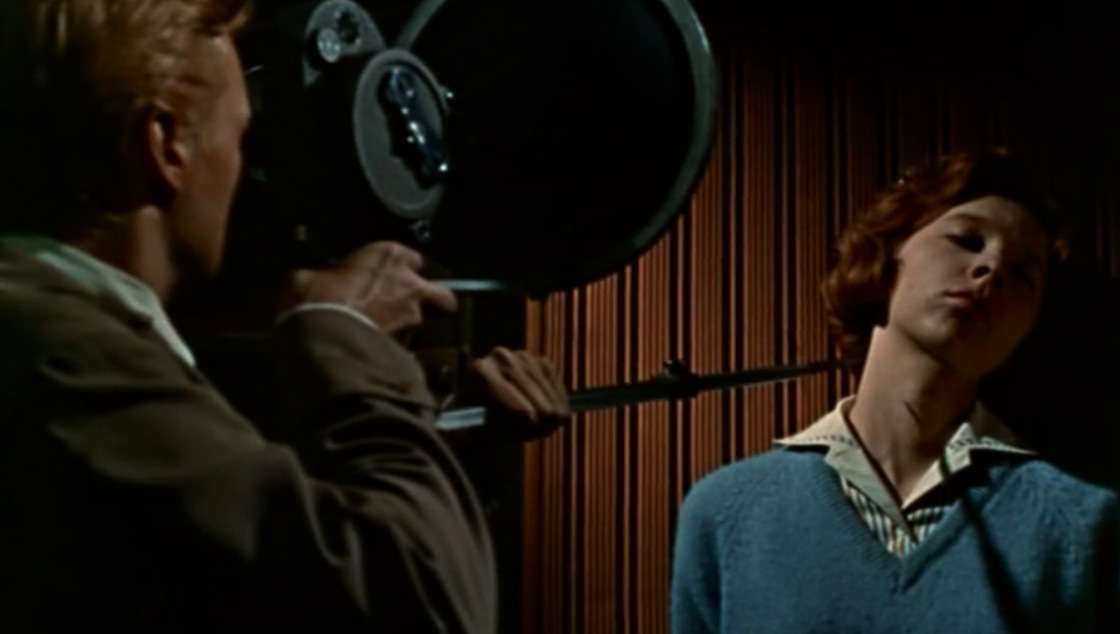
Alexander Nicolas Gehring and Michael Powell are seduced by the psychic camera as evidence but wary of its ability to produce accurate visual records. Gehring engages in an obsession to document the afterlife while Powell challenges the perversity of documenting all aspects of our lives. They contest the “all knowing” camera eye because they also consider what happens outside of the frame; photographic representation inherently lays on the liminal boundary between fact and fiction. The foundation of the darkroom is what grounds these layers of suggested ghostly presence within the photographic “medium”. Itself in danger of becoming a thing of the past, this dark room provides the spectral space in which we can conjure up the unseen and indulge, repeatedly, in our collective and cultural morbid desire to gaze.

Thoughts on “the Art of Fear”: film viewership and why horror?

The first screening of the two-part The Art of Fear series (which will hopefully become a multi-part expanded series) launched last Wednesday to great success with a collection of works by Takeshi Murata, Darren Banks, and Jamie Shovlin titled Pieces. Thanks to all who came out!

Two important strands of thought came out of this initial program (which was also, incidentally, my first foray into exhibiting artist moving images) that I’d like to explore further both in my own curatorial practice and via writing here on TGWKTM…

The first is in consideration of how artist film programs such as The Art of Fear can or should be presented and viewed. My intention with Pieces was to approach in like a gallery context – no seating, no definitive start/stop time, and flexibility of viewership. Meaning, I wanted to embrace the lobby space at Nitehawk not as a dictatorial cinematic space but rather in a manner in which you might approach a static piece of artwork. I’m very interested in an audience encountering a film in a non-time based way, choosing how much time to spend with the work and how entering in different narrative points can alter both the story-line and the audience’s perception of what he/she is seeing. I also embrace the idea of artist films entering into the cinematic sphere, especially as certain artists, like Ben Rivers, produce feature films. It’s simply a matter of context and consideration.

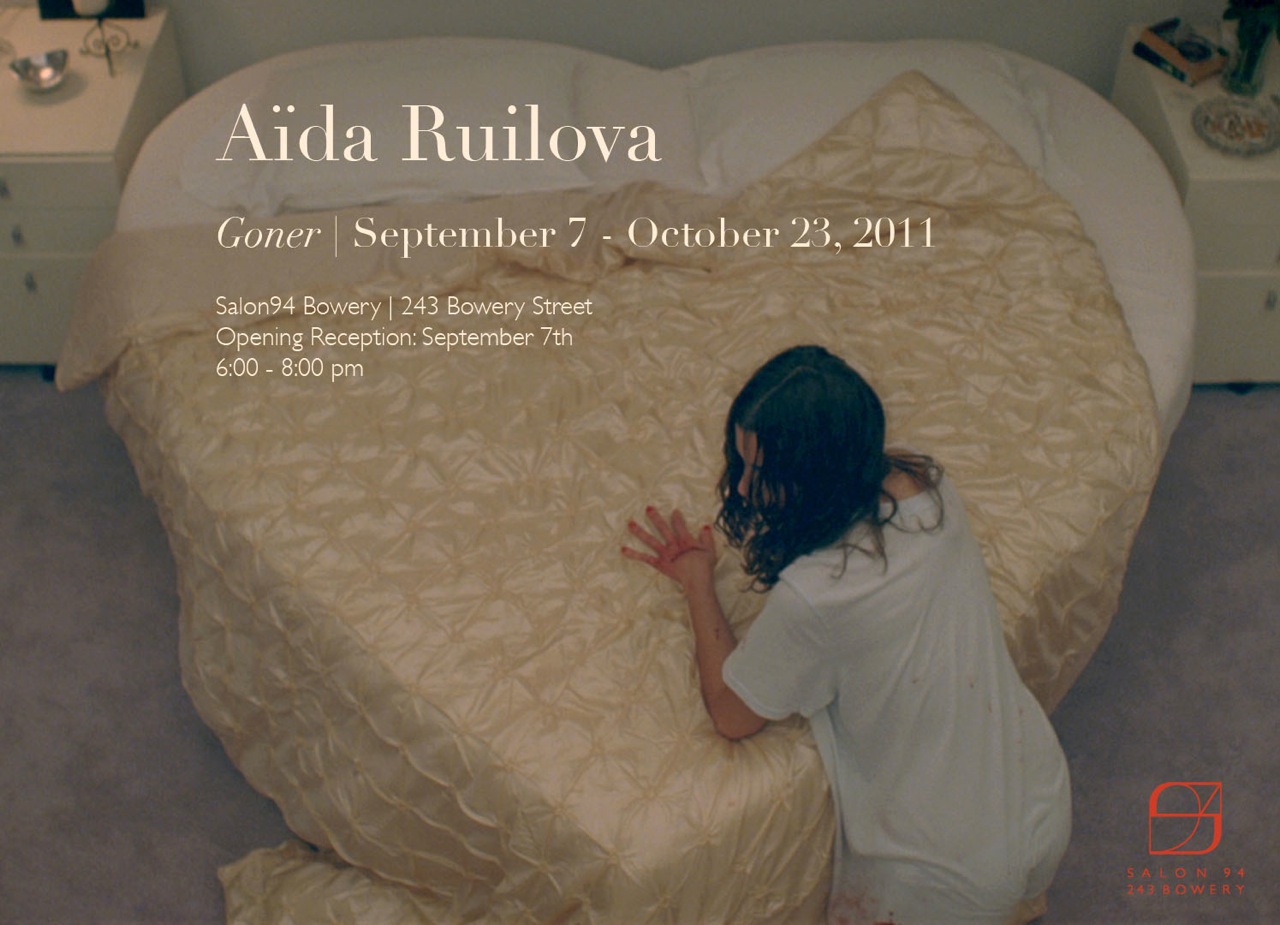
Still, I was surprised the the audience at The Art of Fear was interested in having seating to watch, in its entirety, a program of non-narrative films. In a way I felt as if my curatorial power had been usurped but, in another, it was exciting to see an interest in giving these works undivided attention. This of course has led me to wonder about the sematics of film programming – should this be called a screening? or an exhibition? Are there ways that we, as producers of exhibitions, can set the tone for how the audience will view the artwork or, ultimately, is it that power inherent in the audience? The next portion of the program/exhibition/screening Ghost Stories with My Barbarian, Aida Ruilova, and Marnie Weber is narrative in nature and appropriate for a proper sit-down affair. So the experiment will continue. And it’s going to be amazing so please don’t miss it, whether you sit, stand, or squat.

The other strand of thought involves the question of “why horror?” which is relevant to both my own curatorial investigation and the implementation of horror characteristics by artists. While this question is being visually represented, addressed, somewhat answered in the series of exhibitions I am doing, I believe that an essay series of why horror is of personal, cultural, and political interest is just as crucial. Stay tuned!

Ed Kienholz “Five Car Stud” – on view for the first time in 40 years

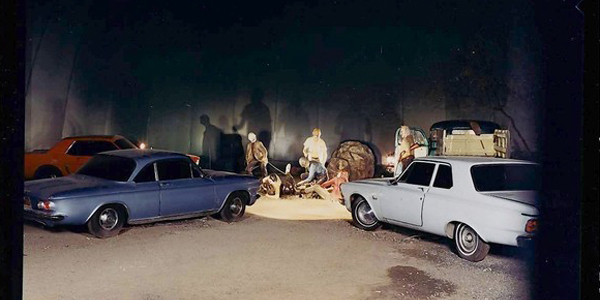
Emphasizing the marginal and the forgotten, tackling racism, sex, and war Ed Kienholz (October 23, 1927 – June 10, 1994) approached his artwork much like a horror film director. His tableaus are annihilated spaces, post-apocolyptic scenes in which we, the audience, can peer into the deeps of what the “other” (still so much like us) feels. Loneliness is palpable as the uncanny figures mock us for not having the guts to be as dirty and as real as they are. These are shocking scenes, even for today, and they resonate deep within our sensibilities. He re-created the ugliness of the world in an environment to which we could safely relate.

Much of his work has an edge to it but one of his more provocative installations is being re-visited this month in Los Angeles. Kienholz’s infamous Five Car Stud (made somewhere between 1969 and 1972) that depicts a brutally violent racial attack will be seen for the first time in forty years at the Los Angeles County Museum of Art as part of the city-wide Pacific Standard Time event. From the Los Angeles Times:

It is a difficult piece on multiple levels. It is enormous, for one thing: a tableau installation involving nine life-sized figures, five automobiles, several trees and a truckload of dirt. More difficult still is what the piece depicts: a circle of white men, lighted only by the headlights of the circled automobiles, pinning and castrating a lone black man, while a child cowers in one of the cars and a woman — presumably the victim’s companion — huddles and vomits in another.

The white figures are all realistically cast, but for the grotesque rubber masks on each of the men. The black figure’s face is uncannily bifurcated: a clear plastic outer face is frozen in a scream while a darker one within it is “sadly resigned and quiet,” as Kienholz put it in a statement at the time. His torso is made from a rectangular tin filled with black water, in which float letters that spell out a racial slur.

Watch Nancy Reddin Kienholz (his wife and collaborator) install the work:

For more see his galleries: LA Louver and Pace Gallery.

Faüxmish

Performance, music, and art have deep roots in the unique creative landscape of Los Angeles. New experimental power trio (Marnie Weber, Dani Tull, & Doug Harvey) Faüxmish is sure to be a part of this legacy.

Faüxmish is celebrating the release of their debut LP & CD ‘F for Ache’ with their debut public performance at Human Resources in Los Angeles on September 2nd. More info here.

Faüxmish is a Los Angeles art-rock supergroup that came together over a shared engagement with American spiritual sects who remove themselves from established social norms and create their own culture as outsiders.

Taking as their motto “Simplicity Through Noise,” Faüxmish have developed a practice rooted in improvisational ensemble playing using electric guitars (played with rubber mallets and other extended as well as traditional techniques) and vintage synthesizers, in various combinations of three.

Initially conceived as a ‘wall of sound,’ the group’s music rapidly developed a complex and idiosyncratic audio vocabulary drawing on the members’ widely divergent individual musical backgrounds, which range from noise to prog, post-punk to film scores, and 90s alt-rock to improvisational audio collage. The results range from dreamy ambient soundscapes to theatrical rock songs.

How to Explain Pictures to a Dead Hare

How to Explain Pictures to a Dead Hare is a collaboration with Darren Banks’ for his current solo exhibition Backwater in Northhampton. My accompanying text is a part of Banks’ film installation of the 1972 classic The Wicker Man in his show at Fishmarket Gallery (on view through 25 June). I’ve written for and about Banks (a fellow horror aficionado) before: read Get on the Band-wagon: Darren Banks’ Mobile Cinema and an interview for LUX.

How to Explain Pictures to a Dead Hare

Robin Hardy’s bizarre film The Wicker Man (1973) situates horror at the boundaries of sanity and puts varying degrees of morality up for grabs. Emerging at the death rattle of the utopian ideal that was widely envisioned in the 1960s, it is situated amongst American shockers The Texas Chainsaw Massacre (1974) and Last House on the Left (1972) which grappled with the disillusionment of societal stability in the wake of the Vietnam War, the assassinations of Martin Luther King Junior and Robert F. Kennedy, the 1969 riots, and emerging fragile economies. The Wicker Man is a decisively British interpretation of this failure by hippie culture and reactively calls those in authority into question. At the same time, it challenges a reluctance to return to nature and the generation’s abandonment of community in favor of new individualism. It’s a unique film that both embraces and discards community, nature, sex, religion, capital, and the value of life.

As a post-modern horror film, The Wicker Man positions its horror within the everyday. The ‘normalcy’ of the Summerisle community (ritual sex, belief in reincarnation, blood sacrifice) is juxtaposed with the ‘logical’ reasoning and Christian beliefs of outsider Sergeant Neal Howie who has come from the mainland to investigate the disappearance of a young girl named Rowan Morrison. So relentless in his struggle to find Rowan, Howie becomes increasingly embedded into what only he considers to be an insane world; a community in which people willing lie to authority, women are sexually empowered, and young girls are potentially sacrificed to the gods. The Wicker Man paints an eerie portrait of a town where people initially appear to be just like us but who slowly reveal the altered reality in which they live.

Importantly The Wicker Man coincides with the development of performance art from the 1960s into the 1970s. Increasingly about the body and in non-capitalist forms contemporary performance art was, like horror cinema, moving into a reflexive direction. Eight years before The Wicker Man was released, Joseph Beuys staged his eponymous performance How to Explain Pictures to a Dead Hare in which he shut out gallery-goers from his exhibition while he explained the artwork to the dead hare he carried in his arms. After he was done people were allowed into the gallery space but he turned his back to them. Thus the audience became the outsiders, just like Sergeant Howie, while the hare and the artist, like Summerisle, became privileged.

This dichotomy between inclusion and exclusion is the core of The Wicker Man. Despite being from the same country, Sergeant Howie is a foreigner from a different time and culture; an urban representative in a rural town rooted in its own pagan tradition. He is not a stand in for the audience (who is relegated to voyeur status) but instead functions as an opposing representative force that continuously inflicts his personal beliefs on others and views their way of life as a personal attack on him and to his God. He thus enacts a clash of belief systems involving a battle between spirituality, opposing lifestyles, and life/death. Ulmiately the actions of Howie and the tribe of Summerisle crystallize an overarching and universal insanity – does anyone really have the answers, access to the one true god, conduct for the moral way to live and who has the right to impose these belief structure on to others?

The Wicker Man is a bizarre translation of the early 1970s shift in culture that still startles in a contemporary context. Full of symbolic representations and potent imagery it incorporates performance (the periodic bursts of song alone make it musical ready) as a ritualistic rite, however sexually perverse or deadly. In fact nearly every gesture is performative; sex in the graveyard, young women jumping over a fertility fire, boys dancing around the Maypole. All these acts lead up to Mayday when what was once depicted as a slightly kooky community is now full-fledged creepy. Donning animal masks, community members are seen spying on Sergeant Howie as he makes one last attempt to save Rowan. Merging in and out of the frame, they preface the dramatic processional towards the sacrificial grounds where Lord Summerisle (Christopher Lee) leads the parade dressed as a manly apparition of a woman. The entire narrative is one big performance enacted by patriarchal figure Lord Summerisle to coherence Sergeant Howie into being the human sacrifice for next year’s fruitful harvest. The virginal, righteous, and Christian Howie becomes the lead character in the performance of a lifetime.

But phallic inferences abound as a way to express that this story is one of regeneration, growth, and fertilization and not resurrection. Until we discover Rowman is still alive, the image of the hare acts as her stand-in thereby referencing the hare’s historical meaning: love (Greek), fertility (Roman and Germanic tribes), and the resurrection (Christianity). The most shocking representational image is simultaneously the one true moment of horror within the film: the appearance of the Wicker Man. Large and looming, this sculpture of death is profoundly terrifying. It’s where Howie’s fears are ultimately realized and its affect palpably reaches the audience via the film’s final performance where Howie frantically prays loudly to his God as the Summerisle community sings in harmony, smiling and satisfied. Unlike hippie culture, their tribe has prevailed over the outside world.

Though rife with problems in the production, editing, and distribution The Wicker Man has since been dubbed the “Citizen Kane of horror movies”. A bold name to be bestowed upon such a strange film but its enduring fascination and horror is undeniable. Perhaps it resonates with us now precisely because it represents something with which we are familiar – ourselves. As a haunting figure, The Wicker Man is a reminder of the inherent survivalistic qualities of human nature and the recognition that society, whether we acknowledge it or not, has the capacity to revert back to more animalistic tendencies when confronted with immediate extinction.

On the Desperate Edge of Now – Folkert de Jong

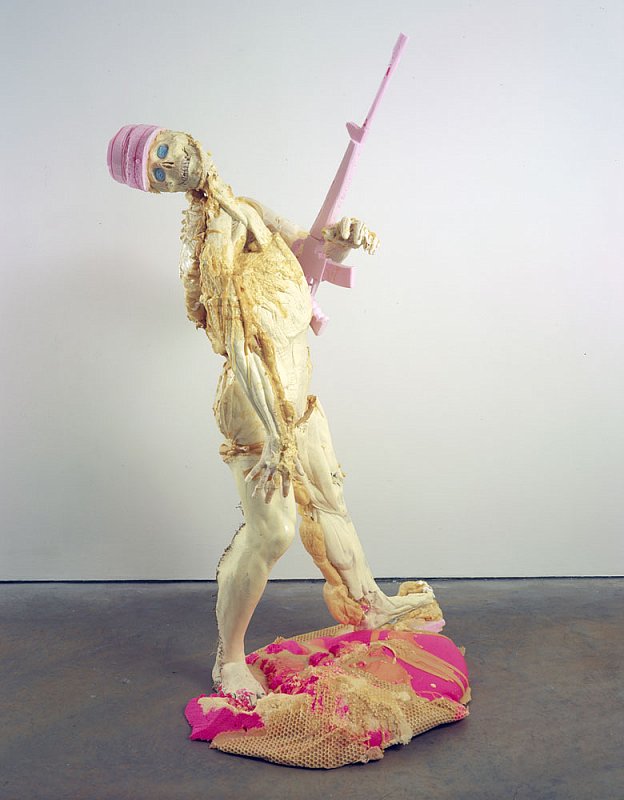
Dutch artist Folkert de Jong’s sculptural works are a grotesque and playful representation of international social histories. He establishes new narratives through the deconstruction of the past (referencing art history, warfare, colonialism, assassinations) assembled in figurative forms so that the viewer can recognize and remember our collective history.

His characters emerge through the time barrier like tarred ghosts, an evocation of negative energies brought forth to enlighten and entertain. These sculptures aesthetically ooze with attraction and repulsion; this push/pull creates a rupture that becomes our portal into an at once familiar and foreign struggle. Carnivalesque costumes, sickeningly sweet colors, and devilish grins are accompanied with barrels of oil, decapitated heads, and rifles. Humor is used to translate the horror and make it palatable. As the bad twin to characters in a Disneyland ride (think Haunted Mansion and Pirates of the Caribbean) De Jong’s figures urgently perform and unfold the history of human drama. These ‘tableaus’ are dropped directly into our present – the gallery, the museum, the studio are the background settings. Here is where time and space collapses as the past merges seamlessly into the now. These are not the desolate and isolated wastelands of Ed Kienholz, they are frighteningly alive ghosts beckoning us join their ‘danse macabre’.

As sheer material form, the sculptures are wholly hand-made and consist of Styrofoam, polyurethane foam, and occasionally clay. The usage of Styrofoam is significant beyond its easily modifiable form; it’s the same medium used in the film industry for architectural and stage design and it’s also produced by the same company who manufactures Napalm (that deadly chemical agent used prolifically in military operations). This subversive combination of fantasy (film) and reality (warfare) makes de Jong’s works resonant with power; an explosion occurs between representation and the acts being represented. And it’s within this space the horrors from the past emerge to haunt our present consciousness.

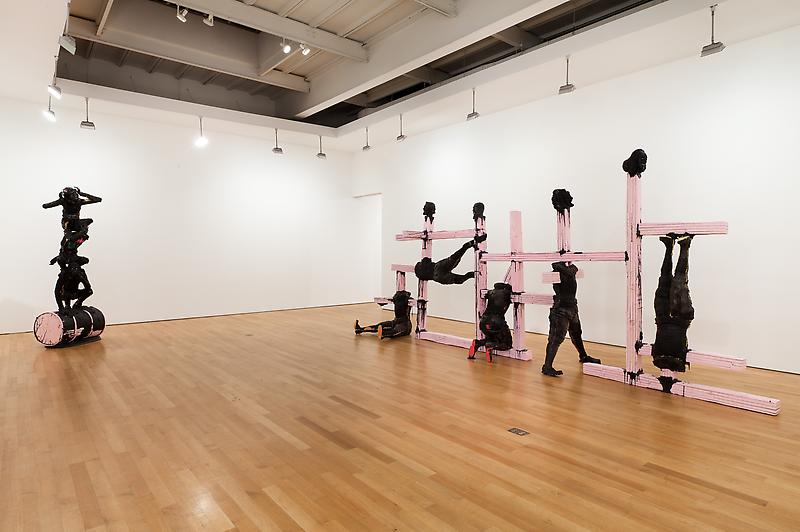
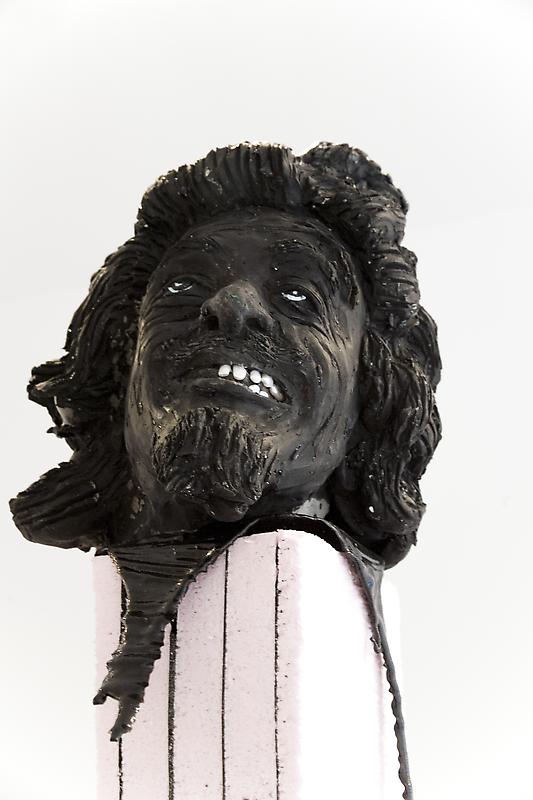
De Jong gives the viewer an arsenal of information. With just enough bit of candy coating, he coaxes us into our historical tales of terror that do not exist within the confines of film set but have been living amongst us within our everyday world. In his latest exhibition at James Cohan Gallery brings this forth via newer and older works including the large-scale and ominously fragmented Operation Harmony (2008). Titled after the contradictory name given to Canada’s 1992 military mission in Bosnia this sculpture references another political invasion, the lynching of Dutch political figures the DeWitt Brothers in 1672. Depicting five headless bodies strewn across the vibrant pink scaffold, only four heads (smiling, direct, sinister) look out at us. They represent men involved in various political assassinations and genocides. With title and source separated by hundreds of years we bear witness to the fact that “progress” often involves a sacrificial death. The conflation of these different historical events and geographical locations together with the present day makes for a curiously charged experience. These men are long dead but their stories have been re-animated.

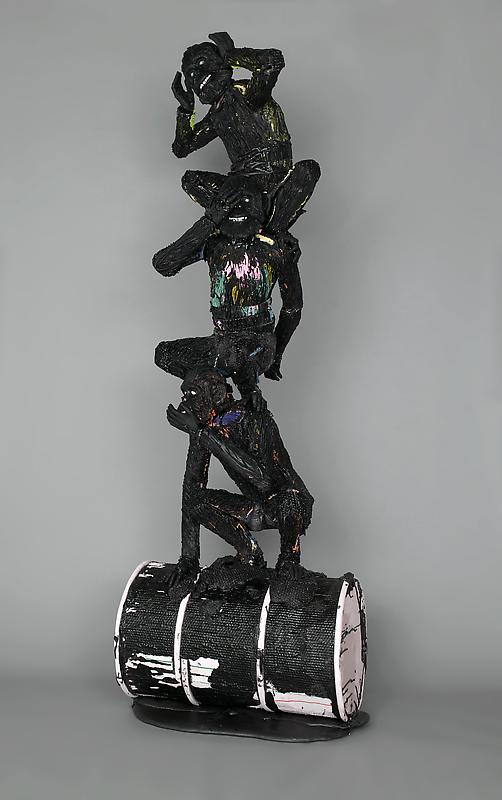
A newer installation is The Balance II: Trader’s Deal 6-9  (2010) featuring a vignette of proud Dutch traders prance with their treasures of beads and whiskey from Manhattan’s Native Americans. Place in the front portion of the gallery and directly facing the street, these men beckon viewers to share in their spoils. However unlike the charm from the buccaneers in Pirates of the Caribbean, we are more suspicious of these fellows and their inviting presentation of swindled goods. Other works like Business As Usual: “The Tower” (2008) the “No Evil” or “Morality Monkeys” remind us of our ability to look the other way and even perhaps America’s obsession with eliminating anything sad from our thoughts.

Seeped in the significant role art has played in the expression, sublimation, and manipulation of war and terror, de Jong continues the art historical tradition of bringing atrocities to light. In this sense he also acts like a skilled horror film director whose purpose is to manipulate reaction and produce affect. Tackling a myriad of historical traumas, like horror cinema, de Jong exposes universal truths to engage the viewer in a proactive remembrance.

Images (top to bottom):
Halleluja, 2007
Installation view:  Operation Harmony (2008) and Business As Usual: “The Tower” (2008)
Detail view: Operation Harmony (2008)
Installation view: The Balance II: Trader’s Deal 6-9  (2010)
Business As Usual: “The Tower” (2008)

Photos: Jason Mandella / James Cohan Gallery

Jamie Shovlin – Pieces

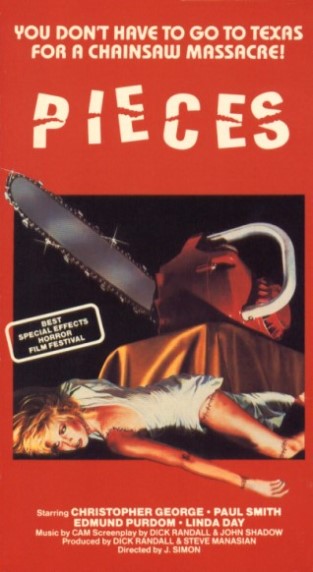
Earlier I mentioned Jamie Shovlin’s Hiker Meat project. In the same slasher film vein, here is an image of Shovlin’s Index (Pieces A) that explicitly references that bloodiest movie about body parts, Pieces (Juan Piquer Simon, 1982). The image used is taken from the trailer.

Index (Pieces A), 2011
Gouache and Image Transfer on linen mounted on board
11×16″ / 28x40cm
Courtesy of Horton Gallery

In addition to Index (Pieces A) I’ve also included the classic and clever poster for the film.


A great synopsis on
Pieces can be found here.

Darren Banks – Public Sculpture for the Masses

The Drawing Room in the UK is currently hosting their Drawing 2011 – Biennial Fundraiser (exhibition runs from 7 April – 18 May 2011 and ‘close of bidding silent auction event’ is 18 May from 6:30-8:30pm) and I just had to share Darren Banks’ The Wicker Man-inspired contribution:

Public Sculpture for the Masses, 2011 (click the title to go to the bidding page)
Medium: pen over print
Dimensions: 29.7 x 21 cm

Related reading: my essay Get on the Band-wagon: Darren Banks’ mobile cinema