Gary Simmons – Metro Pictures (November 29, 2012 – January 19, 2013)
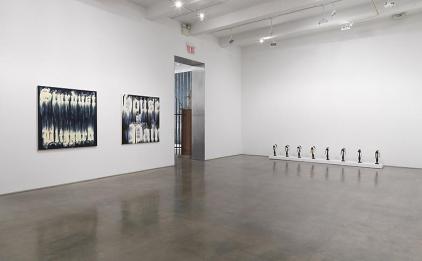
Gary Simmons’ mini-survey featuring selects works of the last twenty years at Metro Pictures reveals a complicated history of race and culture in popular culture (cinema, sports, music, painting). That America’s culture industry can simultaneously perpetuate and challenge stereotypes, politics, and society through representation is the provocation here. I associate Simmon’s work with ghosts and it’s because they evoke the familiar, foreign, forgotten, but ever-present past. The power contained within this sort of representation can bring forth a critical understanding of the effects not only of occurrences on the scale of war but that of the everyday America; its contributions and confrontations. Like the horror film, this work is subversive in nature but revelatory in its origins.
 It’s not simply about popular culture but our complicated societal culture as well, including lynchings. The entrance gates, with an inversion of the racist connotations of the “law n jockey” by replacing the figures with the Klu Klux Klan, are an imposing welcome to Gary Simmons’ works that conflate popular culture imagery with their historical associations. Particularly on point is Fuck Hollywood, a row of shoeshine stands with beautifully embroidered towels of celebrity figures like Elvis. The entertainment industry is built upon the mining of others (an issue still very much relevant today) and this work bluntly pits the representation of the black working class against a system that simultaneously exploits and neglects.
 Simmons’ ghostly, vibrating, cinematic paintings are a personal favorite of mine but when combined with other media, their qualitative power compounds greatly. His dark paintings that are static moving images, caught in an in-between state, in-between frames and movement, the haunting ghosts of American history reemerging and reconfigured as a critical reminding marker of where we have been and where we have yet to go as a nation. The erasure technique that he applies to create his simultaneously static and moving imagery recalls the smoke of ghosts, like faint hands from the past reaching out, through the scene, through the canvas, into the present. One painting screams “House of Pain” with skulls behind it while the painting of the cinema (Bonham Theatre, 2010) stilly spins; a static film still of itself. History never goes away in the promise of a new day.
The embalmed objects of our cultural past are on display as memento-mori: a moonshine set up, boxing gloves, and boom box with record crates. They are starkly white and completely immobilized relics of the last century. But it’s his latest piece, a multi-panel plywood sculpture mounted with drawings of 1930s fight posters, that near perfectly conflates all sorts of media (sculpture, paintings, 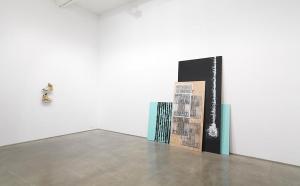 design, sports) and encapsulates the message contained within this exhibition. Significantly, this work includes a painting of a dangling old-school boxing microphone so elongated and furiously still. This mic looks like a backbone, in fact it is a backbone, a stand-in for the sport, racial and political history, and the artist’s oeuvre to date. To me, this look back at Gary Simmons’ own past is actually quite an exciting look into the future (his, ours, America’s).
Installation views, 2012. Metro Pictures, New York.
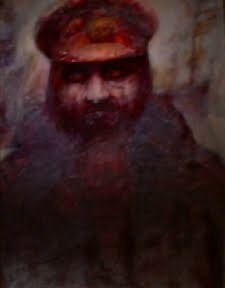

 Los Angeles artist Heather Cantrell uses portrait photography as a means to construct and, ultimately, deconstruct singular and collective identity. Performative elements of her subjects as well as theatrical backgrounds function very much like a movie set in which the actions of her “characters” become exaggerated, solidified in an ever-static moment of the past.
 Here, the still landscapes of Civil War battlefields resonate with America’s collective past, now hauntingly placid tableaus but once the site of bloody horror, while the images of war memorials imbue trauma as remembrance. The Civil War, pitting family against family with cultural and political values at stake, lead to the formation of the United States as it exists today. Cantrell parallels our country’s upbringing with the turmoil of her own by juxtaposing these landscapes with representations of her four fathers who, by default, also symbolize her mother. Her biological father Ivo is the only human figure in the series, her other fathers are depicted through objects – a house, a semi-truck, and most eerily, an urn (one of her stepfathers, Sam, tragically committed suicide).
 Perpetually revealing one specific moment, photography itself is a conjuring up of a spectral past. Based on the historical usage of photography by scientists and occult practitioners to capture the presence of ghosts in “spirit photography” in the late 19th and early 20th century, the very foundational concept of the photograph can be seen as a spectral site, a place where the dead are re-born and re-placed back into the land of the living. Therefore, the idea of “medium” here is twofold: a physical medium (the photographic image) and spiritual medium (a channel between the living and non-living). Corpus Battaglia is therefore a ghost, conjuring up America’s collective formative past when a nation was at war with itself along with the artist’s individualized experience of growing up; manifestations of America and a young American.



 THE GIRL WHO KNEW TOO MUCH
