Shop Smart, Shop S-Mart: Evil Dead and Jennifer and Kevin McCoy

Today is the birthday of the amazingly charismatic Bruce Campbell. An icon from 1980s horror cinema, Campbell’s career has been prolific (in addition to tv’s Burn Notice he’s been featured in almost all of Sam Raimi’s films) but he’s firmly cemented in the horror lexicon as ‘Ash’ from the incredibly funny, scary, and entertaining Evil Dead series.

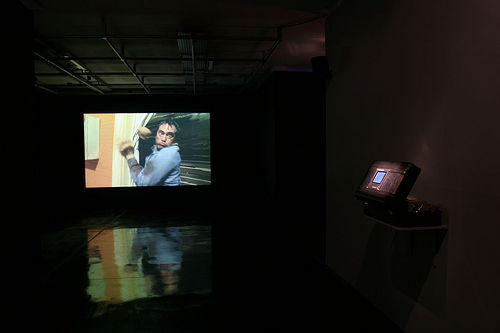
While filmic montage is prevalent amongst those contemporary artists appropriating horror movies, New York based couple and artistic collaborators Jennifer and Kevin McCoy utilize and approach Rami’s Evil Dead 2 (1987) in a very performative way. Inspired by the film that was itself a literal re-make of Evil Dead(1981) – including the same director, plot, and main actor only with a bigger budget – the McCoys’ Horror Chase (2002) is a live computer driven video installation where a series of digitized chase sequences from the film are re-edited and re-presented in real time via the electronics housed in the black suitcase.

Despite the technological inclusion, the work has a tangible architectural and structural element to it as the depicted chase scenes have been laboriously re-constructed by the artists. Replication takes place is many forms. There is the re-made interior of the quintessential ‘cabin in the woods’ in Evil Dead 2 with Kevin McCoy actor Adrian LaTourelle re-enacting Bruce Campbell’s part, the obvious mimic of the movie’s scene/implicit narrative, and then the various random looping supplied by the computers. Of course this re-appropriation is interesting in relation to Evil Dead 2 being a recycled/updated version of the campy original making apparent that Horror Chase uses, re-affirms, and re-projects that compartmentalization in the horror genre by highlighting some of its tropes.

Horror Chase: production design by Roshelle Berliner and shot by Michael McDonough

You can watch Horror Chase online here. 

Monster in the washing machine

Talk about a shift in medium and audience: check out this new video that filmmaker/musician Rob Zombie made for Woolite that pulls from the “torture porn” films popular in the 2000s (and of course from the 70s, most obviously”Texas Chainsaw Massacre”). What’s interesting about this ad is that it pointedly references our cultural collective knowledge about recent horror film and the political implications torture entails. Now, thanks to Woolite and Zombie, monsters can now be found in your washing machine.

Fallen Light: Mario Bava and Bas Jan Ader

My obsessive research on the relationship between horror film and contemporary art often takes me to unexpected places. For instance one day while I was viewing the artist films of Bas Jan Ader, I came across his Nightfall whereby I immediately and instinctually associated his light/dark tonal construction with Mario Bava. I find Bava’s horror movies to be magical experiences, touching and haunting, and I tend to automatically think of Ader in much the same way. The associations I began to draw out between them cement my thinking that the cultural and political climate of the 1960-70s fostered a sense of unease that can be felt throughout different mediums, producing some of the most enduring images of our time.

Italian filmmaker Mario Bava and Dutch conceptual artist Bas Jan Ader are cult figures, mysterious and evocative. They delve down into our sorrows and fears through an extraordinary expression of themselves. In considering how their bodies of work share structurally and thematic characteristics, we see how the subversively ingrained innovations of horror cinema are applicable in other art forms. Most importantly, their work addresses the crucial role the audience plays by watching and relating to what is seen onscreen.

Bava and Ader are two of the biggest creative influencers of the 20th century and yet they are still relatively unknown. Mario Bava, the grandfather of Italian horror cinema, ignited the giallo movement and the subsequent ‘slasher’ films in America. His innovative cinematography and directorial style are referenced in Martin Scorsese’s Cape Fear (1991), Sean Cunningham’s Friday the 13th (1980), Ridley Scott’s Alien (1979(, and Roman Coppola’s CQ (2001). The small oeuvre of video, photography, and installations by Bas Ader, who lived and taught college in California until his mysterious death at sea in 1975, is the stuff of art world intrigue. There has been a documentary on his disappearance, Here is Always Somewhere Else (Daalder, 2007), the recent exhibition Suspended Between Laughter and Tears at Pitzer College that presented contemporary Californian artists whose practice responds to his legacy, and gallery exhibitions of his work appear at Patrick Painter Gallery in Los Angeles. In terms of popular culture Ader’s performances can be considered as a precursor to the Jack Ass era of bodily-harm-humour and hijinks.

Of course Bava and Ader had nothing to do with each other directly even though both were productive roughly around the same time (1960s-70s). This makes uncovering their unlikely relationship so poignant and fascinating. By looking closely at their films The Girl Who Knew Too Much (Bava, 1963) and Nightfall (Ader, 1971) along with other key works, certain specific structural commonalities emerge. Focusing on their usage of light and dark, interiors and isolation, endurance and the body, and death and tragedy provokes a new reading between cinema and visual art.

Light and dark
Bas Jan Ader and Mario Bava’s manipulation of light and dark is a stimulus for the onscreen action and the viewer’s response. This tonal construction is used to heighten the very natural human fear of being alone in the dark. Their contrasting usage of light and dark delineates space, establishing disorientation and ‘spectatorial identification’ with the audience.

In his black-and-white film Nightfall, Ader slowly takes us through the process of ‘becoming dark’. He is alone in what appears to be barn, standing before a large heavy chunk of concrete with two very bright spotlights on the ground. He struggles to pick up the stone, hold it, and then drops it onto the first light. He does this once more until he is obscured in darkness. Murnau’s silent classic Nosferatu (1922) comes to mind in its depiction of death through shadowy devices. In fact, Ader cuts a similar elongated, thin, morose figure. The vampire in cinema (and vampiric nature of cinema) is an interesting example of death by light but in Nightfall Ader is killed by the darkness. Using light as a visual prop and theatrical device, he guides the viewer’s sight lines, peaking our curiosity of what happens in this unseen non-visualized future.

A master manipulator of lighting and visual illusion, Mario Bava has a stylistic habit of highlighting the eyes of his actors. From the haunting black-and-white Black Sunday (1960) to the campy colorful Danger Diabolik (1968), the contrast between the light strip across the eyes and the dark surroundings is so striking that it compels the viewer to look.  This technique is used most effectively in The Girl Who Knew Too Much or La ragazza che sapeva troppo when heroine Nora Davis, believing she has witnessed a murder of a young woman, has difficulty discerning between reality and fantasy. The audience is left ‘in the dark’ along with her, receiving informational clues via Bava’s filtering of illuminating light as the narrative unfolds.

Interiors and isolation
Claustrophobia induced by isolation and interiors is an affective staple of the horror genre. Bava and Ader root their works in a reality by creating unease in familiar spaces such as the domestic interior of the home, turning them into a place of menace and distrust.

About his films Bava said, ‘what interests me is the fear experienced by a person alone in their room. It is then that everything around him starts to move menacingly around, and we realize that the only true ‘monsters’ are the ones we carry in ourselves.’ It’s true that in Bava’s films we never quite know if the characters are actually being pursued or if their imagination will be their ultimate undoing. In The Girl Who Knew Too Much, heroine Nora constructs an elaborate security system of string and powder (see Cape Fear) while alone in a friend’s house. At this point in the narrative, we don’t know whether the threat to her is real or whether it’s her imagination triggered from her passionate reading of murder mysteries. Two stories in Bava’s Black Sabbath (1963) trilogy, The Telephone and The Drop of Water, each feature an isolated woman in a state of panic, unraveling as she loses her good judgment and her mind. Also, the murders in Bava’s giallo classics Bay of Blood (1971) and Blood and Black Lace (1964) only occur when the victims are alone; designed to additionally hide/reveal the killer’s identity.

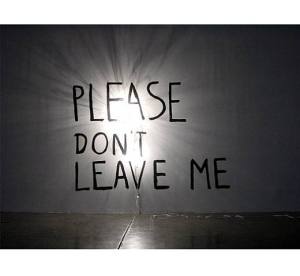
Ader’s evocation of isolation is a much more personal experience. The loneliness in I’m Too Sad to Tell You (1971), where Ader cries and sobs to camera, is undoubtedly the most palpable. His falling film series – Fall I (1970), Fall II (1970), Broken Fall (Organic) (1971), and Nightfall – express gravity in the metaphoric terms of what happens when no one there to catch him: he blows over in the wind, rolls off the roof, winds up in darkness. But the most haunting cry of this undeniable and dreaded absence is the burst of light emanating from the words scrawled on the wall his installation Please Don’t Leave Me (1969) For Ader presence is established in relation to absence; it is in a perpetual state of mourning, searching for future outcomes.

Endurance and the body
Horror films are corporeal beasts and Bava’s films are no exception. With the opening sequence to his first feature Black Sunday he initiates the audiences’ affected reaction by nailing a spiked iron mask to Barbara Steele’s (a vampire witch) face. This film shows how the body exists beyond death, exemplifying physical decay and the possibility to resuscitate dead flesh. His later films Four Times that Night (1972), Bay of Blood, and Blood and Black Lace are less subtle in their approach to bodily destruction as characters are eliminated in classic giallo fashion; torturously chased by an unknown murderer, ultimately being killed by an axe to the face or repeatedly stabbed. In a scene infamously re-used in Friday the 13: Part II, Bava brutally pierced together a couple having sex with a long dagger. Ironically, the actual death scenes are rather quick. It’s the film in its entirely that marks its overarching endurance for the portrayed victims and the audience.

Unlike his California contemporary Chris Burden, Ader’s self-inflicted physical endurances are less aggressive and much more emotionalized. Yes, his Fall series is intense and dangerous but it’s not the act alone that we anticipate, it’s the act in relation to the body that makes the work empathetic.

Ader’s Nightfall is a choreographed test of strength where he uses his body as the main object that enables action. Tension radiates from the artist and permeates into the occupying space (and into the cinematic space) as he struggles to handle the weight of the block he’s holding. The audience feels this and is satisfyingly relieved when he eventually (and strategically) drops the block onto the lights, leaving him and us in darkness.  His Broken Fall (Organic) is similar in this respect – he hangs and sways from a tall tree branch over a creek. As the audience we know we are witnessing an in-between moment; a brief period of waiting until he finally loses his grip and falls onto the ground. Structurally akin to horror cinema, these paused moments of tension build up to the gratifying release for the person onscreen and for the viewer.
Death and tragedy
Since Bas Jan Ader vanished at sea in 1975 while making his last piece of work In Search of the Miraculous (his boat was found but he was not), his melancholic persona tends to overshadow the complexity of his work and our reading of it. Ader embodies death and tragedy on a personal level while Bava outwardly depicts violence onto others (he did make horror films after all). The main focus in Bava’s films was the overall design, including actors to backgrounds, while Ader is simultaneously subject and object. However different in approach, they both fuse together humour and tragedy in such a way that invests a proactive interest in life through the exploration of death.

Humour in a horror context can be interpreted as a way to release the tension and we can see this ebb-and-flow in their artworks. It’s hard not to giggle when Ader falls from the roof in a Buster Keaton-esque physical comedy or when he dangles from a tree in Broken Fall (Organic). And the jolts of laughter Bava provides at the end of Bay of Blood (the children wind up shooting their parents, hilarious!) or Black Sabbath (camera pans out to show Karloff riding on a dummy horse in studio as slapstick music plays) are actually quite amusing. Instinctively, Bava and Ader collate tragedy and comedy, making the intangible accessible through a little bit of therapeutic laughter.

Conclusion
To me, considering Mario Bava and Bas Jan Ader in the same context is a reminder of how powerful images can mirror the struggles and triumphs of life. Perhaps it goes beyond the influence of horror cinema on visual artists and extends into thinking about how social and political environments shape artistic practice. It is also an exciting provocation that the horror genre is successfully productive in differing mediums and not just scare tactics for silly cinema. Thus, my research gladly continues.

IMAGES (top to bottom, all stills)
1. Mario Bava, The Girl Who Knew Too Much (1963)
2.  Bas Jan Ader, Nightfall (1971)
3. Mario Bava, Black Sunday (1960)
4. Bas Jan Ader, Please Don’t Leave Me (1969)
5. Mario Bava, funny ending to Bay of Blood (1971)
TROVE call for videos for James Whale mini-festival

The Birmingham art space TROVE has put out a call for short film works based on the catalogue of legendary filmmaker James Whale. Side note: my favorite Whale film is The Old Dark House from 1932 (see image – that’s Karloff’s hand!). See the call below and also see a previous post on The Girl Who Knew Too Much about Spanish experimental filmmaker Ivan Zulueta’s seminal time-based work Frank Stein (1972).

TROVE call out for shorts film

TROVE is an independent art space in Birmingham, UK. They run a monthly changing programme of contemporary art.

This August (5th-7th August 2011) TROVE will be holding a mini film/performance festival based on the works of James Whale. A film Director born in the Black Country (Dudley, West Midlands) who moved to Hollywood, USA, and made several of the worlds most famous horror films, including Frankenstein (1931), The Bride of Frankenstein (1935) and The Invisible Man (1933).

TROVE are inviting you to submit either proposals for or examples of finished short film pieces that fit the themes James Whale explored in his film back catalogue.

Please send DVDs, CV and a short personal statement by July 15th 2011 to

Kate Spence
TROVE
c/o 229 Dolphin Lane
Acocks Green
Birmingham
West Midlands
B27 7BL

For further info please contact TROVE on info@TROVE.org.uk
And see our website http://www.TROVE.org.uk

Thanks Darren for the heads up!

How to Explain Pictures to a Dead Hare

How to Explain Pictures to a Dead Hare is a collaboration with Darren Banks’ for his current solo exhibition Backwater in Northhampton. My accompanying text is a part of Banks’ film installation of the 1972 classic The Wicker Man in his show at Fishmarket Gallery (on view through 25 June). I’ve written for and about Banks (a fellow horror aficionado) before: read Get on the Band-wagon: Darren Banks’ Mobile Cinema and an interview for LUX.

How to Explain Pictures to a Dead Hare

Robin Hardy’s bizarre film The Wicker Man (1973) situates horror at the boundaries of sanity and puts varying degrees of morality up for grabs. Emerging at the death rattle of the utopian ideal that was widely envisioned in the 1960s, it is situated amongst American shockers The Texas Chainsaw Massacre (1974) and Last House on the Left (1972) which grappled with the disillusionment of societal stability in the wake of the Vietnam War, the assassinations of Martin Luther King Junior and Robert F. Kennedy, the 1969 riots, and emerging fragile economies. The Wicker Man is a decisively British interpretation of this failure by hippie culture and reactively calls those in authority into question. At the same time, it challenges a reluctance to return to nature and the generation’s abandonment of community in favor of new individualism. It’s a unique film that both embraces and discards community, nature, sex, religion, capital, and the value of life.

As a post-modern horror film, The Wicker Man positions its horror within the everyday. The ‘normalcy’ of the Summerisle community (ritual sex, belief in reincarnation, blood sacrifice) is juxtaposed with the ‘logical’ reasoning and Christian beliefs of outsider Sergeant Neal Howie who has come from the mainland to investigate the disappearance of a young girl named Rowan Morrison. So relentless in his struggle to find Rowan, Howie becomes increasingly embedded into what only he considers to be an insane world; a community in which people willing lie to authority, women are sexually empowered, and young girls are potentially sacrificed to the gods. The Wicker Man paints an eerie portrait of a town where people initially appear to be just like us but who slowly reveal the altered reality in which they live.

Importantly The Wicker Man coincides with the development of performance art from the 1960s into the 1970s. Increasingly about the body and in non-capitalist forms contemporary performance art was, like horror cinema, moving into a reflexive direction. Eight years before The Wicker Man was released, Joseph Beuys staged his eponymous performance How to Explain Pictures to a Dead Hare in which he shut out gallery-goers from his exhibition while he explained the artwork to the dead hare he carried in his arms. After he was done people were allowed into the gallery space but he turned his back to them. Thus the audience became the outsiders, just like Sergeant Howie, while the hare and the artist, like Summerisle, became privileged.

This dichotomy between inclusion and exclusion is the core of The Wicker Man. Despite being from the same country, Sergeant Howie is a foreigner from a different time and culture; an urban representative in a rural town rooted in its own pagan tradition. He is not a stand in for the audience (who is relegated to voyeur status) but instead functions as an opposing representative force that continuously inflicts his personal beliefs on others and views their way of life as a personal attack on him and to his God. He thus enacts a clash of belief systems involving a battle between spirituality, opposing lifestyles, and life/death. Ulmiately the actions of Howie and the tribe of Summerisle crystallize an overarching and universal insanity – does anyone really have the answers, access to the one true god, conduct for the moral way to live and who has the right to impose these belief structure on to others?

The Wicker Man is a bizarre translation of the early 1970s shift in culture that still startles in a contemporary context. Full of symbolic representations and potent imagery it incorporates performance (the periodic bursts of song alone make it musical ready) as a ritualistic rite, however sexually perverse or deadly. In fact nearly every gesture is performative; sex in the graveyard, young women jumping over a fertility fire, boys dancing around the Maypole. All these acts lead up to Mayday when what was once depicted as a slightly kooky community is now full-fledged creepy. Donning animal masks, community members are seen spying on Sergeant Howie as he makes one last attempt to save Rowan. Merging in and out of the frame, they preface the dramatic processional towards the sacrificial grounds where Lord Summerisle (Christopher Lee) leads the parade dressed as a manly apparition of a woman. The entire narrative is one big performance enacted by patriarchal figure Lord Summerisle to coherence Sergeant Howie into being the human sacrifice for next year’s fruitful harvest. The virginal, righteous, and Christian Howie becomes the lead character in the performance of a lifetime.

But phallic inferences abound as a way to express that this story is one of regeneration, growth, and fertilization and not resurrection. Until we discover Rowman is still alive, the image of the hare acts as her stand-in thereby referencing the hare’s historical meaning: love (Greek), fertility (Roman and Germanic tribes), and the resurrection (Christianity). The most shocking representational image is simultaneously the one true moment of horror within the film: the appearance of the Wicker Man. Large and looming, this sculpture of death is profoundly terrifying. It’s where Howie’s fears are ultimately realized and its affect palpably reaches the audience via the film’s final performance where Howie frantically prays loudly to his God as the Summerisle community sings in harmony, smiling and satisfied. Unlike hippie culture, their tribe has prevailed over the outside world.

Though rife with problems in the production, editing, and distribution The Wicker Man has since been dubbed the “Citizen Kane of horror movies”. A bold name to be bestowed upon such a strange film but its enduring fascination and horror is undeniable. Perhaps it resonates with us now precisely because it represents something with which we are familiar – ourselves. As a haunting figure, The Wicker Man is a reminder of the inherent survivalistic qualities of human nature and the recognition that society, whether we acknowledge it or not, has the capacity to revert back to more animalistic tendencies when confronted with immediate extinction.

On the Desperate Edge of Now – Folkert de Jong

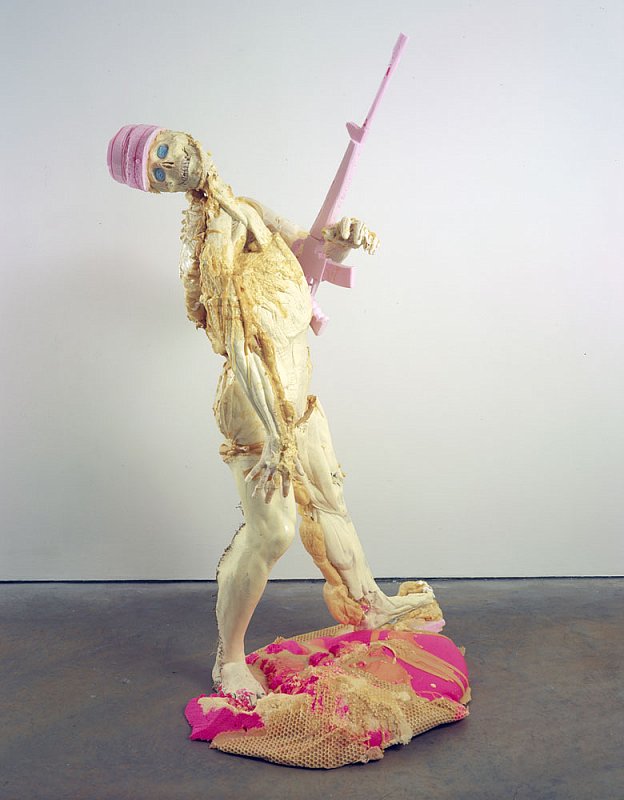
Dutch artist Folkert de Jong’s sculptural works are a grotesque and playful representation of international social histories. He establishes new narratives through the deconstruction of the past (referencing art history, warfare, colonialism, assassinations) assembled in figurative forms so that the viewer can recognize and remember our collective history.

His characters emerge through the time barrier like tarred ghosts, an evocation of negative energies brought forth to enlighten and entertain. These sculptures aesthetically ooze with attraction and repulsion; this push/pull creates a rupture that becomes our portal into an at once familiar and foreign struggle. Carnivalesque costumes, sickeningly sweet colors, and devilish grins are accompanied with barrels of oil, decapitated heads, and rifles. Humor is used to translate the horror and make it palatable. As the bad twin to characters in a Disneyland ride (think Haunted Mansion and Pirates of the Caribbean) De Jong’s figures urgently perform and unfold the history of human drama. These ‘tableaus’ are dropped directly into our present – the gallery, the museum, the studio are the background settings. Here is where time and space collapses as the past merges seamlessly into the now. These are not the desolate and isolated wastelands of Ed Kienholz, they are frighteningly alive ghosts beckoning us join their ‘danse macabre’.

As sheer material form, the sculptures are wholly hand-made and consist of Styrofoam, polyurethane foam, and occasionally clay. The usage of Styrofoam is significant beyond its easily modifiable form; it’s the same medium used in the film industry for architectural and stage design and it’s also produced by the same company who manufactures Napalm (that deadly chemical agent used prolifically in military operations). This subversive combination of fantasy (film) and reality (warfare) makes de Jong’s works resonant with power; an explosion occurs between representation and the acts being represented. And it’s within this space the horrors from the past emerge to haunt our present consciousness.

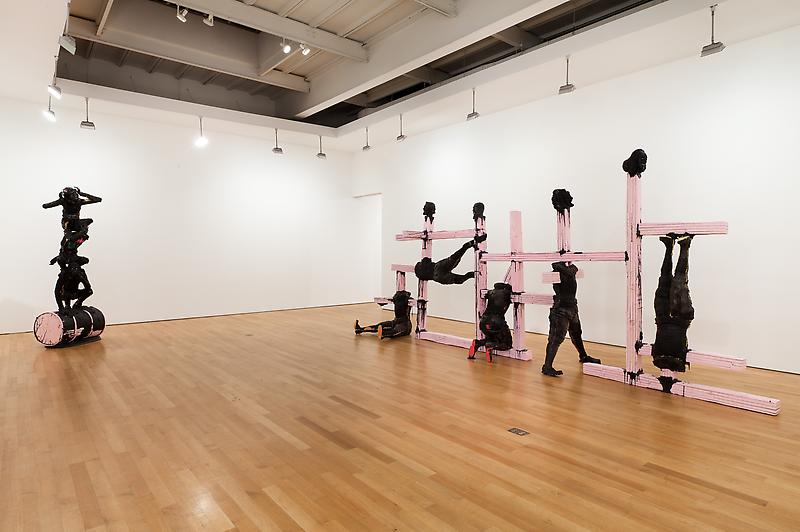
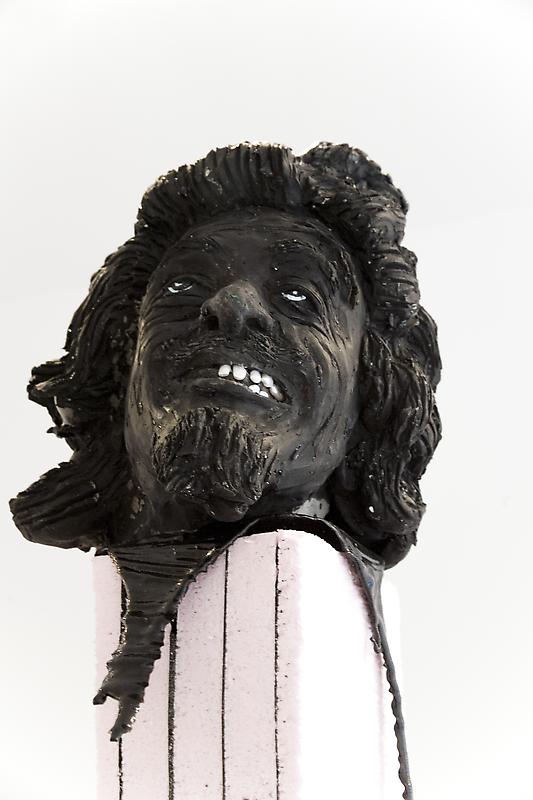
De Jong gives the viewer an arsenal of information. With just enough bit of candy coating, he coaxes us into our historical tales of terror that do not exist within the confines of film set but have been living amongst us within our everyday world. In his latest exhibition at James Cohan Gallery brings this forth via newer and older works including the large-scale and ominously fragmented Operation Harmony (2008). Titled after the contradictory name given to Canada’s 1992 military mission in Bosnia this sculpture references another political invasion, the lynching of Dutch political figures the DeWitt Brothers in 1672. Depicting five headless bodies strewn across the vibrant pink scaffold, only four heads (smiling, direct, sinister) look out at us. They represent men involved in various political assassinations and genocides. With title and source separated by hundreds of years we bear witness to the fact that “progress” often involves a sacrificial death. The conflation of these different historical events and geographical locations together with the present day makes for a curiously charged experience. These men are long dead but their stories have been re-animated.

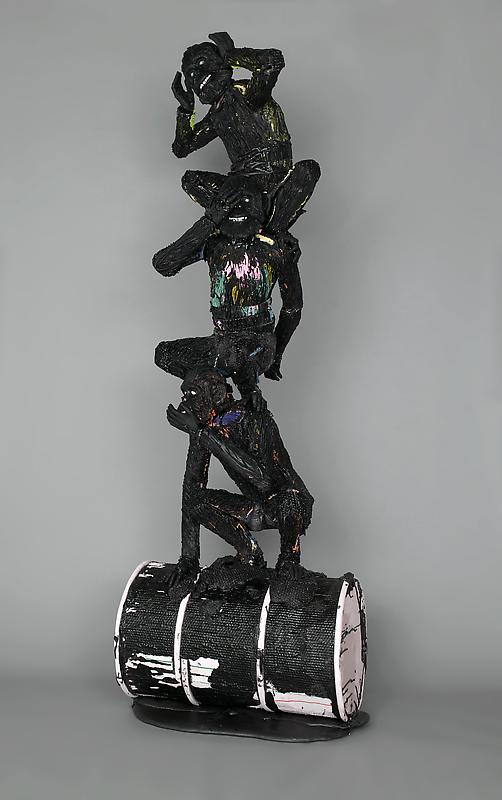
A newer installation is The Balance II: Trader’s Deal 6-9  (2010) featuring a vignette of proud Dutch traders prance with their treasures of beads and whiskey from Manhattan’s Native Americans. Place in the front portion of the gallery and directly facing the street, these men beckon viewers to share in their spoils. However unlike the charm from the buccaneers in Pirates of the Caribbean, we are more suspicious of these fellows and their inviting presentation of swindled goods. Other works like Business As Usual: “The Tower” (2008) the “No Evil” or “Morality Monkeys” remind us of our ability to look the other way and even perhaps America’s obsession with eliminating anything sad from our thoughts.

Seeped in the significant role art has played in the expression, sublimation, and manipulation of war and terror, de Jong continues the art historical tradition of bringing atrocities to light. In this sense he also acts like a skilled horror film director whose purpose is to manipulate reaction and produce affect. Tackling a myriad of historical traumas, like horror cinema, de Jong exposes universal truths to engage the viewer in a proactive remembrance.

Images (top to bottom):
Halleluja, 2007
Installation view:  Operation Harmony (2008) and Business As Usual: “The Tower” (2008)
Detail view: Operation Harmony (2008)
Installation view: The Balance II: Trader’s Deal 6-9  (2010)
Business As Usual: “The Tower” (2008)

Photos: Jason Mandella / James Cohan Gallery

Vincent Price Art Museum preview on Rue Morgue

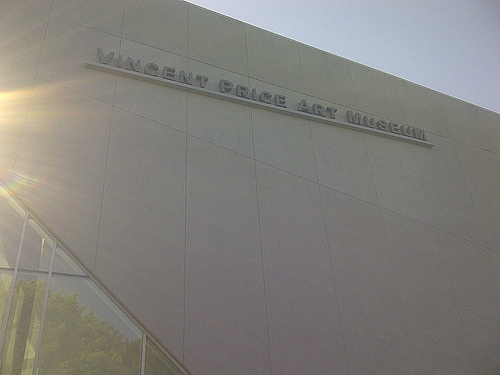
While recently in Los Angeles I had the pleasure of taking a sneak peek at the insanely big and beautiful Vincent Price Art Museum as well as meeting with Director, Karen Rapp. You’ll find out all about the museum, its first series of exhibitions, and Price’s infectious mission to get art into the public arena on my piece for Rue Morgue – Vincent Price Art Museum set to re-open.

On the Desperate Edge of Now

Auschwitz. Hiroshima. Vietnam. These are names associated with specific places and occurrences [of historical trauma] but they are also wounds in the fabric of culture and history that bleed through conventional confines of time and space. – Adam Lowenstein ‘Shocking Representation’

One of my research strands on the influence of horror cinema and contemporary artists is looking at how artists manifest historical trauma within their work. By using the structure of the horror film as a guide and in considering Deleuze and Bergson’s notion of the now as an “ever shifting amalgam of past, present, and future”, I’m exploring the idea of a haunted present and possible recuperation seen in the representation of trauma in contemporary artworks.

This particular project (which I plan on realizing in exhibition form) is being called On the Desperate Edge of Now, titled after the first episode of British filmmaker Adam Curtis’ documentary series The Living Dead. In a visual mash up of archival footage, interviews, and appropriated images Curtis describes the relationship between history and memory in the context of World War II as both an individual and political construct that is never fully resolved – a ghost always haunting the present or an omniscient zombie walking the earth. This collision of the past and the present that Curtis outlines makes for an explosively charged ever-present “now” particularly as it manifests itself into representational forms such as film and visual art.

Horror films are subversive and often entertaining social commentary reflecting the cultural and political issues relevant to the time period in which they are produced. Wes Craven’s Last House on the Left (1972), Tobe Hooper’s The Texas Chainsaw Massacre (1974), and Bob Clark’s Deathdream (1974) are all
reactions to the traumatic experiences, personally and culturally, of the Vietnam War. Many horror academics also view newer films like Eli Roth’s Hostel (2005) as a reflection of America’s torturing of political prisoners at Guantanamo Bay. On the Desperate Edge of Now looks at how artists tackle similar histories through a knowing employment of strategies and signifiers found in horror cinema: humor, the family, death in life, societal repression, spatiality, allegory, and the corporeal.

Like their filmmaking counterparts, the artists I will be writing about attempt to confront history more than compensate for it. They are: Folkert de Jong, Heather Cantrell, Sue de Beer, and Gert & Uwe Tobias.

Vincentennial celebration: Vincent Price’s art insights (3)

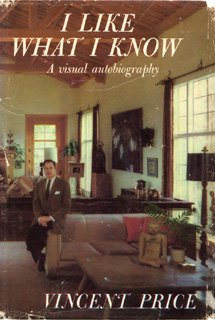
Written over fifty years ago, the latest selected quotes from Vincent Price’s I Like What I Know still profoundly resonate with today:

The other misunderstanding [about art] is that it is beyond their means. Yet the people of the United States live beyond their means, gladly and disastrously. They have let themselves be sold the biggest bill of goods in history by a Frankenstein – industrial advertising – of their own making. We all are perfectly content to make down payments on any luxury we’re told we can’t live without, but we can’t quite bring ourselves to chance investing in ourselves through education, art, or any of those splendors we lyrically call “the best things in life”…

Many people are blinded by fear of seeing something different, or of seeing anything differently, or by the inability to differentiate between what they know how to see and what they could see if they knew how.

Read previous quotes/posts herehere, and here.