The first screening of the two-part The Art of Fear series (which will hopefully become a multi-part expanded series) launched last Wednesday to great success with a collection of works by Takeshi Murata, Darren Banks, and Jamie Shovlin titled Pieces. Thanks to all who came out!
Two important strands of thought came out of this initial program (which was also, incidentally, my first foray into exhibiting artist moving images) that I’d like to explore further both in my own curatorial practice and via writing here on TGWKTM…
The first is in consideration of how artist film programs such as The Art of Fear can or should be presented and viewed. My intention with Pieces was to approach in like a gallery context – no seating, no definitive start/stop time, and flexibility of viewership. Meaning, I wanted to embrace the lobby space at Nitehawk not as a dictatorial cinematic space but rather in a manner in which you might approach a static piece of artwork. I’m very interested in an audience encountering a film in a non-time based way, choosing how much time to spend with the work and how entering in different narrative points can alter both the story-line and the audience’s perception of what he/she is seeing. I also embrace the idea of artist films entering into the cinematic sphere, especially as certain artists, like Ben Rivers, produce feature films. It’s simply a matter of context and consideration.
Still, I was surprised the the audience at The Art of Fear was interested in having seating to watch, in its entirety, a program of non-narrative films. In a way I felt as if my curatorial power had been usurped but, in another, it was exciting to see an interest in giving these works undivided attention. This of course has led me to wonder about the sematics of film programming – should this be called a screening? or an exhibition? Are there ways that we, as producers of exhibitions, can set the tone for how the audience will view the artwork or, ultimately, is it that power inherent in the audience? The next portion of the program/exhibition/screening Ghost Stories with My Barbarian, Aida Ruilova, and Marnie Weber is narrative in nature and appropriate for a proper sit-down affair. So the experiment will continue. And it’s going to be amazing so please don’t miss it, whether you sit, stand, or squat.
The other strand of thought involves the question of “why horror?” which is relevant to both my own curatorial investigation and the implementation of horror characteristics by artists. While this question is being visually represented, addressed, somewhat answered in the series of exhibitions I am doing, I believe that an essay series of why horror is of personal, cultural, and political interest is just as crucial. Stay tuned!
The Art of Fear begins in two days! To satiate your appetite in the meantime, here is the trailer to Jesus Rinzoli’s long forgotten slasher, Hiker Meat and the program for the first screening:
Horror cinema is ripe for the slaughter as Takeshi Murata (Chicago), Darren Banks (United Kingdom), and Jamie Shovlin (United Kingdom) cut, recompose, and manipulate scenes from classic horror films. These works are montages from classic (and not so classic) giallo, slasher, and B-movies from the 1960s-1980s. By re-arranging and manipulating the actions and contexts of films such as The Burning, Friday the 13th, and Mask of Satan, these artists apply new meaning to what is familiar in horror. As the first program in The Art of Fear, Pieces is an homage to and de-construction of this influential time period of horror.
Darren Banks, I’m sure if there were a monster in the midlands we would have seen it on the telly UK, 2011, Found video footage, 17 minutes, Color, Sound
Darren Banks, Interiors UK, 2005, Found video footage, 10 minutes, Color, Sound
I’m so excited to announce The Art of Fear, a two-part artist film program I am curating at Nitehawk Cinema in Brooklyn. Featuring moving image works influenced by horror cinema, it is the first manifestation of my research on horror film and contemporary art presented in New York (look out for a major upcoming exhibition in Los Angeles) and I’mthrilled to be working with such truly incredible artists. Please come support artist film, cinema, and horror this October!
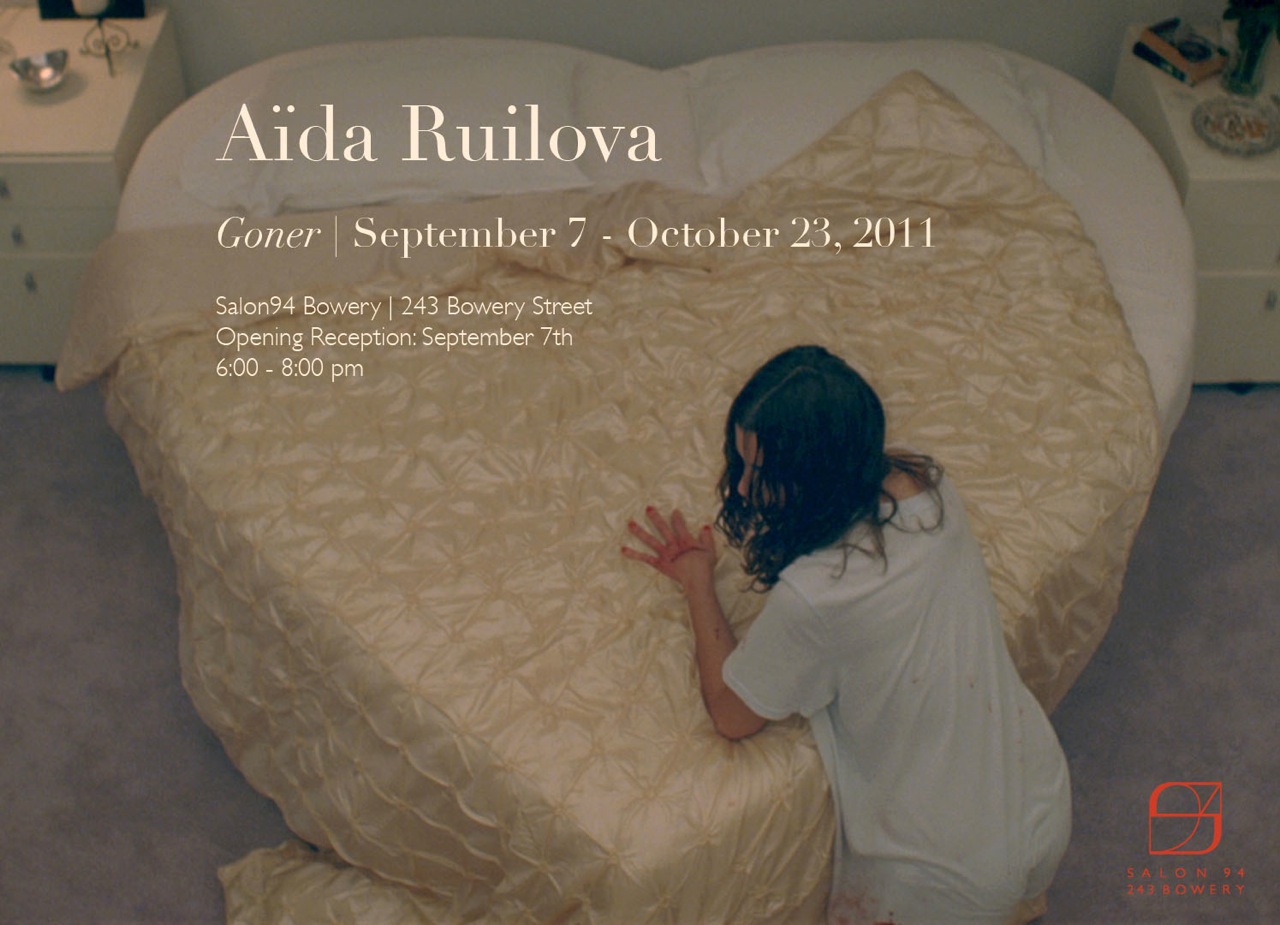
The two-part screening features works by Takeshi Murata, Darren Banks, Jaime Shovlin (October 5) and My Barbarian, Aida Ruilova, Marnie Weber (October 19).
I’ve been inspired lately by Henri Langlois and the Cinematheque Francaise. His approach to the cinema was flawed in some areas (I would argue for more curation) but was instrumental not only to the history of showing, archiving, and promoting film but how we continue to process film. Decades after his death, Langlois is challenging me – a contemporary art curator – to re-think and re-shape how I approach my programming. And to do so, always, with passion.
Never forget, you’re always programming for ten percent of the audience. Nothing matters as long as you’ve made those ten percent happy.
Haven’t you noticed people going through art museums? They come into a room, see a picture, walk over to read the label, discover who the pictures is by and what its title is, and then move on. They have read: they know. I don’t want that sort of thing in my museum. I want people to look at everything, really look, and if there are no labels then they have to try to figure out what the object of photograph is. That is the difference between and illustrated book with its captions and a museum: it’s not important that people should know exactly what still came from which film; the whole museum has been planned as an almost autonomous living history of the cinema.
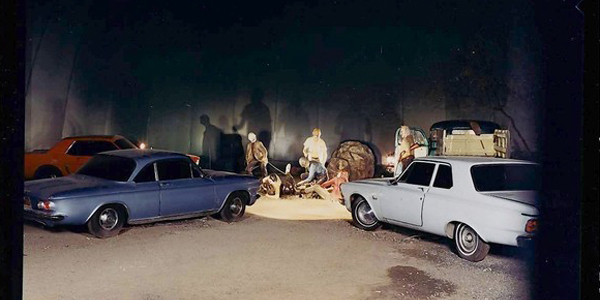
Emphasizing the marginal and the forgotten, tackling racism, sex, and war Ed Kienholz (October 23, 1927 – June 10, 1994) approached his artwork much like a horror film director. His tableaus are annihilated spaces, post-apocolyptic scenes in which we, the audience, can peer into the deeps of what the “other” (still so much like us) feels. Loneliness is palpable as the uncanny figures mock us for not having the guts to be as dirty and as real as they are. These are shocking scenes, even for today, and they resonate deep within our sensibilities. He re-created the ugliness of the world in an environment to which we could safely relate.
Much of his work has an edge to it but one of his more provocative installations is being re-visited this month in Los Angeles. Kienholz’s infamous Five Car Stud (made somewhere between 1969 and 1972) that depicts a brutally violent racial attack will be seen for the first time in forty years at the Los Angeles County Museum of Art as part of the city-wide Pacific Standard Time event. From the Los Angeles Times:
It is a difficult piece on multiple levels. It is enormous, for one thing: a tableau installation involving nine life-sized figures, five automobiles, several trees and a truckload of dirt. More difficult still is what the piece depicts: a circle of white men, lighted only by the headlights of the circled automobiles, pinning and castrating a lone black man, while a child cowers in one of the cars and a woman — presumably the victim’s companion — huddles and vomits in another.
The white figures are all realistically cast, but for the grotesque rubber masks on each of the men. The black figure’s face is uncannily bifurcated: a clear plastic outer face is frozen in a scream while a darker one within it is “sadly resigned and quiet,” as Kienholz put it in a statement at the time. His torso is made from a rectangular tin filled with black water, in which float letters that spell out a racial slur.
Watch Nancy Reddin Kienholz (his wife and collaborator) install the work:
Performance, music, and art have deep roots in the unique creative landscape of Los Angeles. New experimental power trio (Marnie Weber, Dani Tull, & Doug Harvey) Faüxmish is sure to be a part of this legacy.
Faüxmish is celebrating the release of their debut LP & CD ‘F for Ache’ with their debut public performance at Human Resources in Los Angeles on September 2nd. More info here.
Faüxmish is a Los Angeles art-rock supergroup that came together over a shared engagement with American spiritual sects who remove themselves from established social norms and create their own culture as outsiders.
Taking as their motto “Simplicity Through Noise,” Faüxmish have developed a practice rooted in improvisational ensemble playing using electric guitars (played with rubber mallets and other extended as well as traditional techniques) and vintage synthesizers, in various combinations of three.
Initially conceived as a ‘wall of sound,’ the group’s music rapidly developed a complex and idiosyncratic audio vocabulary drawing on the members’ widely divergent individual musical backgrounds, which range from noise to prog, post-punk to film scores, and 90s alt-rock to improvisational audio collage. The results range from dreamy ambient soundscapes to theatrical rock songs.
This Saturday (3 September) as part of theVision Sound Music Festivalat the South Bank Centre is London is theSound of Fear. Quite related to a link I mentioned earlier on sound/music/affect in horror films (actually it’s a topic that keeps coming up more and more). The scoop is below and, oh yes indeed, John Carpenter is included!
Sound of Fear is an epic two-part event featuring an international cast of artists, critics and composers brought together in a celebration of the music and sound design of the horror film. Through live performance and discussion, Sound of Fear explores the musical universe of horror, with its supernatural soundscapes and shrieking string arrangements, and pays homage to the masters of musical menace who have made the horror movie soundtrack a melting pot of opposing musical cultures.
Tracing the historical developments and cultural significance of music set to horror films, Sound of Fear looks at the introduction of the European avant garde into popular culture via the Hammer pictures of the 50s, Bernard Herrmann’s redefinition of how horror was heard with his revolutionary score for Hitchcock’s Psycho and the influence of cult director John Carpenter’s atmospheric genre scores of the late 70s and early 80s on a new wave of musicians working today.
Artist Vicki Bennett’s (aka People Like Us) will be screening Horror Collage (2008) on Saturday 3rd September, Part 1 6pm-8:10pm and Part 2 8:30pm – 10:30pm. Watch a clip here.
As summer winds down and I get ready to kick this blog back into high-gear for autumn, here are some art/horror/curating links from the past couple of months:
James Morgart’s Hostile Rebirth of Horror: The Morality of Eli Roth’s Hostel 1 and 2 on Horror News.net Many of us in the horror academia biz love to look at the classics (Night of the Living Dead, Halloween, The Texas Chainsaw Massacre, etc.) and with good reason: these films changed the course of horror forever and are still relevant works. However, it’s important to realize that they were made over thirty years ago and the political/social/culture relevance we ascribe to them is in retrospect and not pointed to our moment of now. Some have argued that horror today (at least American horror) doesn’t cut the mustard and, hey, maybe they’re right. Still, it’s critically important that we (and by we I mean all of us fascinated with horror film) to put into context movies of the past decade. And Morgart did that with Roth’s Hostile films quite well. It’s a much needed and appreciated beginning.
Mario Bava Week on Network Awesome: Speaking of Mario Bava, Network Awesome did an, ahem, pretty damn awesome series on the influential director claiming it “Mario Bava Week”. I’m going to publicly declare that it should be a celebration of “Mario Bava 24/7/365” because where would horror be without him? There would be no American slashers or John Carpenter (wait, maybe that would be a good thing). Regardless, endless credit needs to be given to Bava in scholarly horror history and props to Network Awesome for stepping forward with insightful articles and free-style online screenings of his classics like Danger Diabolik and Rapid Dogs (his last film and a true gem).
Kim Newman and Mark Kermode in Conversation at the British Film Institute: I’ll be honest, one of the places that I miss most in London is the BFI. There’s no better place to go in the world on a dark and rainy afternoon to see The Picture of Dorian Gray, Repulsion, or Eyes without a Face. I’ve even seen bizarro wonders like Miss Leslie’s Dolls to much loving fan-fare on the big screen there. BFI definitely celebrates horror history in a respectful manner. That’s why I wish I could’ve seen this conversation in person, one celebrating the launch of Newman’s “essential horror tome” Nightmare Movies: forty years of fear. Both Newman and Kermode are such visible fans of the genre it becomes infectious.
Ian White’s Invisible Cinemas on LUX: Ian White talks about the movement of film (artist film and video) from the context of the cinema into the museum saying, “In my experience as a writer – which I think is also shared by some of those in academia, probably to a greater profit – it’s not ‘cinema’ but the museum that is publishing monographs and catalogues that are invaluable resources for research, career enshrinements and a decent contributor’s fee.” For me, I am increasingly attracted to the idea of encountering a film or video as you would an artwork – sometimes half-way through the story but this fractured exposure can break itself open to new readings and increased interest.
Scala Forever film series: Speaking of London love, how am-az-ing is this multi-month long homage to Scala Cinema? The fact that they use Big Black in the video promo is simply icing on the awesome cake. Sigh. Began 13 August and runs through 2 October.
Maureen Dowd’s Washington Chain Saw Massacre in the New York Times: It’s interesting how horror is not just a political commentary in-and-of itself but also a comparative tool in which to talk about today’s politics. But as I mentioned above, I think it’s a little tricky to relate what’s happening in the present with films made 30/40/50 years ago. Those films still have resonance but relevance needs to be found with what’s being culturally produced today. It takes more work but it’s going to have more urgency in meaning. Still, Dowd referencing horror is a clear indication of horror’s relevance within popular culture.
Look and Learn in Frieze Magazine: In celebration of its twenty year run, Frieze Magazine is talking about art world developments during this period. This conversation with Alex Farquharson, Sofía Hernández Chong Cuy, Anthony Huberman, Christy Lange, Maria Lind, and Polly Staple on the proliferation of curatorial programmes addresses – but appropriately doesn’t solve – the emerging, evolving, contested, and diverse role of the curator since the 1990s. What stuck with me: How do you want to articulate what you stand for and how do you want to share that with the world? To me, that statements strikes on the core of what being a curator is.
On that note I will leave you with the funniest discovery of my summer: a horror/curator convergence featuring none other than Shaft…
 The first screening of the two-part The Art of Fear series (which will hopefully become a multi-part expanded series) launched last Wednesday to great success with a collection of works by Takeshi Murata, Darren Banks, and Jamie Shovlin titled Pieces. Thanks to all who came out!



 THE GIRL WHO KNEW TOO MUCH