

Open Call for Submission: Historical Trauma
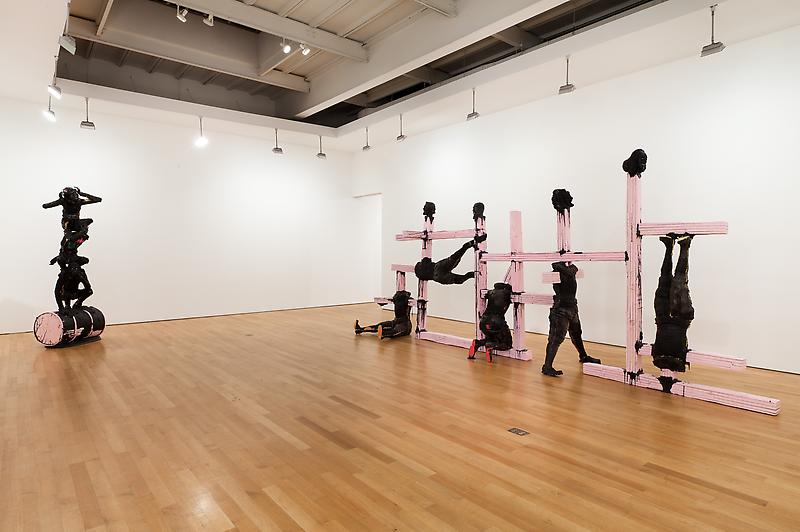 The fourth issue of Incognitum Hactenus will be published in connection with my exhibition On the Desperate Edge of Now at Dumbo Arts Center (New York) in Feburary 2013. There will be an online version and printed catalogue version of this issue. We are seeking contributions that deal with ghosts, history, the cinematic, cultural memory, historical trauma, and the conflation of time.
On the Desperate Edge of Now explores historical trauma, collective cultural experience, and personal memory as represented in contemporary visual art and horror film. Titled after the first episode of British filmmaker Adam Curtis’ 1994 BBC documentary The Living Dead, On the Desperate Edge of Now positions the construction of memory as a coping mechanism for both the individual and an international public. Expanding the notion of “horror” to include a more philosophical context of understanding the world, this exhibition employs horror cinema as a structural guide to locate the ever-present now. Through an adoption of Gilles Deleuze and Henri Bergson’s notion of the now as an “ever shifting amalgam of past, present, and future”, On the Desperate Edge of Now aims to evoke a haunting at DUMBO Arts Center in February 2013. Artists: Heather Cantrell, Folkert de Jong, Joachim Koester, and Marnie Weber.
Open call: if you are interested in contributing to On the Desperate Edge of Now please send a 200 word abstract to both editors: tom.trevatt@hotmail.com and caryn@caryncoleman.com. Please note that not all submissions will be accepted for publication.
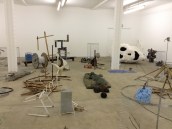
Image: Folkert de Jong, Operation Harmony (2008)
Living On: Zombies Release Party
The journal I co-edit is having a release party in New York for our latest issue, Living On: Zombies…

INCOGNITUM HACTENUS INVITES YOU TO…
LIVING ON: ZOMBIES RELEASE PARTY
Tuesday, October 2 from 7 – 9pm
Nitehawk Cinema (cafe)
Pre-party for the 9:30pm NY premiere of V/H/S (new horror anthology film released by Magnolia Pictures)
Screening: Jim Shaw’s The Hole (2007)
Spinning: “Undead Soul” by Dave Tompkins
Special horror cocktail: the Corpse Reviver
Stuff: Free digital copies of Living On: Zombies | check out books by contributors
Thanks to Magnolia Pictures, Nitehawk Cinema, Blonde Art Books, Darren Banks, Dave Tompkins, and all of our contributors!
Curator gone mad: the 1966 film “It!”
 While there are more “artists as villains” in horror films, there are a select few gems of “curators as killers” too (usually involving some sort of occult-practice and historical knowledge). My most recent find it this 1966 British film It! starring Roddy MacDowall as a twisted assistance curator who uses the museum’s newfound acquisition, a 16th century Golem, to increase his standing in life. The museum exteriors and interiors in It! are in London’s impressive Imperial War Museum.
Three Films at Once: Shocking Representation at DAC
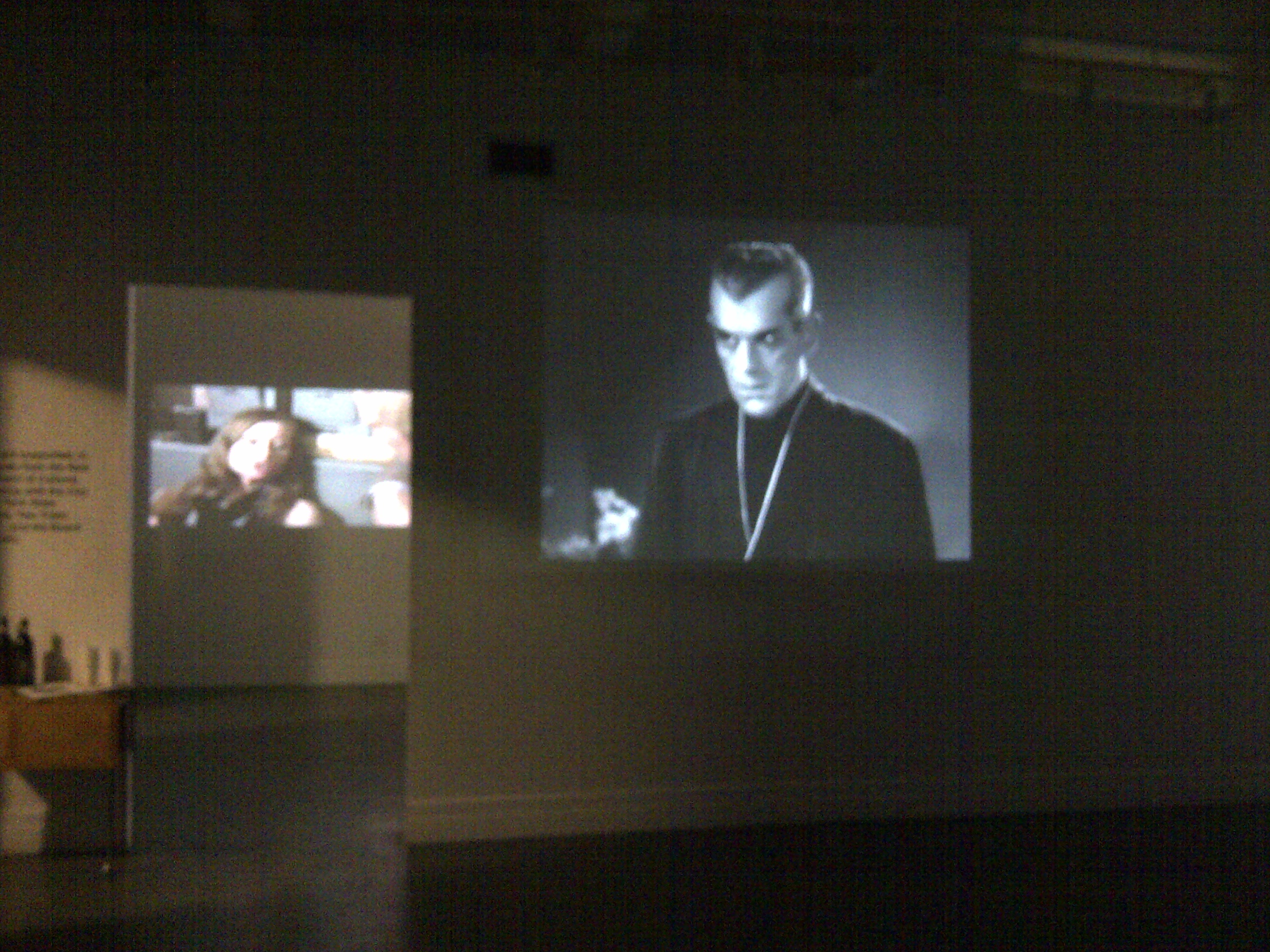 Shocking Representation.
Via invitation from Dumbo Arts Center, on Thursday (September 6) I presented a one-night event in support of my upcoming February exhibition at DA On the Desperate Edge of Now (historical trauma in horror film and contemporary art ) with Heather Cantrell, Folkert de Jong, Marnie Weber, and Joachim Koester.
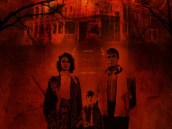
On view was a simultaneous play of three horror films – Edgar G. Ulmer’s The Black Cat (1934), Bob Clark’s Deathdream or Dead of Night (1974), and the documentary The American Nightmare (2000) – merging social, political, and cinematic history into one monstrous audio-visual experience.
The “screening” lasted for three hours during the Dumbo Art Walk. People came in, some stayed, some talked about the impact of these films culturally, others questioned if this was art to be hung on the walls of their home. But mostly, the ghosts of cinema floated on the wall, floating between the past and the future, in-and-out of sync, telling us stories from beyond the grave.


They Have No Place in Paradise
Ghost in the machine, food footage, and technological fear. UK artist Darren Banks’ (Gods and Monsters contributor) music video for the Stefan Blomeier song, They Have No Place in Paradise.
NO rules of the game
The horror genre isn’t (or shouldn’t) be beholden to a set of hard and fast rules. As with art, it has the unique freedom to create and establish innovation while simultaneously being acutely aware of its own history.
Behind the knife: horror versus terror
 Differentiation by Evan Calder Williams between horror and terror that reflects both a representational turn (in terms of genre) and in real-life manifestations. Horror is repetitive, recyclable, unending, instructive.
Terror is about the threat to life, the knife behind you. Horror, conversely, is about the threat to understanding, of living to see the after-effects of suddenly realizing you were behind the knife all along. In this way, horror is apocalyptic. It confronts us with the symptoms – and with our complicity in reproducing them – and demands that we find new sets of instructions. – Evan Calder Willams, Combined and Uneven Apocalypse, pg. 226.
Afterlifers: Walking and Talking
As we’re currently in production for Living On: Zombies (the third volume of Incognitum Hactenus in which we make the position to re-contextualize, consider, and represent the zombie figure), I have zombies on the brain. And this 2004 film Afterlifers: Walking and Talking by Halflifers (artists Torsten Zenas Burns and Anthony M. Discenza) fits the bill, addressing the post-culture life after the pop-culture knowledge of the zombie.
Particularly interesting is their notion of “zombie architecture” or “zombie space” – a existing zone where people and objects “become zombie” – in relation to Shaviro’s term “zombie time” in his “Contagious Allegories” where he says:
The slow meanders of zombie time emerge out of the conventional time of progressive narrative. This strangely empty temporality also corresponds to a new way of looking, a vertiginously passive fascination. The usual relation of audience to protagonist is inverted. Instead of the spectator projecting him-or-herself into the actions unfolding on the screen, an on-screen characters lapses into a quasi-spectatorial position. This is the point at which dread slips into obsession, the moment when unfulfilled threats turn into seductive promises. Fear becomes indistinguishable from an incomprehensible, intense, but objectless craving.
In considering a zombie-space and zombie-time we perhaps might tap into the way in which these narratives fold in on themselves, addressing the fear of the viewer while also basing this fear on an acknowledged fiction. Unable to speak or articulate, the zombie has become the language we use to address the unspeakable: this craving, this need for representation.
The work of Torsten Zenas Burns is currently on view at the Dumbo Arts Center in Brooklyn.
The cabin in the woods: representation and repetition
As I’m writing an essay about the uncanny relationship to Mario Bava’s Planet of the Vampires (1965) and Ridley Scott’s Alien (1979), I’m thinking about the slipages that occur between imitation and homage in creative forms. Where does the impulse come from to manifest a narrative, a style, an atmosphere come from?Where is the boundary border between being on the safe side of homage rather than the evil side of plagiarism? And how does this influence perpetuate the evolvement and dissemination of the horror genre?
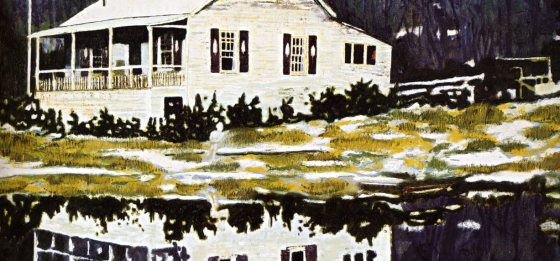
In a collusion of similar thoughts, yesterday I looking at the cabin paintings from the 1990s by Peter Doig. Knowing his interest in horror film, seen in his culling from Friday the 13th (1980) imagery, I’ve tended to draw a correlation to this cabin series and the pervasive use of the isolated cabin in the woods in horror films. The claustrophobia of the forrest, shown frenetically and close up in Doig’s paintings, is situated around the idilic solitude of the house. This notion, of course, tends to explode in horror cinema – man is not safe, not even and especially, in nature.
So as I look to Doig’s “homage/influence” from horror, I noticed that perhaps horror film is producing a mutual admiration. How did I come to think this? Seeing the poster for Drew Goddard’s The Cabin in the Woods (2012) I felt something familiar. There was something about that cabin, mirroring itself, reflection both an above world and a reality below that struck a nerve. Then I remembered Doig’s cabin paintings, his layering on imagery, the spatiality he establishes in his work:
 Peter Doig – Camp Forestia (1996), Oil on canvas
AND THEN…

The similarities between Camp Forestia and The Cabin in the Woods poster suggest that visual art and horror film might just be bouncing ideas (concept and design) off of each other. Intentional or not, this type of intense self-reflexivity means that these ideas about the representation of horror are contagious. My only hope is that there is still room in which to facilitate the production of new generative images and narratives.
 THE GIRL WHO KNEW TOO MUCH