
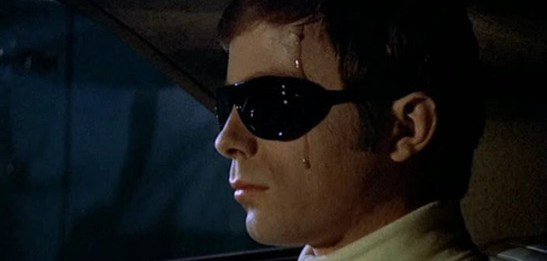
Deathdream: Vietnam Comes Home

[Essay written for the Deathdream screening at Nitehawk Cinema on February 12, 2013 that included an introduction by Adam Lowenstein, Film Professor and author of Shocking Representation: historical trauma, national cinema, and the modern horror film).

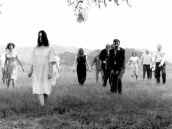
Bob Clark’s 1972 cult classic Deathdream (original title: Dead of Night) is part of a select group of films from the era that dealt with the trauma of the Vietnam War. These films positioned this trauma back onto the United States by expressing the horror of war returning back to a place in which it originated but wasn’t fought. Deathdream visualizes this return in the ghostly form of a young deceased soldier, finding his way back to his family and to establish his final resting ground on familial soil. However, unlike the visceral explosions played out in Wes Craven’s The Last House on the Left (1972) and Tobe Hooper’s The Texas Chainsaw Massacre (1974), Deathdream is a representation of hope in the faith of certain death; his family wants so much to believe he is alive, almost as much as he wants to come to terms with his death.

imagesThe family structure lays at the center of these post-Vietnam horror films, no matter how messed up in its depiction (re: the Virgin Spring-inspired parental revenge and/or the in-bred role-shifting dynamic). In Deathdream there is a powerful, near transcendent, relationship between mother and son. The mother (Christine Brooks played by Faces actress Lynn Carlin) refuses to believe that her son Andy could possibly be dead, even when military officers deliver its confirmation. So when Andy returns, she delights in this truth even though his father (Charles played by Faces and Godfather star John Marley) suspects something is wrong. And wrong it is. Andy has indeed died, as the audience sees in the opening sequence, and has somehow managed to find his way home. He’s not a zombie or a vampire as many descriptions surmise (although he does drink blood to retain “life”) but, rather, a restless ghost whose soul is adrift, conflicted about how and where he was killed, and who needs to find solace in his hometown, with the love of his mother.

dead-of-night--2Immediately after Andy’s arrival back to his home we (and everyone except his mother) get the sense that there is something terribly wrong. Despondent and angrily violent, his behavior mimics the dissociation experienced by Vietnam soldiers trying to acclimate when back on U.S. soil. However, it’s much more than that – Andy is deadly. He kills truck drivers, the family dog and family doctor (uttering the brilliant line – I died for you, the least you can do is die for me) along with his former girlfriend and nearly his sister. The family dynamic breaks down in these realizations over the truth about Andy, resulting in a despondent father fighting with the in-denial mother. It isn’t until the very end, when his mother’s love rescues his soul that we see what Andy needed all along; to come home to die.

deathdream01Made before Bob Clark’s nearly unwatchable debut Children Shouldn’t Play with Dead Things (1973) and his brilliant horror opus Black Christmas (1974), Deathdream is a pitch-perfect revelation of the horror of Vietnam in cinema. Perhaps it’s not so different from our current political climate as we can sympathize with the painful unknowing of why one is fighting and dying overseas and how families continue to cope with loss. Watching Deathdream now, it’s important to recognize the importance horror film has to mirror the unseen and discarded painful aspects of human existence. While we may be seeing a reference to Vietnam unfold on screen, we are really looking at a reflection of humanity: war, death, life, loss, and love. Equally full of pain and affection (with a bit of Bob Clark humor thrown in), Deathdream reveals the universal potency of horror cinema in its most beautifully basic form.
On the Desperate Edge of Now: Joachim Koester

Part of an in-progress writing series related to an upcoming exhibition, On the Desperate Edge of Now, that looks at historical trauma and collective cultural memory in horror film and contemporary artists. These writings will eventually be published in volume four of Incognitum Hactenus and as exhibition catalogue. See previous post on Folkert de Jong here and Heather Cantrell here.

“Koester echoes in his investigations the magic at the heart of photography that fold the past into the future and the known into the imagined, a process that arrests time and captures possibilities.” – Lisa Le Feuvre

gJoachim Koester’s film and photographic work become persistent ghost stories that meld the historical with pop-cultural and fictional constructions. Seeming to gravitate towards the macabre, Koester inclusion of Charles Mason, Bram Stoker’s Dracula, the occult, the opium trade, and speculative fiction writers such as Baudelaire and Dumas as well as H.P. Lovecraft result in a contextual montage that both familiarizes and complicated our understanding of the past.

Koester’s video Numerous Incidents of Indefinite Outcomes (2007) attacks the very concept of time in terms of mining the past and manipulating the present. This work processes textual fragments from the “weird fiction: of H.P. Lovecraft’s The Notes of Commonplace Book through a computer program that generates endless possibilities of speculative musings. This is a never-ending, never-repetitive, constantly morphing process is a theatrical word play visualized. Fusing new connections pulls the past into the present or as William S. Burrough’s observed, “when you cut into the present the future leaks out.”

Morning of the MagiciansThe video invokes the spirit of H.P. Lovecraft, an early 20th century writer who would, no doubt, be delighted to reach out from beyond the grave, manipulating his own words. Unlike his predecessor Edgar Allen Poe, who was more interested in the ghostly realm, the phenomenological writings of Lovecraft detail unseen worlds parallel to our own reality, often detailing an ancient monstrous civilization that exists on the liminal boundary between the past and the present. His infamous fictional cosmic entity Cthulu appeared in a series of stories as an ancient Elder God worthy of religious worship and capable of universal destruction while others, faceless and formless beings in The Beyond, threaten the limits of scientific and philosophical reasoning.

From The Beyond: “What do we know,” he had said, “of the world and the universe about us? Our means of receiving impressions are absurdly few, and our notions of surrounding objects are infinitely narrow. We see things only as we are constructed to see them, and can gain no idea of their absolute nature. With five feeble senses we pretend to comprehend the boundlessly complex cosmos, yet other beings with a wider, strong, or different range of senses might not only see very differently the things we see, but might see and study whole worlds of matter, energy, and life which lie at hand yet can never be detected with the senses we have…”

The-Beyond-Final-ImageKoester’s technologically regulated usage of this “weird realism” adds an additional layer on to the pile of memory, belief, cult structures, and an understanding of our existence being shared embedded in Lovecraft’s ouvre. Numerous Incidents of Indefinite Outcomes fragments and perpetually re-contexutalizes meaning while simultaneously releasing the ghost of Lovecraft (the utilized text was published posthumously) as well as the undead characters in these narratives and the generative ghost in the machine. It verbalizes to us that we cannot trust continuity, or technology, and that variance and change are inevitable. Most importantly it presents and represents an evolving past, playing out in the now and into the foreseeable future. 

Images:
Tarantism, 2007, 16 mm film installation
The Hashish Club
, 2009, 16mm film and B/W photo installation
Morning of the Magicians, 2006, 16mm film
Final scene in Lucio Fulci’s The Beyond, 1981


The Black Cat: Revenge. Murder. Incest. Satanism.

An essay I wrote on Edgar Ulmer’s 1934 classic The Black Cat in relation to a dual screening I programmed at Nitehawk Cinema (in conjunction with the On the Desperate Edge of Now exhibition I’m curating)…


The-Black-CatSupernatural, perhaps. Baloney, perhaps not. There are many things under the sun.

The displaced American in Europe; Henry James made a literary career out of it, so did Hemingway, and filmmaker Edgar G. Ulmer made one of the most brilliant conflations of the new-and-old worlds in his explosive 1934 film The Black Cat. Himself an émigré from the former Austro-Hungarian Empire working in Hollywood, Ulmer was all too familiar with cultural outsider-ness and he uses it to great effect when he features the misfortune that befalls two naïve Americans traveling through central Europe on their honeymoon.

This Black Cat is loosely based on Edgar Allan Poe’s “immortal” classic but, aside from the fearful presence of a cat that is black, it bears little resemblance to the short story. Instead, there is a complexly interwoven story with much at play: revenge, love, treason, psychological disorders, incest, Satanism, and architecture. But at the core are the eruptions caused by historical trauma caused by World War I with the film asking: what does war make men do? What is surviving or even living? Do free men make their own prisons? Who are the “good” guys? Ulmer’s film places together the past and the present, America and Europe cultures, and the traumatized with the innocent.

blackcat6The story takes place in an imposing Bauhaus-inspired architectural structure that has been built upon the graves of a battlefield by Hjalmar Poelzig (played by Boris Karloff). The two Americans, Peter and Joan Allen, and a Hungarian psychiatrist named Dr. Vitus Werdegast (played by Bela Lugosi) wind up at the modernist house after a deadly accident in their shared car. But whereas the couple is taken off-course and enters a world unfamiliar, Werdegast is exactly where he intended to be – at the former site of war that he fought alongside Poelzig. Home. He is there to kill Poelzig as retribution for abandoning their battalion and for stealing his wife while he, loyal until the end, was a prisoner of war for fifteen years.

Of course, the war being echoed here is World War I (the Great War) that, with no doubt, had a significant impact on European culture and on Ulmer himself. “The force of their struggle symbolizes the shattered and corrupted humanity left in the wake of World War I. Their personal desire for death, then, is a natural extension of wartime patriotism, and duty: a desire for destruction adopted and internalized.”1 This intensely rich back-story embodies the The Black Cat and forms the underlining profound sense of loss echoed throughout the film; everybody has lost something and has been the walking dead for all these years, coping in different ways with the effects of the war. As a result, both men are mad and self-destructive. As Poelzig says shiningly, “Even the phone is dead here…even the phone is dead.”

the+black+cat+1In the battle of Karloff and Lugosi (it was the first time the two huge stars of the time had been onscreen together), it’s Karloff’s Poelzig who becomes the void in which trauma has been funneled into. Deeply guilty about his treason and about surviving, Poelzig is never-the-less a calculating and evil monster. He abandoned his team, stole his friend’s wife, killed her (and other women) while she was still young to retain her beauty, married his step-daughter, and is a Satanic high priest capable of human sacrifice. Living in his Gothic mansion, albeit a modernist masterpiece, he has isolated the outside world and remained living in his own contamination. So it is with little surprise at the vehemence in which Werdegast attacks his nemesis; he destroyed his life, the world destroyed them both.

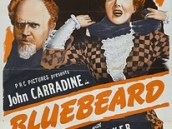
the-black-cat-boris-and-belaConsidered the original “King of the B’s”, the mysterious Edgar G. Ulmer notoriously made his films on the cheap side (mainly do to the fact that he was blacklisted in Hollywood after marrying the already married woman of a Universal Studio chief). Along with The Black Cat, his films Damage Lives (1933), Bluebeard (1944), and Detour (1945) are an incredible combination of horror, noir, and German Expressionism, near perfect in their expression of loneliness, pain, and failure. In fact Detour is rightly considered one of the best films in cinematic history. What makes Ulmer films so special is how seemingly anachronistic they are, utterly daring in narrative, cinematography, and acting they are. It’s difficult to come to grips that these films were made in the 1930s and 40s! The Black Cat is particularly bold in showing a satanic mass (something more 
culturally associated with the Anton Lavey 1960s) and Poelzig being tied up then flayed alive (who can come to terms with a shirtless Boris Karloff being skinned?!).

Brutal in its subject matter while inventive in its depiction, The Black Cat is, and should be rightly considered to be, one of the classic forefathers of horror cinema. The inclusion of two young Americans symbolizes the culture clash of the time and, as Paul A. Cantor writes in his essay The Fall of the House of Ulmer, “The Black Cat suggests that, unfortunately, Americans would not recognize a European horror story even if they wandered right into the middle of it.” But would we now? Through its self-reflexive (and explicitly meta-texual) combination of histories (personal and cultural) played out on the big screen, it is possible that as the horrors of past wars continuously haunt us through cinema, we are being forced to comes to terms and deal with these traumas still today. 

The Fall of the House of Usher

In celebration of Edgar Allen Poe’s birth:

FROM The Fall of the House of Usher (1839)
I shall ever bear about me a memory of the many solemn hours I thus spent alone with the master of the House of Usher. Yet I should fail in any attempt to convey an idea of the exact character of the studies, or of the occupations, in which he involved me, or led me the way. An excited and highly distempered ideality threw a sulphureous lustre over all. His long improvised dirges will ring forever in my ears. Among other things, I hold painfully in mind a certain singular perversion and amplification of the wild air of the last waltz of Von Weber. From the paintings over which his elaborate fancy brooded, and which grew, touch by touch, into vaguenesses at which I shuddered the more thrillingly, because I shuddered knowing not why ; – from these paintings (vivid as their images now are before me) I would in vain endeavor to educe more than a small portion which should lie within the compass of merely written words. By the utter simplicity, by the nakedness of his designs, he arrested and overawed attention. If ever mortal painted an idea, that mortal was Roderick Usher. For me at least – in the circumstances then surrounding me – there arose out of the pure abstractions which the hypochondriac contrived to throw upon his canvass, an intensity of intolerable awe, no shadow of which felt I ever yet in the contemplation of the certainly glowing yet too concrete reveries of Fuseli. 

Read my ART OF FEAR essay on the Roger Corman version, House of Usher, and the role of artwork in the narrative.

usher-painting03

Quote: From Beyond

“What do we know,” he had said, “of the world and the universe about us? Our means of receiving impressions are absurdly few, and our notions of surrounding objects are infinitely narrow. We see things only as we are constructed to see them, and can gain no idea of their absolute nature. With five feeble senses we pretend to comprehend the boundlessly complex cosmos, yet other beings with a wider, strong, or different range of senses might not only see very differently the things we see, but might see and study whole worlds of matter, energy, and life which lie at hand yet can never be detected with the senses we have…”

Quote from H.P. Lovecraft’s From Beyond (1920). Related to Joachim Koester’s Numerous Incidents of Indefinite Outcomes (2007), amongst other things.

On the Desperate Edge of Now: Heather Cantrell

Artillary-Hell
Part of an in-progress writing series related to an upcoming exhibition,
On the Desperate Edge of Now, that looks at historical trauma and collective cultural memory in horror film and contemporary artists. These writings will eventually be published in volume four of Incognitum Hactenus and as exhibition catalogue. See previous post on Folkert de Jong here .

Founding-Fathers(Ivo)Los Angeles artist Heather Cantrell uses portrait photography as a means to construct and, ultimately, deconstruct singular and collective identity. Performative elements of her subjects as well as theatrical backgrounds function very much like a movie set in which the actions of her “characters” become exaggerated, solidified in an ever-static moment of the past.

In the very personal Corpus Battaglia (2004), Heather Cantrell set a cultural and personal stage as she identifies her familial history with the haunted battlegrounds of the American Civil War. The title itself references the “body” and “battle” and, presumably, the profound influence that one can have upon the other. As a photographic series, Corpus Battaglia entangles (our) national and (her) personal trauma by conflating public and private histories of the American South: the mausoleum-still landscapes of the Gettysburg, Antietam, and Valley Forge battlefields along with the iconic portrait assembly of the artist’s own southern “fore-fathers” (her mother’s four previous husbands).

Yankee-Bullet-HoleHere, the still landscapes of Civil War battlefields resonate with America’s collective past, now hauntingly placid tableaus but once the site of bloody horror, while the images of war memorials imbue trauma as remembrance. The Civil War, pitting family against family with cultural and political values at stake, lead to the formation of the United States as it exists today. Cantrell parallels our country’s upbringing with the turmoil of her own by juxtaposing these landscapes with representations of her four fathers who, by default, also symbolize her mother. Her biological father Ivo is the only human figure in the series, her other fathers are depicted through objects – a house, a semi-truck, and most eerily, an urn (one of her stepfathers, Sam, tragically committed suicide).

Founding-Fathers(Sam)Perpetually revealing one specific moment, photography itself is a conjuring up of a spectral past. Based on the historical usage of photography by scientists and occult practitioners to capture the presence of ghosts in “spirit photography” in the late 19th and early 20th century, the very foundational concept of the photograph can be seen as a spectral site, a place where the dead are re-born and re-placed back into the land of the living. Therefore, the idea of “medium” here is twofold: a physical medium (the photographic image) and spiritual medium (a channel between the living and non-living).  Corpus Battaglia is therefore a ghost, conjuring up America’s collective formative past when a nation was at war with itself along with the artist’s individualized experience of growing up; manifestations of America and a young American. 
*******

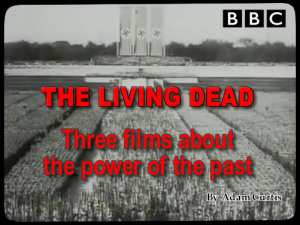
The title of this project (and its inspiration) is the first episode of Adam Curtis’ blindingly good BBC series called “The Living Dead.” It’s about how the past bleeds into the present, how it cannot be ignored, and how our memory of current/past events is a construction. 

thelivingdeadmo5

Book review: House of Psychotic Women

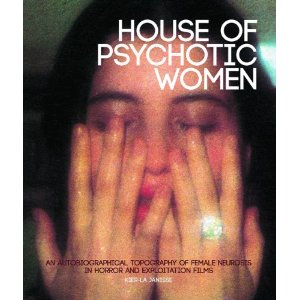
houseofpsychoticwomenPer the enthusiastic recommendation by Fangoria‘s Sam Zimmerman, I recently purchased and immediately devoured House of Psychotic Women: An Autobiographical Topography of Female Neurosis in Horror and Exploitation Films Book by Kier-La Janisse (FAB Press). 

Despite its obvious subtitle, I expected a somewhat standard anthology of horror films featuring women in horror films. And while that actually may have been enough, what this book is instead is so much more; an unexpectedly raw narrative of a woman’s journey as related, and influenced, by horror films. House of Psychotic Women is perfectly whip smart, with just the right combination of academic philosophical references, personal narratives, and film analysis. That Janisse has the ability and bravery to discuss her life in these terms is beyond engrossing, it’s admirable. 

As with most female horror fans, people love to ask me what it is I get out of horror. I give them the stock answers: catharsis, empowerment, escapism and so on. Less easy to explain is the fact that I gravitate towards films that devastate and unravel me completely – a good horror film will more often make me cray than make me shudder. I remember someone describing their first time seeing Paulus Manker’s The Moor’s Head as so devastating they had to lie on the sidewalk when they exited the theatre. Now, that’s what I look for in a film.

For those of us who have an obsession with horror films (and we do for numerous and various reasons) there is a common denominator the Janisse underlines throughout the book: the ultimate reason why we watch these movies that we can’t stop watching is because something about them reflects ourselves. Not that we’re all murderous psychos, but the psychological breakdowns displayed before us in cinema tend to resonate with those who, quite frankly, aren’t like everyone else. And while my personal research of horror tends to purposefully sidestep the affect/cathartic aspect of horror, Janisse managed to get me to consider how these aspects of horror cinema actually do affect me. She is so dead on (see quote above, only from page 7) because it’s the power of cinema, the lure of the ugliness in life, the punched-in-the-heart feeling that horror films produce that also keep me coming back for more. 

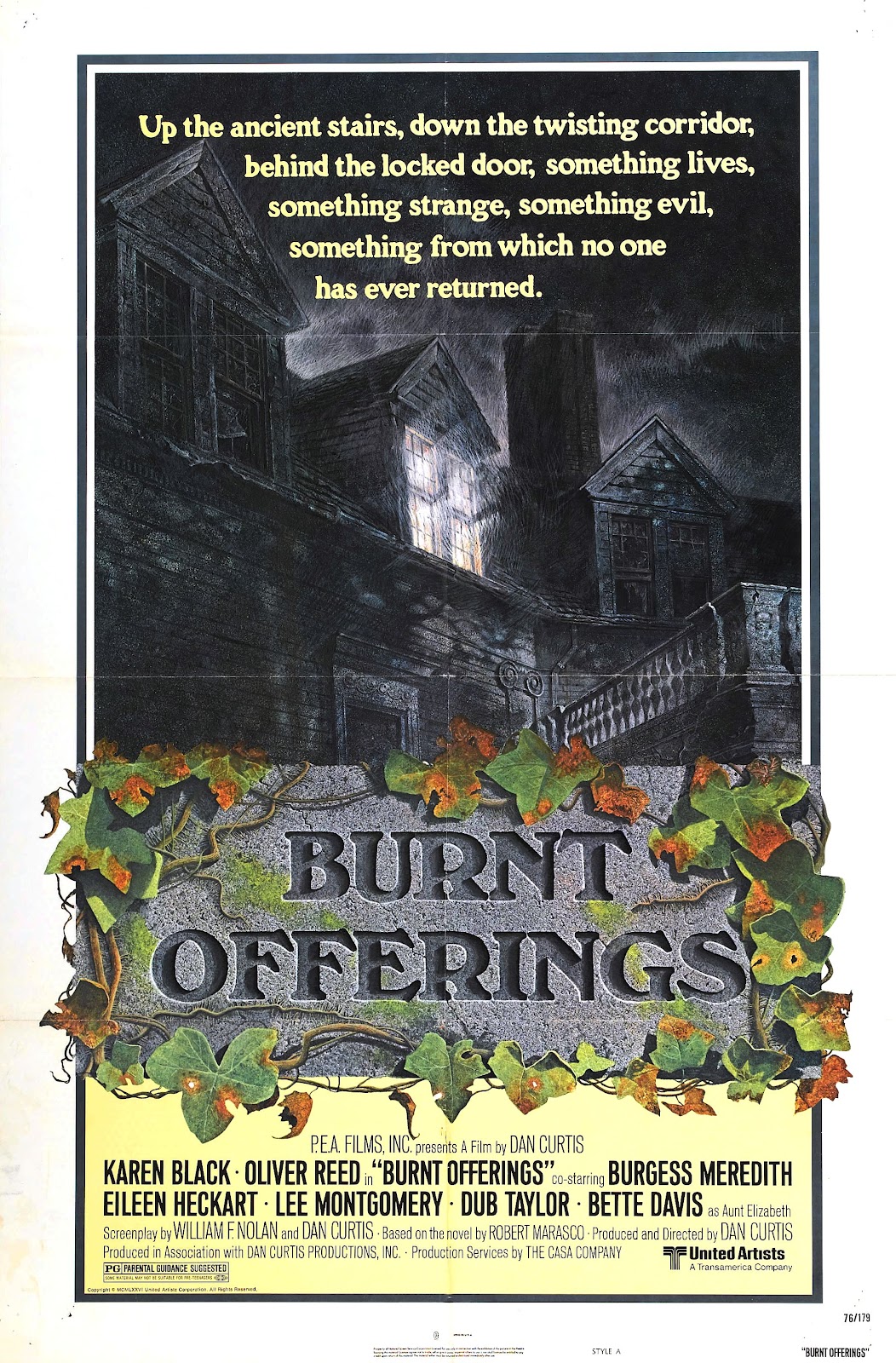
One of my favorite films discussed in the book…

burnt_offerings_poster_01


Psycho House: representation and repetition

The fine line between imitation, homage, and influence in artworks and horror movies isn’t just reflected in the works of today’s filmmakers. In the early 1960s, the now iconic house featured in Alfred Hitchcock’s seminal thriller Psycho was the preeminent site of all things horror. In fact, it still quietly looms on a hillside at Universal Studios California as frightening and distant as ever to the tourists who ride by. And although Hitchcock had done something similar twenty years earlier in Rebecca (1940), using the house as a near character full of anxiety and memory, that film was all about interiority of space and of mind. Psycho, on the other hand, was a full-on exterior explosion, everything on the outside, the lure to a deadly trap. 

psycho-house

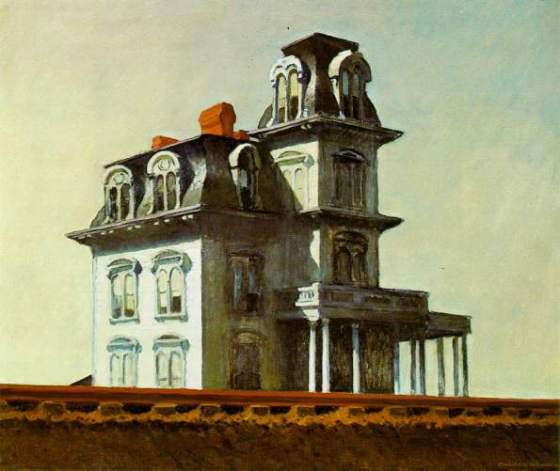
The slippages again occur here, reaching further back into art history, as the bones for the Psycho house were inspired by and modeled after this 1925 painting, House by the Railroad, by American realist painter Edward Hopper. Not horrific by any means, Hopper’s paintings reveal static moments shared between an architectural space (diner, movie theater, room) and those creatures who inhabit them. 

hopper-railroad

Thanks to the Horror and Architecture  (the new-to-me but still-awesome-after-zero-updates-for-two-years blog).

Previous in this series:

Ed Kienholz – The Ozymandias Parade

IMG-20121207-01225Confronting (and that’s what it is, a confrontation) Ed Kienholz’s The Ozymandias Parade at Pace Gallery is a wonderfully jarring experience. Profound and silly, meaningful through a montage of manipulated meanings, the installation is intensely dark and scary because, like all of Kienholz’s work, it hits way too close to the perverbial home. As always, the marginalized reflects us, our struggles and our history. Historical trauma manifested, shown in all its grossly entertaining forms. Kienholz is an utter master at revealing that which society prefers to keep under wraps but shoving it in our face – his works cannot be ignored. They are shockingly beautiful in their ugly honesty (with a big middle finger implied). 

From Pace…
The centerpiece of the exhibition is the incendiary large-scale installation The Ozymandias Parade (1985), an opulent allegory of the abuse of political power, with a parade of figures and symbols representing elements of society. The decadent, nationalistic “ship of fools” is capped with nearly 700 blinking lights, which change with each presentation to reflect the colors of the nation where the work is being displayed. Addressing the corrosive effects of fear and propaganda, the tableau depicts a chaotic world turned upside-down: an armed general rides on the back of a fragile female figure who is lured by the “carrot” of a crucifix; the vice president’s horse has toppled off of his roller skates; the menacing, headless vice president faces backwards, blowing a trumpet and waving the flag; the sinister president clings to the belly of his horse, a red phone clutched in his hand and a yellow rubber ducky on his head. Whether the parade’s president shows a YES or a NO across his face is the result of a poll conducted in the weeks leading up to the installation’s opening, comprised of just one simple question: “Are you satisfied with your government?”