Burnt Offerings: Gary Simmons and Karen Black

As a precursor to their Bloody Women panel discussion tomorrow night, the ICA London asked the Twitter-verse to name our favorite horror ladies (mine: Barbara Steele, Dara Nicoladi, Karen Black), and it sparked thoughts on how the role of the women and even the “Final Girl”often directly manifests in artists’ work too.

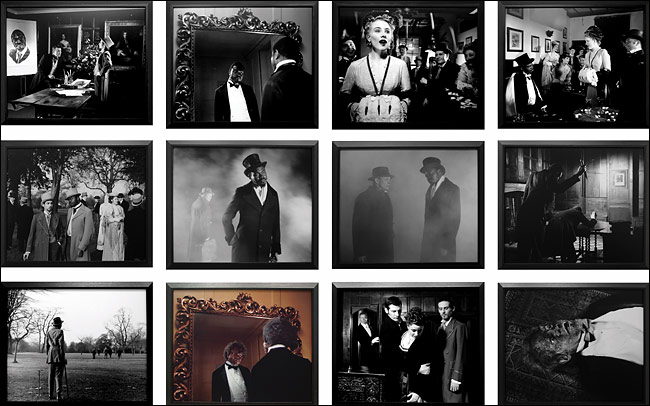
Take Gary Simmons frenetic paintings in his 2010 exhibition Midnight Matinee where images from the Texas Chainsaw MassacrePsychoAmityville Horror, and Burnt Offerings referenced familiar architectural places found in horror films: the house, the gas station, and the cinema. Interestingly the paintings themselves mimic filmstrips, a further collision of art and film. And if you’re wondering how this relates to women…

I’m just beginning research on the role of architecture in visual art stemming from a direct relationship to horror cinema (think of the aforementioned Simmons, Mike Nelson, etc). Amongst other structural functions such as spatiality and establishing a sense of unease within the familiar, the house/home in horror films challenges the forced and/or changing ideas of domesticity throughout the decades. One example of this is also one of the films Simmons references, Burnt Offerings (1976) starring my horror heroine Karen Black. The movie is about a young family who takes care of a mysterious house one summer to escape the city however they wind up as literal house food. The house kills most of family, save Black’s character, who is gradually yet forcibly absorbed into the house becoming its official “mother” and caretaker. The film can be read as a reaction to second wave of feminism in the United States, a return back to traditional and fundamental women/mother/Victorian ideals.

Simmon’s usage of the Burnt Offerings house facade reinforces the notion that we (i.e. the audience, viewer, or visitor) can never really judge a book by its cover; that what lurks behind the front door to an old house or behind the cinema screen curtain can be an unexpected yet real horror. His blurred reflection of the house establishes a visual tension that reminds us that physical and mental ‘interiors’ are infinitely complicated and that there can be a serious danger in the projected appearance of perfection.

Images:
Gary Simmons Burnt Grid, 2010 – Pigment and charcoal on paper – 12 panels
Still of Karen Black in Burnt Offerings (Dan Curtis, 1976)
Gary Simmons Between Offerings, 2010 – Pigment, oil paint and cold wax on canvas
Brendan Flanagan

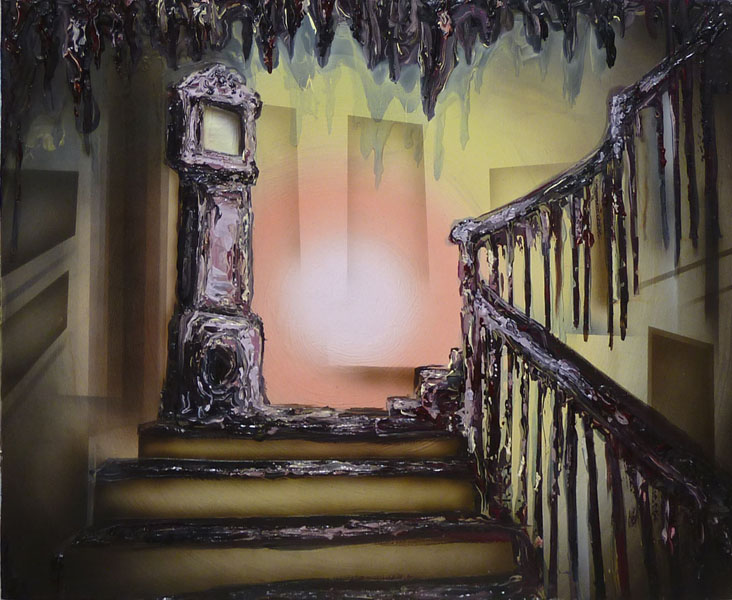
I’m really interested when filmic influences, particularly horror cinema and B-movies, manifest themselves into static images. The paintings of Canadian artist Brendan Flanagan are a recent discovery. The works are architectural, structured, and extremely painterly. Culled from film, photographic, and archival images they are set within a cultural framework yet still quite unsettling.

See his Sightlines solo exhibition that just closed at Thierry Goldberg in New York.

Image: Landing, 2010 – 0il and acrylic on board – 20 x 25 inches (Courtesy of Thierry Goldberg)


Mike Nelson

Mike Nelson scares me. His installations are claustrophobic and isolating and while no one thing in the elaborately constructed spaces is particularly frightening (clown masks aside), it’s the immediate convergence of all the things that produces an overwhelming intense experience. And I can’t get enough.

I feel like I shouldn’t be in one of Nelson’s rooms, touching and opening doors, searching my way through the maze (not in the literal dark but the tension is just the same). The sense of something being off is palpable and yet, during this feeling of disorientation, I feel totally within my element. Like a good horror film, I feel both displaced and engrossed, enjoying not knowing my way and appreciating the sensory overload provided to me. Indeed, Nelson’s work has a lot in common with the aesthetics and structure of horror cinema such as his employment of architecture and interiors, particularly in the usage of a succession of rooms.

In her essay on Nelson’s Coral Reef (owned by Tate and recently on display at Tate Britain), Helen Delaney says: “Nelson’s use of suggested, open-ended narratives is influenced by filmmakers Sergei Parajanov and Dario Argento, whose ambient, non-linear films present tableaux that absorb and envelop the viewer. The movement from one room to another produces a kind of filmic ‘cut’ between one scene and the next, allowing narrative possibilities to proliferate without coalescing into anything fixed. It triggers a growing sense of unease.”

I could only wander, stop, and stare when encountering his Studio Apparatus for Camden Arts Centre… (1998/2010) at Camden Arts Centre’s now closed exhibition Never the Same River (Possible Futures, Probable Pasts). Consisting of three rooms (dirty entrance walkway and a small reception/office room that led to the larger backyard object extravaganza. In an attempt to focus, record, and re-live the experience I just wrote down all I thought I saw: selection of motorcycle helmets with raccoon takes; slices of science fiction mags; fake flames; slouched body with paper bag head; log fire with face shield, fur, gas cans, wood planks and concreted blocks; space constellations of hubcaps, wire, and balls; latters; antlers; Mickey Mouse with devil antlers; chicken wire; humming radio; fabric mountains; the list goes on.

Each new work I encounter of Nelson’s is a new adventure. I have a long road of discovery ahead when it comes to his work and I’m looking forward to the journey.

Mike Nelson will be representing Britain at the 54th Venice Biennale this summer. Image is from Camden Arts Centre, courtesy of the artist.

Film influences: David Noonan

In Frieze’s October 2006 Life in Film London-based artist David Noonan discusses, amongst others, two influential horror films: Susperia and Toby Dammit (which is certainly one of the most surreal and insane Poe adaptations in cinema). Noonan’s screenprints are filmic in themselves. A collage of images from movies, books, and magazines, they are haunting impressions of a scene that vibrate with a sense of performative movement. See his most recent exhibition at David Kordansky Gallery in Los Angeles.

In Suspiria (1977), directed by Dario Argento, an American ballerina enrols in an exclusive ballet school in Germany and becomes embroiled in a witches’ coven bent on chaos and destruction. The art direction is astonishing and overshadows the acting; the film is saturated in a very unnatural palette, which heightens its sense of unreality, right down to the wallpaper designs by Escher. The baroque, flamboyant soundtrack is by the Italian Prog Rock band Goblin and is a masterpiece in itself. The murders are theatrical and balletic; the film is like a violent opera.

Federico Fellinis’ short film Toby Dammit (1968) is part of the trilogy, ‘Histoires Extraordinaire’, also known as ‘Spirits of the Dead’ after a short story by Edgar Allen Poe. The film is complete with Fellini’s trademark references, from circuses to paparazzi, stardom, kitsch and glamour. The film stars Terrence Stamp at his finest: an alcoholic, self destructive thespian lured to Rome to appear in a television show by the promise of a Ferrari – in other words a Faustian pact. Fellini conjures an extraordinary, creepy atmosphere, and Stamp’s crazed, decadent performance makes it all the more powerful.

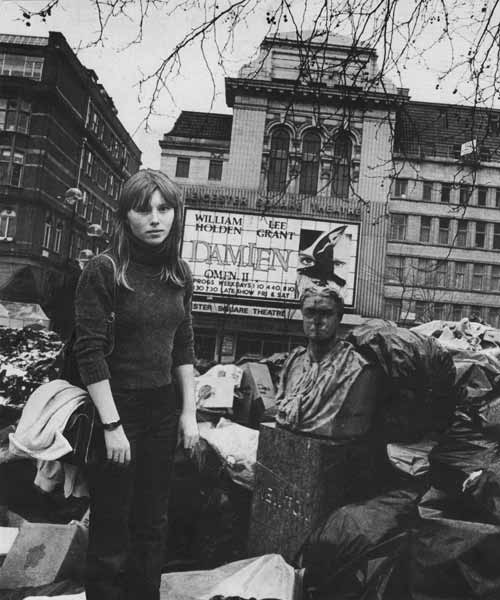
Image: Leicester Square, 2005, Archival inkjet on paper from paper collage (not one of the more filmic works but one of my favorites)

Thinking Through Cinema (Deep Red)

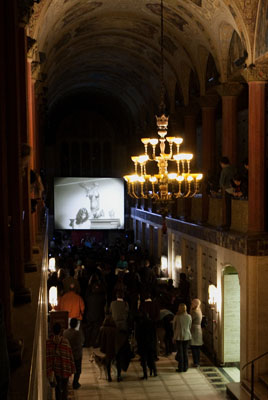
As part of my The Art of Fear post on Dario Argento’s Profondo Rosso, I wanted to highlight LUX’s Thinking Through Cinema (Deep Red) that used the film as the basis for commissioned artworks (film, video, and sound) at last year’s Artissima Art Fair.

For Thinking Through Cinema (Deep Red), LUX’s project at this year’sArtissima Art Fair in Turin, Argento’s film becomes a stand-in for cinema as a whole – a starting point from which to explore the differences between film (as a physical medium) and cinema (as the cultural, architectural and social space in which film has traditionally been experienced).

Six commissioned artists – Meris Angioletti, Juliette Blightman, Claire Gasson, Torsten Lauschmann, Nathaniel Mellors and Emily Wardill – will each present their ‘version’ of Profondo Rosso, using Argento’s film as a source text but perhaps without showing a single frame of the original. The artists’ projects will be presented over the course of the fair as part of a rolling programme of timed events, hosted in a specially constructed space modelled on a cinema auditorium, framed within the fair’s ‘House of Contamination’ strand. Thinking Through Cinema (Deep Red) offers an opportunity for artists to completely reimagine cinema – its history, its limits and its untapped possibilities – from the perspective of both creator and audience.

View installation images here.

Image: Still from Clare Gasson’s 7′ (2010)

Frankenstein: Boris Karloff and Iván Zulueta

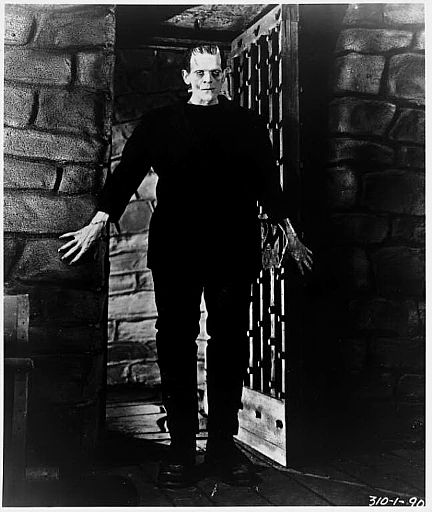
Forty-two years ago horror legend Boris Karloff passed away. Best known for his role in James Whales’ Frankenstein (although I love him best in Mario Bava’s Black Sabbath) Karloff created an image of a complex, self-referential monster that has evolved throughout the decades. In honour of the man, I’ve included below some brief writing on the influence of Frankenstein in relation to Spanish filmmaker Iván Zulueta’s 1972 experimental film Frank Stein.

***
The absorption of the cinematic within Iván Zulueta’s work, Frank Stein and King Kong among them, reacts to the political and social constructs of the 1970s. This is why his version the ‘Frankenstein’ story as subject is so fascinating. Born in the 19th century in a novel by Mary Shelley (Frankenstein 1817), this monstrous tale has been told throughout the decades as a reflection on modern society. In the 1800s, the Frankenstein monster could be read as an allegory on the dangers of scientific explorations or fears of an expanding world. At the dawn of the new decade while the idealism of the 1960s waned, Zulueta’s ‘Frankenstein’ represents the confusion and lapsed innocence of this new world. That Frank Stein is filmed from a television broadcast remarks on the change in media consumption and how its accessibility began to blur the line between information and entertainment. Meaning can seemingly be projected onto this monster in any given era, thereby he perpetually symbolises the recycled, relevant, and rejuvenated spirit of the horror genre.

Read more on Zulueta on a short essay I wrote from LUX called The horror film and contemporary art.

Yinka Shonibare – Dorian Gray

Horror narratives are cyclical and often self-reflective – evolving from literature to theatre to film and, as I express here on the blog, onto artwork. Bouncing along and between these different mediums means horror continues to generate its relevance and influence. To show how this is true, take my recent Art of Fear discussion about how artwork functioned within the horror of The Picture of Dorian Gray. In 2001, British born Nigerian artist Yinka Shonibare produced Dorian Gray, his first photographic series in which he assumes the lead role. Here, much as in the book and film, Shonibare uses this story as a commentary on Victorian (and contemporary) values of class.

Another stellar example of this is experimental filmmaker Ivan Zulueta’s Frank Stein (1972) which I hope to discuss more in length here soon.

The Art of Fear – an introduction

The Art of Fear is a writing series on horror cinema’s prolific usage of art as the focal point of fear.

I’m happy to announce the launch of a new writing feature on The Girl Who Knew Too Much called The Art of Fear. Titled in homage to Vincent Price’s BBC radio programme The Price of Fear and subsequent biography, The Art of Fear focuses on horror cinema’s prolific usage of art as the focal point of fear. Below is an introduction, in the very simplest of terms, to what I hope will become a lively, thought-provoking, and entertaining discussion on two of my favorite things: art and horror.

That horror films frequently feature artwork is not a startling revelation but this noticing this brought my individual obsessions with horror and art together, kick-starting my research on horror’s influence on contemporary artists. Now, by delving into arts role in horror I can further map out connections between the two. It also raises significant questions: Why is it that painting and sculpture can easily incorporate into horror narratives? What is it about art and artists that adapt so readily into the horrific? And since visual art and cinema are two different ways in which to tell a story, how can the collation of the two in the context of the horror genre, establish a more in-depth visual and narrative experience?

Here I’ll address these questions through a discussion of films such as Picture of Dorian Gray, House of Usher, Daughters of Satan as well as the television series Night Gallery in the terms of how artwork is used as the motivating force of horror. I’ll also be looking at how the conservation and preservation of art is an integral part of apocalyptic films like The Omega Man, I am Legend, and Children of Men. This ongoing process becomes more profound and fun with each new discovery I make and I hope it’ll be the same for you!

The plan is to publish an entry for The Art of Fear each week until the series concludes (if it ever does) but, of course, this may vary from time-to-time. First up will be… Albert Lewin’s Picture of Dorian Gray (1945).

Featured so far:

The Art of Fear: Picture of Dorian Gray
The Art of Fear: The Fall of the House of Usher

Image: Rod Serling introducing an episode of Night Gallery where the artwork told the story.

Jean Rollin and Aïda Ruilova

On 15 December legendary French ‘erotic horror’ (read: vampires and lesbians) director Jean Rollin passed away at the age of 72. In memorandum, I am posting an excerpt of my writing on artist Aïda Ruilova and her use of Rollin in her artist films.

Aïda Ruilova is interested in cult relationships associated with horror film, using the appeal of the underground and insider fandom as an alluring edge to her works. Her narrative film Meet the Eye (2009) cast cult queen Karen Black and legendary punk artist Raymond Pettibon but her literal incorporation of lesbian vampire director Jean Rollin in tuning (2001) and life like (2006) is Ruilova’s pinnacle of reflexivity. Here imitation slips into an homage to Rollin, locating points of desire as she also do by festishising the objects of Carlo Mollino in Endings (2007).

As in Roman Polanski’s Rosemary’s Baby, Ruilova shifts horror away from representing the ‘other’ and marks it pointedly back onto our selves. Her films and videos reveal a different side to horror, one that uses the genre as a vehicle to express the agony of being close to others and to your self. Her single channel installation tuning consists of an image of the artist holding hands with cult director Jean Rollin in his Parisian home. In a little over one minute this blurry picture quickly jerks in and out of focus. Repeatedly looped action and scored to Sonic Youth’s Confusion is Sex (1993), Ruilova creates a jarring experience for the viewer. Tuning entices a close watch but never quite permits audience projection into the action.

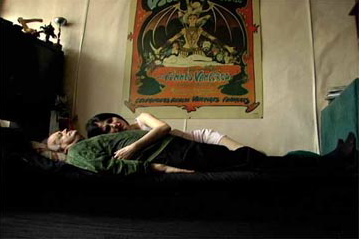
Years later, her video life like revisits Rollin as a character once again in his apartment. In it he has died and a woman baring close resemblance to Ruilova paces the room and caresses his body. Like a lot of her work, life like features a series of tightly composed scenes that collapse the distance between the onscreen action and the audience to create an appropriately intimate and personal space, seductively calling loyalty and love into question.

She bravely exposes herself by weaving into her narratives themes of love, loss, confusion, pain, and obsession. Through this collusion of herself and horror historical figures she establishes a dialogical relationship with the past and uses it to construct a new path for the genre.

Video clip from life like (2006) – image still above

Marnie Weber Interview

My interview with the amazing Marnie Weber featured on Lux.

Marnie Weber creates fantastical worlds that, quite frankly, I want to live in or, at the very least, pay a visit. Her atmospheres are an aesthetic mash up of Victorian, 1970s commune, and gritty punk filled with the kind of unsettling creatures that would scare the pants off you if they weren’t somehow totally endearing. Indeed, there is something very magical and intangible about her film, collages, and installations. Weber expresses the theatricality of old Hollywood, bringing forth our own nostalgic tendencies through the expression of death and dreamscapes. Her images are touching, luscious, and melancholic; reflecting another world placed firmly within our own.

For the past six years, Marnie Weber has woven together fictional narratives about the post-mortem adventures of the Spirit Girls, taking us on their bizarre and uncanny journey through the afterlife. Earlier this month at the Mountain View Cemetery & Mausoleum in Altadena, California, Weber put an end to their perpetual mourning and opened up a new avenue for exploration. Eternity Forever, presented by West of Rome Public Art, was inaugurated with a funeral processional and the debut screening of Weber’s film The Eternal Heart where the Spirit Girls, in their last performance, played the live score. This exhibition, which also features a new series of collages, represents the death and re-birth of Weber’s ongoing relationship with her monstrous characters.

CONTINUE READING ON LUX’S WEBSITE

Image: crowd at the Eternity Forever opening.  Courtesy of Marnie Weber and West of Rome.