I wrote about the impossibility of writing about Night of the Living Dead for the Annotated Palace Collection (project by Darren Banks):

In 1968 two films were released that changed the landscape for cinema and ushered in the era of the post-modern horror film.
The first is Roman Polanski’s Rosemary’s Baby (an adaptation of Ira Levon’s novel) in which a young New York woman is betrayed by her husband and neighbors into having Satan’s child. With its colorful characters, saturated landscape, and lush style, Rosemary’s Baby is in stark contrast to the gritty black-and-white reality expressed in the wholly original second film of 1968 – George A. Romero’s groundbreaking Night of the Living Dead. Like Rosemary’s Baby, Night fundamentally questions our ability to trust other people, particularly those closest to us but its expression of the utter collapse of society (because of an unexplained phenomena that causes the dead to walk and because of the inherently violent nature of the living) and its not-so-subtle socio-political representations, makes Night of the Living Dead a devastating experience still today.

To write something new about Night of the Living Dead is nearly as unthinkable as watching the dead rise up from the grave. This isn’t because its relevancy is relegated to the past but rather frighteningly because the issues attacked in the film are still very much apart of America’s cultural fabric. The antagonistic familial relationship as expressed between brother and sister (Barbara and Johnny: first in dealing with their dead father’s grave and then in dealing with their separation in life/death) and the nuclear family (in Night the young girl kills and eats her parents) are still familiar. Of course, Night’s famously known for its shocking representation of racism through main character Ben whose blackness is unaddressed throughout the film until the end where he is shot, killed, and burned by the redneck authorities. They may have mistaken him for a zombie but the visceral reaction to the news-footage style sequence at the film’s end – where Ben’s dead body is brutally carried by meat hooks – is a very painful visualization of America’s racism in the 1960s. Whereas then it was a representation of that turbulent time, now it’s a challenge for our generation to process these past traumas.

Pop-culturally, Night of the Living Dead marks the birth of the modern zombie. Only a slew of “zombie” (Haitian Voodoo zombies) films existed before and although interesting correlations can be drawn between the pre-and-post Romero zombie cinema (mainly in their cultural reflections), it’s undeniable that Romero constructed the near unbreakable collective notion of the zombie narrative. Now, it’s imperative to re-think the zombie in order to establish contemporary allegories however, at the same time, it’s crucial to revisit Night of the Living Dead (and the rest in Romero’s “Dead” series) as a reminder of not only what innovative filmmaking can produce but also as a reminder of cinema’s power to painfully confront life as we know it.


 Los Angeles artist Heather Cantrell uses portrait photography as a means to construct and, ultimately, deconstruct singular and collective identity. Performative elements of her subjects as well as theatrical backgrounds function very much like a movie set in which the actions of her “characters” become exaggerated, solidified in an ever-static moment of the past.
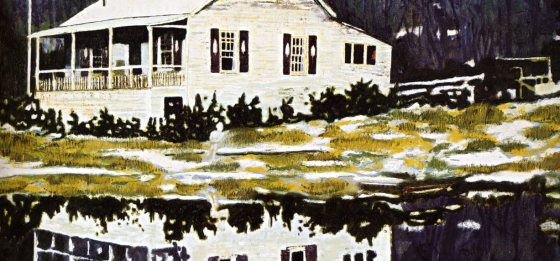
 Here, the still landscapes of Civil War battlefields resonate with America’s collective past, now hauntingly placid tableaus but once the site of bloody horror, while the images of war memorials imbue trauma as remembrance. The Civil War, pitting family against family with cultural and political values at stake, lead to the formation of the United States as it exists today. Cantrell parallels our country’s upbringing with the turmoil of her own by juxtaposing these landscapes with representations of her four fathers who, by default, also symbolize her mother. Her biological father Ivo is the only human figure in the series, her other fathers are depicted through objects – a house, a semi-truck, and most eerily, an urn (one of her stepfathers, Sam, tragically committed suicide).
 Perpetually revealing one specific moment, photography itself is a conjuring up of a spectral past. Based on the historical usage of photography by scientists and occult practitioners to capture the presence of ghosts in “spirit photography” in the late 19th and early 20th century, the very foundational concept of the photograph can be seen as a spectral site, a place where the dead are re-born and re-placed back into the land of the living. Therefore, the idea of “medium” here is twofold: a physical medium (the photographic image) and spiritual medium (a channel between the living and non-living). Corpus Battaglia is therefore a ghost, conjuring up America’s collective formative past when a nation was at war with itself along with the artist’s individualized experience of growing up; manifestations of America and a young American.






 THE GIRL WHO KNEW TOO MUCH
