Thinking Through Cinema (Deep Red)

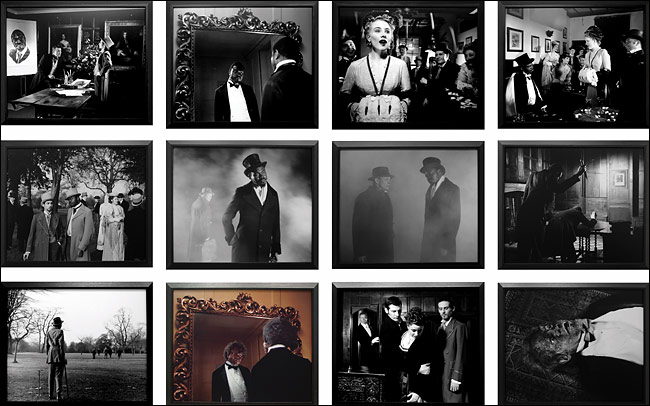
As part of my The Art of Fear post on Dario Argento’s Profondo Rosso, I wanted to highlight LUX’s Thinking Through Cinema (Deep Red) that used the film as the basis for commissioned artworks (film, video, and sound) at last year’s Artissima Art Fair.

For Thinking Through Cinema (Deep Red), LUX’s project at this year’sArtissima Art Fair in Turin, Argento’s film becomes a stand-in for cinema as a whole – a starting point from which to explore the differences between film (as a physical medium) and cinema (as the cultural, architectural and social space in which film has traditionally been experienced).

Six commissioned artists – Meris Angioletti, Juliette Blightman, Claire Gasson, Torsten Lauschmann, Nathaniel Mellors and Emily Wardill – will each present their ‘version’ of Profondo Rosso, using Argento’s film as a source text but perhaps without showing a single frame of the original. The artists’ projects will be presented over the course of the fair as part of a rolling programme of timed events, hosted in a specially constructed space modelled on a cinema auditorium, framed within the fair’s ‘House of Contamination’ strand. Thinking Through Cinema (Deep Red) offers an opportunity for artists to completely reimagine cinema – its history, its limits and its untapped possibilities – from the perspective of both creator and audience.

View installation images here.

Image: Still from Clare Gasson’s 7′ (2010)
The Art of Fear: Profondo Rosso

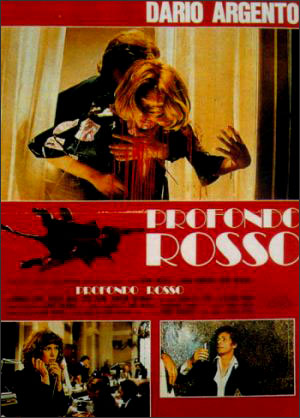
The presence and absence of artwork in Dario Argento’s giallo classic Profondo Rosso (1975) act as puzzle pieces to solve the murder mystery. The Art of Fear puts it all together…

Profondo Rosso, aka Deep Red, depicts a series of gruesome murders committed by an unknown person (who turns out to be the mother, take that Friday the 13th!) as well as bits of the supernatural, childhood/psychological trauma, and an insane score by Goblin. Like some of the other films included in The Art of Fear, the art featured in Profondo Rosso act as clues or markers to finding the source of horror rather than being the source itself. These clues function in two parts: one as a painting and the other as a child’s drawing. As the narrative evolves, the initial perception of these artworks becomes more complicated for the characters and the audience. However when the revelations contained within each work finally emerge, they reveal not only who committed the murders but also the personal history as to why all this carnage began.

Continue reading

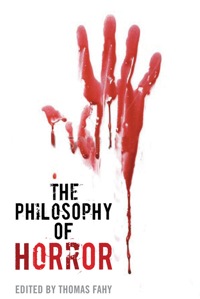
Book Review: The Philosophy of Horror

The Philosophy of Horror (2010) makes me wonder if it’s not horror criticism that’s in a bit of a crisis.

With the release of American Horror: the genre at the turn of the millennium and The Philosophy of Horror in late 2010, there was a sudden onslaught of essays that promised fresh perspectives on the horror genre. While American Horror certainly delivered in introducing some of the first texts on horror film produced in the last decade, The Philosophy of Horror (edited Thomas Fahy) regurgitates many of the old philosophies to a seemingly non-horror audience (i.e. it’s very basic). This sameness isn’t productive and it isn’t really re-productive, it’s actually non-productive. A good comparison is the analysis of Land of the Dead seen in both books; Craig Bernardini’s Cronenburg, Romero, Twilight of American Horror Auteur proposed new readings of the evolved zombie in a contemporary context while John Lutz’s Zombies of the World offered an extremely didactic examination.

Continue reading

Frankenstein: Boris Karloff and Iván Zulueta

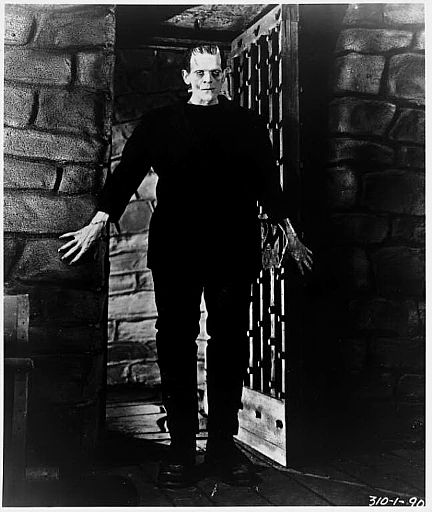
Forty-two years ago horror legend Boris Karloff passed away. Best known for his role in James Whales’ Frankenstein (although I love him best in Mario Bava’s Black Sabbath) Karloff created an image of a complex, self-referential monster that has evolved throughout the decades. In honour of the man, I’ve included below some brief writing on the influence of Frankenstein in relation to Spanish filmmaker Iván Zulueta’s 1972 experimental film Frank Stein.

***
The absorption of the cinematic within Iván Zulueta’s work, Frank Stein and King Kong among them, reacts to the political and social constructs of the 1970s. This is why his version the ‘Frankenstein’ story as subject is so fascinating. Born in the 19th century in a novel by Mary Shelley (Frankenstein 1817), this monstrous tale has been told throughout the decades as a reflection on modern society. In the 1800s, the Frankenstein monster could be read as an allegory on the dangers of scientific explorations or fears of an expanding world. At the dawn of the new decade while the idealism of the 1960s waned, Zulueta’s ‘Frankenstein’ represents the confusion and lapsed innocence of this new world. That Frank Stein is filmed from a television broadcast remarks on the change in media consumption and how its accessibility began to blur the line between information and entertainment. Meaning can seemingly be projected onto this monster in any given era, thereby he perpetually symbolises the recycled, relevant, and rejuvenated spirit of the horror genre.

Read more on Zulueta on a short essay I wrote from LUX called The horror film and contemporary art.

The Art of Fear: Crucible of Terror

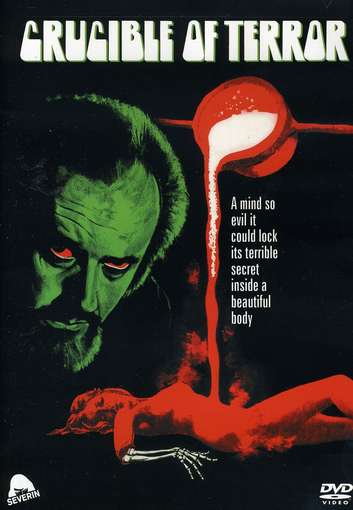
Women, money, and revenge are all expressed through art in Crucible of Terror (Ted Hooker, 1971). The Art of Fear explains…

Crucible of Terror is a weird mash up of characters tied together through art and antiquities (paintings, vintage clothes, ancient weaponry) who wind up dead as a result from their relationship to art…and the artist. Unlike our dear Walter in A Bucket of Blood, Victor Clare (played by Mike Raven)* is a true artist who can channel his emotions into paintings, sketches, and into one very mysterious sculpture. In the film’s very first scene we see Victor making this piece, forming a lifeless female body into a seductively lounging pose, covering her in a sealant, and then pouring liquid bronze all over her. Voila!

Continue reading

Book: ‘American Horror Film: The Genre at the Turn of the Millennium’

Horror’s not dead! Long musing on American Horror Film: The Genre at the Turn of the Millennium…

American Horror Film: The Genre at the Turn of the Millennium (edited by Stefen Hantke) is a provocation on the status of American horror cinema through discussing and analyzing films and trends from the last decade. I’d been anxious to read this anthology after reading Hantke’s essay Academic Film Criticism, the Rhetoric of Crisis, and the Current State of American Horror Cinema: Thoughts on Canonicity and Academic Anxiety. Split into three sections – 1) Bloody America: Critical Reassessments of the Trans/-national and of Graphic Violence; 2) The Usual Suspects: Trends and Transformations in the Subgenres of American Horror Film; 3) Look Back in Horror: Managing the Canon of American Horror Film – it’s a breath of much-needed fresh air, relocating academic focus from the 1960/70s into the present.

Continue reading

The Art of Fear: A Bucket of Blood

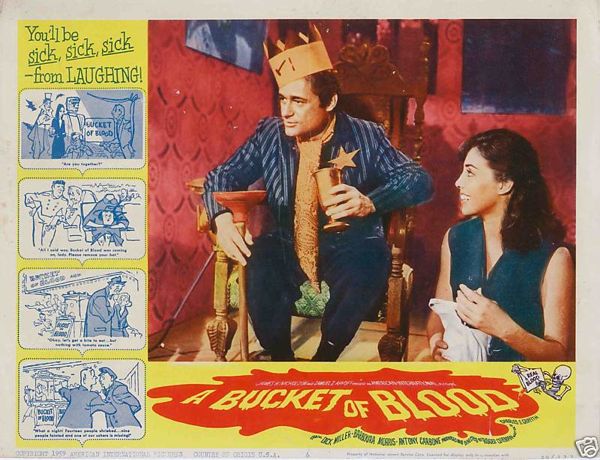
Who says the art world isn’t scary? The Art of Fear takes on Roger Corman’s classic A Bucket of Blood.

If there’s a better satirical film on the art world than A Bucket of Blood (1959) then I certainly haven’t seen it (Pecker and Untitled come close-ish). Corman’s hilarious jab at the beatnik artist types of the 1950s easily translates into the ridiculousness of today’s contemporary art world. Though made by the ‘King of B-movies’ and reportedly made for a mere $50k, A Bucket of Blood is a thoughtful and provoking look at the beginning of contemporary art as cultural phenomenon. It owes a lot to House of Wax in its relationship to revenge and the frustrating experience of creating artwork whether the artist is deformed as in House of Wax or without talent as in A Bucket of Blood. However, it quite cleverly mimics the capriciousness of the art world. As Sarah Thornton writes in her enthnographic study Seven Days in the Art World, ‘It’s [the contemporary art world] structured around nebulous and often contradictory hierarchies of fame, credibility, imagined historical importance, institutional affiliation, education, perceived intelligence, wealth, and attributes such as the size of one’s collection.’[1] More than fifty years after its release, the satire in A Bucket of Blood is still relevant and relatable.

Continue reading

Yinka Shonibare – Dorian Gray

Horror narratives are cyclical and often self-reflective – evolving from literature to theatre to film and, as I express here on the blog, onto artwork. Bouncing along and between these different mediums means horror continues to generate its relevance and influence. To show how this is true, take my recent Art of Fear discussion about how artwork functioned within the horror of The Picture of Dorian Gray. In 2001, British born Nigerian artist Yinka Shonibare produced Dorian Gray, his first photographic series in which he assumes the lead role. Here, much as in the book and film, Shonibare uses this story as a commentary on Victorian (and contemporary) values of class.

Another stellar example of this is experimental filmmaker Ivan Zulueta’s Frank Stein (1972) which I hope to discuss more in length here soon.

The Art of Fear: The Fall of the House of Usher

Family portraits in The Fall of the House of Usher encapsulate the Usher’s ‘plague of evil’.

The second film for The Art of Fear is Roger Corman’s vibrant The Fall of the House of Usher or House of Usher (1960) starring the estimable Vincent Price. Like The Picture of Dorian Gray the film adapts a literary classic, Edgar Allen Poe’s short story of the same name published in 1839. It is the first of eight movies Corman would use Poe, sometimes adding a little H.P. Lovecraft into the mix, and besides The Masque of the Red Death it is the best of the bunch. Paintings actually factor in many of the Corman/Price/Poe movies – remember the watchful painting of the ‘dead’ wife in The Pit and the Pendulum (1961) and the looming ancestral portrait in The Haunted Palace (1963). Considering Corman’s original A Bucket of Blood (next feature on AOF), perhaps he has an art fetish!

Continue reading