Fallen Light: Mario Bava and Bas Jan Ader

My obsessive research on the relationship between horror film and contemporary art often takes me to unexpected places. For instance one day while I was viewing the artist films of Bas Jan Ader, I came across his Nightfall whereby I immediately and instinctually associated his light/dark tonal construction with Mario Bava. I find Bava’s horror movies to be magical experiences, touching and haunting, and I tend to automatically think of Ader in much the same way. The associations I began to draw out between them cement my thinking that the cultural and political climate of the 1960-70s fostered a sense of unease that can be felt throughout different mediums, producing some of the most enduring images of our time.

Italian filmmaker Mario Bava and Dutch conceptual artist Bas Jan Ader are cult figures, mysterious and evocative. They delve down into our sorrows and fears through an extraordinary expression of themselves. In considering how their bodies of work share structurally and thematic characteristics, we see how the subversively ingrained innovations of horror cinema are applicable in other art forms. Most importantly, their work addresses the crucial role the audience plays by watching and relating to what is seen onscreen.

Bava and Ader are two of the biggest creative influencers of the 20th century and yet they are still relatively unknown. Mario Bava, the grandfather of Italian horror cinema, ignited the giallo movement and the subsequent ‘slasher’ films in America. His innovative cinematography and directorial style are referenced in Martin Scorsese’s Cape Fear (1991), Sean Cunningham’s Friday the 13th (1980), Ridley Scott’s Alien (1979(, and Roman Coppola’s CQ (2001). The small oeuvre of video, photography, and installations by Bas Ader, who lived and taught college in California until his mysterious death at sea in 1975, is the stuff of art world intrigue. There has been a documentary on his disappearance, Here is Always Somewhere Else (Daalder, 2007), the recent exhibition Suspended Between Laughter and Tears at Pitzer College that presented contemporary Californian artists whose practice responds to his legacy, and gallery exhibitions of his work appear at Patrick Painter Gallery in Los Angeles. In terms of popular culture Ader’s performances can be considered as a precursor to the Jack Ass era of bodily-harm-humour and hijinks.

Of course Bava and Ader had nothing to do with each other directly even though both were productive roughly around the same time (1960s-70s). This makes uncovering their unlikely relationship so poignant and fascinating. By looking closely at their films The Girl Who Knew Too Much (Bava, 1963) and Nightfall (Ader, 1971) along with other key works, certain specific structural commonalities emerge. Focusing on their usage of light and dark, interiors and isolation, endurance and the body, and death and tragedy provokes a new reading between cinema and visual art.

Light and dark
Bas Jan Ader and Mario Bava’s manipulation of light and dark is a stimulus for the onscreen action and the viewer’s response. This tonal construction is used to heighten the very natural human fear of being alone in the dark. Their contrasting usage of light and dark delineates space, establishing disorientation and ‘spectatorial identification’ with the audience.

In his black-and-white film Nightfall, Ader slowly takes us through the process of ‘becoming dark’. He is alone in what appears to be barn, standing before a large heavy chunk of concrete with two very bright spotlights on the ground. He struggles to pick up the stone, hold it, and then drops it onto the first light. He does this once more until he is obscured in darkness. Murnau’s silent classic Nosferatu (1922) comes to mind in its depiction of death through shadowy devices. In fact, Ader cuts a similar elongated, thin, morose figure. The vampire in cinema (and vampiric nature of cinema) is an interesting example of death by light but in Nightfall Ader is killed by the darkness. Using light as a visual prop and theatrical device, he guides the viewer’s sight lines, peaking our curiosity of what happens in this unseen non-visualized future.

A master manipulator of lighting and visual illusion, Mario Bava has a stylistic habit of highlighting the eyes of his actors. From the haunting black-and-white Black Sunday (1960) to the campy colorful Danger Diabolik (1968), the contrast between the light strip across the eyes and the dark surroundings is so striking that it compels the viewer to look.  This technique is used most effectively in The Girl Who Knew Too Much or La ragazza che sapeva troppo when heroine Nora Davis, believing she has witnessed a murder of a young woman, has difficulty discerning between reality and fantasy. The audience is left ‘in the dark’ along with her, receiving informational clues via Bava’s filtering of illuminating light as the narrative unfolds.

Interiors and isolation
Claustrophobia induced by isolation and interiors is an affective staple of the horror genre. Bava and Ader root their works in a reality by creating unease in familiar spaces such as the domestic interior of the home, turning them into a place of menace and distrust.

About his films Bava said, ‘what interests me is the fear experienced by a person alone in their room. It is then that everything around him starts to move menacingly around, and we realize that the only true ‘monsters’ are the ones we carry in ourselves.’ It’s true that in Bava’s films we never quite know if the characters are actually being pursued or if their imagination will be their ultimate undoing. In The Girl Who Knew Too Much, heroine Nora constructs an elaborate security system of string and powder (see Cape Fear) while alone in a friend’s house. At this point in the narrative, we don’t know whether the threat to her is real or whether it’s her imagination triggered from her passionate reading of murder mysteries. Two stories in Bava’s Black Sabbath (1963) trilogy, The Telephone and The Drop of Water, each feature an isolated woman in a state of panic, unraveling as she loses her good judgment and her mind. Also, the murders in Bava’s giallo classics Bay of Blood (1971) and Blood and Black Lace (1964) only occur when the victims are alone; designed to additionally hide/reveal the killer’s identity.

Ader’s evocation of isolation is a much more personal experience. The loneliness in I’m Too Sad to Tell You (1971), where Ader cries and sobs to camera, is undoubtedly the most palpable. His falling film series – Fall I (1970), Fall II (1970), Broken Fall (Organic) (1971), and Nightfall – express gravity in the metaphoric terms of what happens when no one there to catch him: he blows over in the wind, rolls off the roof, winds up in darkness. But the most haunting cry of this undeniable and dreaded absence is the burst of light emanating from the words scrawled on the wall his installation Please Don’t Leave Me (1969) For Ader presence is established in relation to absence; it is in a perpetual state of mourning, searching for future outcomes.

Endurance and the body
Horror films are corporeal beasts and Bava’s films are no exception. With the opening sequence to his first feature Black Sunday he initiates the audiences’ affected reaction by nailing a spiked iron mask to Barbara Steele’s (a vampire witch) face. This film shows how the body exists beyond death, exemplifying physical decay and the possibility to resuscitate dead flesh. His later films Four Times that Night (1972), Bay of Blood, and Blood and Black Lace are less subtle in their approach to bodily destruction as characters are eliminated in classic giallo fashion; torturously chased by an unknown murderer, ultimately being killed by an axe to the face or repeatedly stabbed. In a scene infamously re-used in Friday the 13: Part II, Bava brutally pierced together a couple having sex with a long dagger. Ironically, the actual death scenes are rather quick. It’s the film in its entirely that marks its overarching endurance for the portrayed victims and the audience.

Unlike his California contemporary Chris Burden, Ader’s self-inflicted physical endurances are less aggressive and much more emotionalized. Yes, his Fall series is intense and dangerous but it’s not the act alone that we anticipate, it’s the act in relation to the body that makes the work empathetic.

Ader’s Nightfall is a choreographed test of strength where he uses his body as the main object that enables action. Tension radiates from the artist and permeates into the occupying space (and into the cinematic space) as he struggles to handle the weight of the block he’s holding. The audience feels this and is satisfyingly relieved when he eventually (and strategically) drops the block onto the lights, leaving him and us in darkness.  His Broken Fall (Organic) is similar in this respect – he hangs and sways from a tall tree branch over a creek. As the audience we know we are witnessing an in-between moment; a brief period of waiting until he finally loses his grip and falls onto the ground. Structurally akin to horror cinema, these paused moments of tension build up to the gratifying release for the person onscreen and for the viewer.

Death and tragedy
Since Bas Jan Ader vanished at sea in 1975 while making his last piece of work In Search of the Miraculous (his boat was found but he was not), his melancholic persona tends to overshadow the complexity of his work and our reading of it. Ader embodies death and tragedy on a personal level while Bava outwardly depicts violence onto others (he did make horror films after all). The main focus in Bava’s films was the overall design, including actors to backgrounds, while Ader is simultaneously subject and object. However different in approach, they both fuse together humour and tragedy in such a way that invests a proactive interest in life through the exploration of death.

Humour in a horror context can be interpreted as a way to release the tension and we can see this ebb-and-flow in their artworks. It’s hard not to giggle when Ader falls from the roof in a Buster Keaton-esque physical comedy or when he dangles from a tree in Broken Fall (Organic). And the jolts of laughter Bava provides at the end of Bay of Blood (the children wind up shooting their parents, hilarious!) or Black Sabbath (camera pans out to show Karloff riding on a dummy horse in studio as slapstick music plays) are actually quite amusing. Instinctively, Bava and Ader collate tragedy and comedy, making the intangible accessible through a little bit of therapeutic laughter.

Conclusion
To me, considering Mario Bava and Bas Jan Ader in the same context is a reminder of how powerful images can mirror the struggles and triumphs of life. Perhaps it goes beyond the influence of horror cinema on visual artists and extends into thinking about how social and political environments shape artistic practice. It is also an exciting provocation that the horror genre is successfully productive in differing mediums and not just scare tactics for silly cinema. Thus, my research gladly continues.

IMAGES (top to bottom, all stills)
1. Mario Bava, The Girl Who Knew Too Much (1963)
2.  Bas Jan Ader, Nightfall (1971)
3. Mario Bava, Black Sunday (1960)
4. Bas Jan Ader, Please Don’t Leave Me (1969)
5. Mario Bava, funny ending to Bay of Blood (1971)
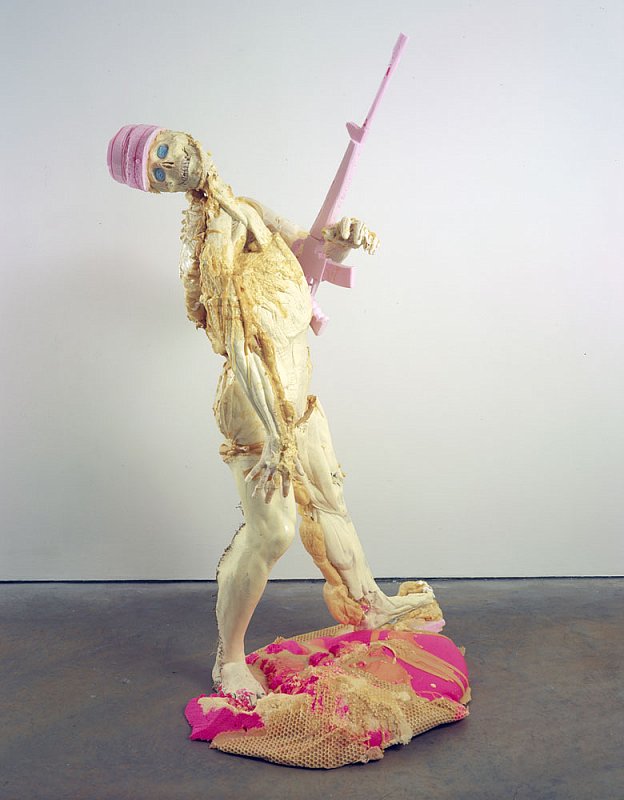
On the Desperate Edge of Now – Folkert de Jong

Dutch artist Folkert de Jong’s sculptural works are a grotesque and playful representation of international social histories. He establishes new narratives through the deconstruction of the past (referencing art history, warfare, colonialism, assassinations) assembled in figurative forms so that the viewer can recognize and remember our collective history.

His characters emerge through the time barrier like tarred ghosts, an evocation of negative energies brought forth to enlighten and entertain. These sculptures aesthetically ooze with attraction and repulsion; this push/pull creates a rupture that becomes our portal into an at once familiar and foreign struggle. Carnivalesque costumes, sickeningly sweet colors, and devilish grins are accompanied with barrels of oil, decapitated heads, and rifles. Humor is used to translate the horror and make it palatable. As the bad twin to characters in a Disneyland ride (think Haunted Mansion and Pirates of the Caribbean) De Jong’s figures urgently perform and unfold the history of human drama. These ‘tableaus’ are dropped directly into our present – the gallery, the museum, the studio are the background settings. Here is where time and space collapses as the past merges seamlessly into the now. These are not the desolate and isolated wastelands of Ed Kienholz, they are frighteningly alive ghosts beckoning us join their ‘danse macabre’.

As sheer material form, the sculptures are wholly hand-made and consist of Styrofoam, polyurethane foam, and occasionally clay. The usage of Styrofoam is significant beyond its easily modifiable form; it’s the same medium used in the film industry for architectural and stage design and it’s also produced by the same company who manufactures Napalm (that deadly chemical agent used prolifically in military operations). This subversive combination of fantasy (film) and reality (warfare) makes de Jong’s works resonant with power; an explosion occurs between representation and the acts being represented. And it’s within this space the horrors from the past emerge to haunt our present consciousness.

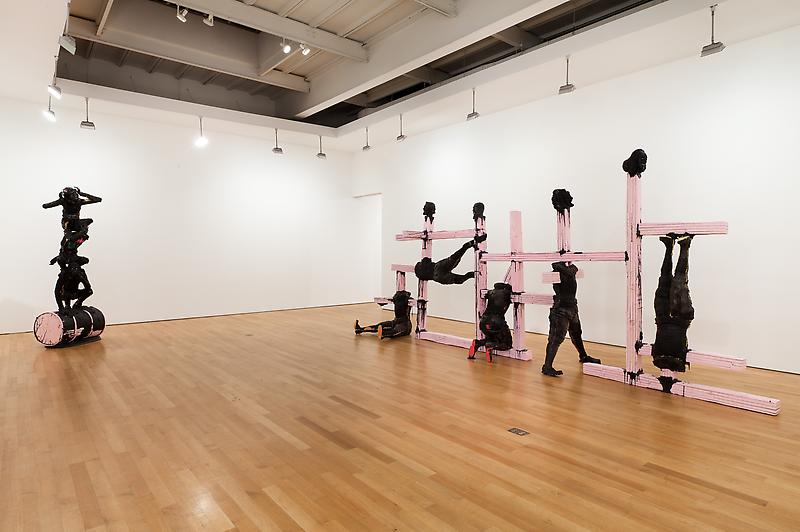
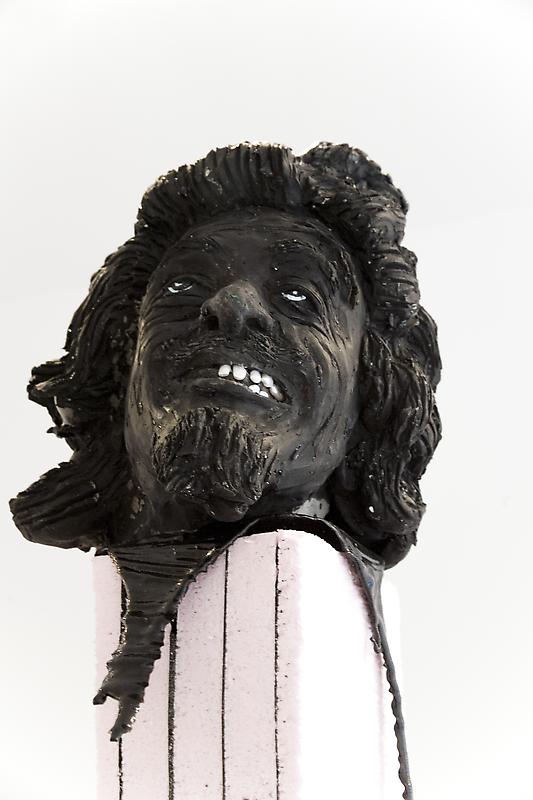
De Jong gives the viewer an arsenal of information. With just enough bit of candy coating, he coaxes us into our historical tales of terror that do not exist within the confines of film set but have been living amongst us within our everyday world. In his latest exhibition at James Cohan Gallery brings this forth via newer and older works including the large-scale and ominously fragmented Operation Harmony (2008). Titled after the contradictory name given to Canada’s 1992 military mission in Bosnia this sculpture references another political invasion, the lynching of Dutch political figures the DeWitt Brothers in 1672. Depicting five headless bodies strewn across the vibrant pink scaffold, only four heads (smiling, direct, sinister) look out at us. They represent men involved in various political assassinations and genocides. With title and source separated by hundreds of years we bear witness to the fact that “progress” often involves a sacrificial death. The conflation of these different historical events and geographical locations together with the present day makes for a curiously charged experience. These men are long dead but their stories have been re-animated.

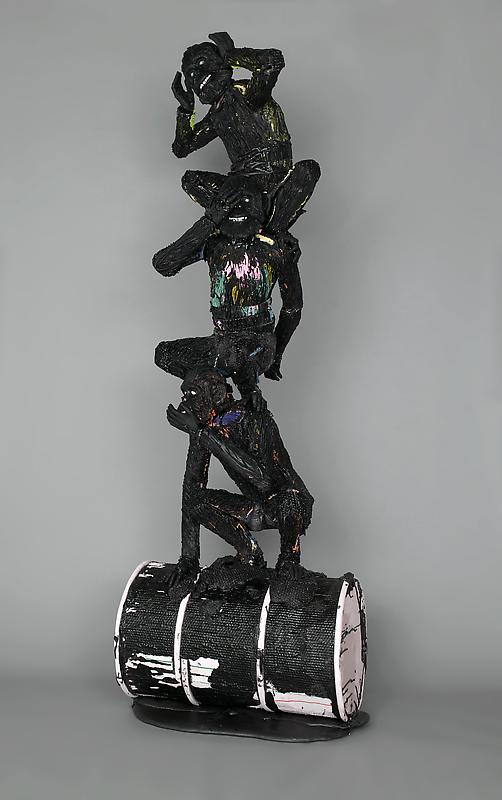
A newer installation is The Balance II: Trader’s Deal 6-9  (2010) featuring a vignette of proud Dutch traders prance with their treasures of beads and whiskey from Manhattan’s Native Americans. Place in the front portion of the gallery and directly facing the street, these men beckon viewers to share in their spoils. However unlike the charm from the buccaneers in Pirates of the Caribbean, we are more suspicious of these fellows and their inviting presentation of swindled goods. Other works like Business As Usual: “The Tower” (2008) the “No Evil” or “Morality Monkeys” remind us of our ability to look the other way and even perhaps America’s obsession with eliminating anything sad from our thoughts.

Seeped in the significant role art has played in the expression, sublimation, and manipulation of war and terror, de Jong continues the art historical tradition of bringing atrocities to light. In this sense he also acts like a skilled horror film director whose purpose is to manipulate reaction and produce affect. Tackling a myriad of historical traumas, like horror cinema, de Jong exposes universal truths to engage the viewer in a proactive remembrance.

Images (top to bottom):
Halleluja, 2007
Installation view:  Operation Harmony (2008) and Business As Usual: “The Tower” (2008)
Detail view: Operation Harmony (2008)
Installation view: The Balance II: Trader’s Deal 6-9  (2010)
Business As Usual: “The Tower” (2008)

Photos: Jason Mandella / James Cohan Gallery

On the Desperate Edge of Now

Auschwitz. Hiroshima. Vietnam. These are names associated with specific places and occurrences [of historical trauma] but they are also wounds in the fabric of culture and history that bleed through conventional confines of time and space. – Adam Lowenstein ‘Shocking Representation’

One of my research strands on the influence of horror cinema and contemporary artists is looking at how artists manifest historical trauma within their work. By using the structure of the horror film as a guide and in considering Deleuze and Bergson’s notion of the now as an “ever shifting amalgam of past, present, and future”, I’m exploring the idea of a haunted present and possible recuperation seen in the representation of trauma in contemporary artworks.

This particular project (which I plan on realizing in exhibition form) is being called On the Desperate Edge of Now, titled after the first episode of British filmmaker Adam Curtis’ documentary series The Living Dead. In a visual mash up of archival footage, interviews, and appropriated images Curtis describes the relationship between history and memory in the context of World War II as both an individual and political construct that is never fully resolved – a ghost always haunting the present or an omniscient zombie walking the earth. This collision of the past and the present that Curtis outlines makes for an explosively charged ever-present “now” particularly as it manifests itself into representational forms such as film and visual art.

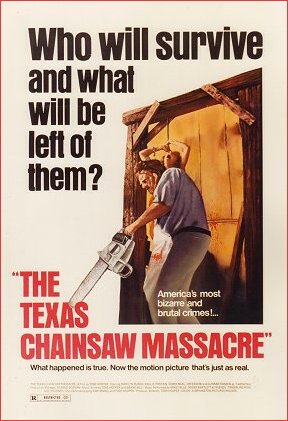
Horror films are subversive and often entertaining social commentary reflecting the cultural and political issues relevant to the time period in which they are produced. Wes Craven’s Last House on the Left (1972), Tobe Hooper’s The Texas Chainsaw Massacre (1974), and Bob Clark’s Deathdream (1974) are all
reactions to the traumatic experiences, personally and culturally, of the Vietnam War. Many horror academics also view newer films like Eli Roth’s Hostel (2005) as a reflection of America’s torturing of political prisoners at Guantanamo Bay. On the Desperate Edge of Now looks at how artists tackle similar histories through a knowing employment of strategies and signifiers found in horror cinema: humor, the family, death in life, societal repression, spatiality, allegory, and the corporeal.

Like their filmmaking counterparts, the artists I will be writing about attempt to confront history more than compensate for it. They are: Folkert de Jong, Heather Cantrell, Sue de Beer, and Gert & Uwe Tobias.

Jamie Shovlin – Pieces

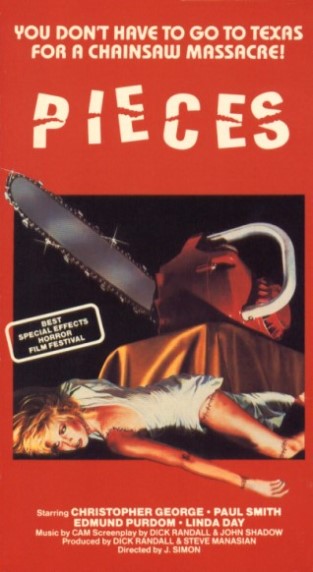
Earlier I mentioned Jamie Shovlin’s Hiker Meat project. In the same slasher film vein, here is an image of Shovlin’s Index (Pieces A) that explicitly references that bloodiest movie about body parts, Pieces (Juan Piquer Simon, 1982). The image used is taken from the trailer.

Index (Pieces A), 2011
Gouache and Image Transfer on linen mounted on board
11×16″ / 28x40cm
Courtesy of Horton Gallery

In addition to Index (Pieces A) I’ve also included the classic and clever poster for the film.


A great synopsis on
Pieces can be found here.

‘Hiker Meat’ (Jamie Shovlin) at Milton Keynes Gallery

UK artist Jamie Shovlin ongoing installation on Jesus Rinzoli’s 1981 Hiker Meat is the best slasher film never made. Featuring scripts, posters, drawings, and thousands of culled horror clips, Hiker Meat is a celebration of a memory that didn’t happen except for in our generation’s joint enthusiasm for campy killer classics.

Hiker Meat has been shown in various incarnations recently in London at IBID Projects, New York at Horton Gallery, and will be at MACRO this fall. However this Thursday Milton Keynes Gallery will be showing the film’s ‘rough cut’, along with a live performance by Lustfaust, as part of their Scratch Nights series.

Sue de Beer – 500 words on ‘The Ghosts’

One of Artforum’s February ‘500 Words’ was artist Sue de Beer talking about The Ghosts, her film and installation for the Art Production Fund. De Beer has continuously folded horror and gothic influences into her photography and films through a cinematically macbare representation of the past, the historical, memory, and youth culture.

ORIGINALLY I WANTED TO MAKE A GIALLO––a very classic version, with ghosts in it. During the course of the narrative development I began to undergo a series of hypnosis, and I also started going to a sensory deprivation tank in Berlin. So I began to wonder about intersections between the physiological and the psychological, or about ways to take your conscious mind to a place that is unconscious but still visible––a place that produces images. It was then that I began to conceive of a character that was very much in a giallo––an occult hypnotist. After I completed the basic outline for the script, I asked Alissa Bennett to write a text for the hypnotist, where the hypnotist talks about ghosts and the way ghosts inhabit a room––leaving traces of its former occupancy, clues for present and future residents. I also asked her to write a text for a character who repeatedly visits the hypnotist, to experience a more vivid sort of “recollection.” Alissa named this “the material recollection.”

Visit: Recent exhibition at Marianne Boesky gallery Depiction of a Star Obscured by Another Figure

Scream versus Scream

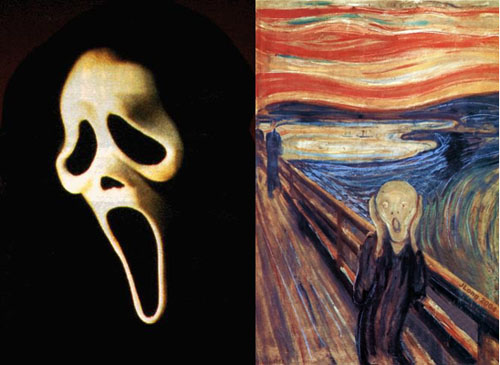
In 1996 a little film named Scream became the ultimate post-modern and self-reflexive horror film. It managed to solidify the “rules” of the slasher genre (and before that giallo) even though these rules were never die-hard and it remains as a really clever and fun movie. Fifteen years laterScream 4opens today and to mark this occasion, having not seen the film yet I don’t know whether this is good or bad, here is a reminder of painterly inspiration in horror cinema:

Darren Banks – Public Sculpture for the Masses

The Drawing Room in the UK is currently hosting their Drawing 2011 – Biennial Fundraiser (exhibition runs from 7 April – 18 May 2011 and ‘close of bidding silent auction event’ is 18 May from 6:30-8:30pm) and I just had to share Darren Banks’ The Wicker Man-inspired contribution:

Public Sculpture for the Masses, 2011 (click the title to go to the bidding page)
Medium: pen over print
Dimensions: 29.7 x 21 cm

Related reading: my essay Get on the Band-wagon: Darren Banks’ mobile cinema

Ben Rivers: filmic montage and final girls in “Terror” and “Alice”

Following up my recent posting on Peter Doig and Friday the 13th are thoughts on the artist films Terror (2006) and Alice (2010) by UK artist Ben Rivers.

In addition to focusing on Alice from Friday the 13th and her status as the ultimate final girl (which I will get to later on), Ben Rivers uses the archive of horror cinema as a modifiable object. While the basis for his films is usually self-shot and original, Terror and Alice are his “love letters’ to horror. Sourced entirely from the “giallo” and “slasher” sub-genre (1970-80s) they include Lucio Fulci’s The Beyond, John Carpenter’s Halloween, Dario Argento’s Susperia, and dozens more. By establishing a dialogical relationship between his own work and these movies through montage, Rivers carefully negotiates this particular portion of horror history and by fluently speaking the language of horror cinema he conflates the past with the present to create a new process of looking. This makes for future genre possibilities in what Sergei Einsenstein termed an “intellectual montage” (proposing that a new idea can emerge from a sequence of shots unintended by the original footage). For Rivers this new emergent idea directly involves the audience.

The chosen scenes in Terror build upon a structural frame of familiarity through a progressive sequence that increases in intensity and absorbs the viewer in its rhythm. Rivers’ filmic montage (and homage) to the influential “giallo” and “slasher” movies inverses storylines and audience participation and exemplifies Steven Shaviro’s ‘zombie time’ terminology in his essay Contagious Allegories: George Romero:

‘the slow meanders of zombie time emerge out of the paralysis of the conventional time of progressive narrative. This strangely empty temporality also corresponds to a new way of looking, a vertiginously passive fascination. The usual relation of audience to protagonist is inverted’ (1993, 99).

Rivers establishes linearity by editing similar scenes together: houses in the fog, people calling out for each other, the mysterious opening of doors, shots of keys, and even bits of comedy. Each sequence builds incrementally, simultaneously acknowledging that the audience knows these are “only movies” but still provoking some serious unease. For those who recognize the sources, the suspense becomes palpable and the alternating tension between this conglomeration of references continues just until the moment when the one questions whether or not the violent resolution will ever come. Then Rivers provides a brilliant release with the most fantastic eruption of surplus gore; a bloody violent collage that is completely satisfying and totally thrilling.

Relying on the audience’s knowledge and/or non-knowledge of horror films, Rivers acknowledges that the viewer’s familiarity with the movies determines meaning for Terror and Alice. This is most evident in his new film Alice, a heavily edited piece focusing solely on the main character and “Final Girl” from Friday the 13th.

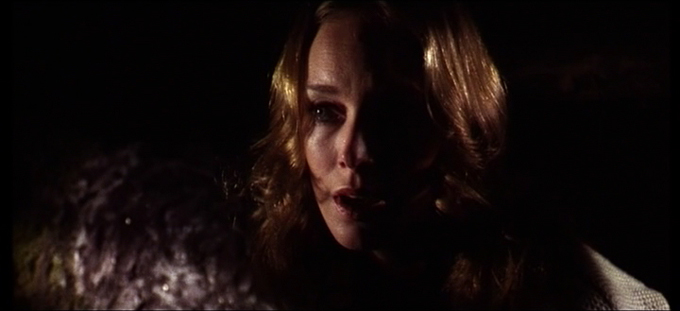
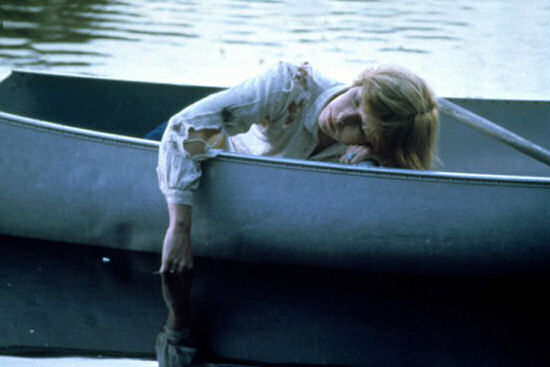
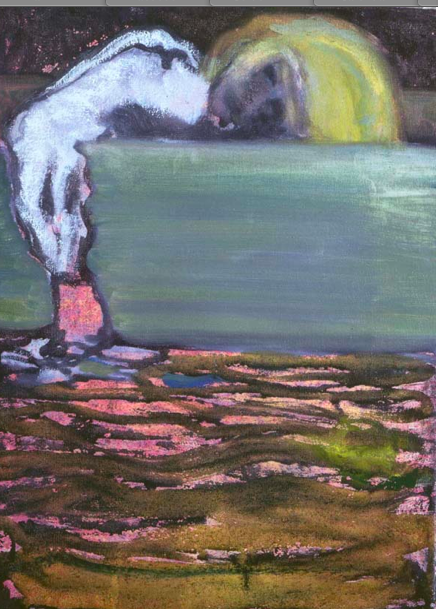
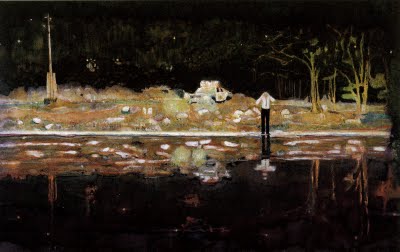
As with Peter Doig’s Canoe Lake (1997-98), Echo Lake (1999), and Friday the 13th (1998), Rivers has completely omitted any visual expression of the life-threatening encounters Alice endures. What we see is Alice making coffee, putting on her coat, lounging in a canoe on the lake; a rhythmic succession of the benign moments that surround the unseen moments when she is fighting for her life. Those unaware of Friday the 13th could find this a little bit boring but understanding the filmic source makes the friction between what we see and what we know explode brilliantly onscreen. Still, it’s significant that the exclusion of the scary stuff has not pacified the situation – the audience is aware of the narrative tension and feels it when viewing the works.

Rivers’ films purposefully identify with an audience’s relationship to watching a horror movie. A fan himself, Rivers incorporates this passion for the genre into other works containing his own footage, House (2007) and Origin of the Species (2008). He extends his interest onscreen, acknowledging the audience and their expectations of what a “good” horror film should be.

As mentioned in Peter Doig – Friday the 13th, Alice plays into critical debates surrounding feminism in horror movies specifically addressing slasher films where the lone survivor is usually a female who is, generally, victorious over her male counterparts (monster and fellow victims). Carol J. Clover dubbed her the “Final Girl” and while her definition is tenuous at best (I think that the unique differences in each film make such solidified terms near impossible), this “Final Girl” has an enduring legacy in horror that can provide us a framework in which to consider gender roles in society throughout the decades. Friday the 13th is a particularly interesting example because not only is the lone survivor female but the killer is as well (it isn’t until the sequels that Jason becomes the monster). It’s a battle between motherly devotion and the perceived loose morals of teenagers.

Rivers views Alice as the ultimate “Final Girl” and utilizes this process of identification as a structure to creates a contemporary version of the same story. His editing might suggest we question whether women are now safer in society. Have women become more integrated and better shielded from unknown horrors? Or is the perception of equality and safety an illusion – is the past still there, lurking in the background, waiting to grab hold?

Ben Rivers recently exhibited his new film Slow Action at Matt’s Gallery in London and Picture This in Bristol. I have previously written about Rivers for LUX and his film Terror was screened last fall during The Real Horror Symposium.

Friday the 13th: Peter Doig

Furthering the topic of women in horror film as it extends into contemporary art is a discussion on Friday the 13th’s main character Alice in the work of Peter Doig and Ben Rivers. As artists both Doig and Rivers touch upon the famous horror heroine’s status as the ultimate slasher ‘Final Girl’ who Carol Clover describes as, ‘…intelligent, watchful, level headed; the first character to sense something amiss…the only one, in other words, whose perspective approaches our own privileged understanding of the situation’ (Clover 1987, 79). As our portal into the action and into narrative meaning, she is the character with whom the audience most identifies because we have shared in her suffering and she, like us, remains alive.

Peter Doig is well known for his usage of photographic, film, and cultural as image references. What makes his explicit crediting of Friday the 13th in his painting series that includes Canoe Lake and Echo Lake is that it marks the only time he has openly credited a filmic source. Despite this, the influence film has on him creatively is obvious (his ongoing commitment to the Studio Film Club in Trinidad is evidence) and a stylistic composition of horror films can be read throughout much of Doig’s work. For instance, he invests in the unknown with his cabin series Cabin Essence (1993-4), Concrete Cabin (1991-2), and Concrete Cabin II (1992). Architecturally the ‘house’, haunted or otherwise, is prevalent in horror but it is particularly the isolated cabin in the woods often used as a trope; The Old Dark House (Whale, 1932), Evil
Dead
(Rami, 1981), Cabin Fever (Roth, 2002), and The Strangers (Bertino, 2008) are but a few examples. The woods themselves are generally areas of the unknown and produce fear in imagining what kind of people inhabit them. Equally Doig’s Hitch Hiker (1989-90) contains an aimless sense of unease and feelings of solitude, calling to mind The Hitcher (Harmon, 1986) and Steven Spielberg’s Duel (1971).

What connects a seemingly miscast Doig to horror cinema is the incredible spatiality created between the captured in-between moment and the conflated relationship between the audience and the scene. Peter Doig encapsulates the entirety of meaning into one image in his works inspired by the camp-counselor killing classic, Friday the 13th. Formally he uses paint to construct this insertive space with linear divisions on the canvas, compiling multiple layers of memories and stories. This reflective image becomes the area where the viewer can insert him/herself and his/her stories into the picture.

Specifically in Echo Lake and Canoe Lake he delineates the crucial point in Friday the 13th when what appears to be resolved is anything but. With these paintings he creates alternate points of view: in Canoe Lake we look onto Alice safely in her canoe but in Echo Lake are viewpoint is through Alice’s eyes, looking onto the policemen on the shore. Viewed in relation to each other, this is similar to different cuts used in film where the audience is simultaneously the eyes of the killer, the victim, and the outsider. Importantly with Doig, who may or may not intend to completely tell the heroine Alice’s tale, he never privileges the audience with resulting action. Instead, he evokes her storyline as a device to hold all tension. By never moving forward or backwards, the girl and the audience are forever held in to this singular moment. It is a beautifully evocative way to frame anticipation and anxiety that will never be released.

Images (top to bottom)
Peter Doig – Canoe Lake (1997-98), oil on canvas
Film still from Friday the 13th (Cunningham, 1980)
Peter Doig – Friday the 13th (1999), oil on linen
Peter Doig – Echo Lake (1998), oil on canvas