Incognitum Hactenus: new journal on art, horror, and philosophy

I am thrilled to announce that the first issue of the new quarterly journal Incognitum Hactenus (edited by Tom Trevatt and myself) is now available! Download it here.

Incognitum Hactenus is a new quarterly journal featuring writing on art, horror, and philosophy. Conceived as an ongoing investigation into each sphere and its crossovers, the journal publishes new work by leading international scholars, artists, filmmakers, curators, musicians, and designers. With a focused interest in that which finds an affiliation with horrific contemporaneity and the exposure to radical thought, Incognitum Hactenum reveals the twisting of contingency (that which comes from outside) as it produces new monstrosities. We aim to tear asunder the fleshy belly of the established and expected.

Volume 1.1 “Real Horror” of Incognitum Hactenum includes texts and artwork by Amanda Beech, Simon Clark, Carl Neville, Ben Rivers, Steven Shaviro, and Ben Woodard that were produced in conjunction with The Real Horror Symposium last October in London.

Please visit the website to download the first issue and to learn about the journal.

We hope that you enjoy and participate in these new strains of discussion as we celebrate the present, past, and future of art, horror, and philosophy!

Halloween Lullaby: how the Cure shaped my love for horror

“On candy-striped legs, the spiderman comes…”

Because I’m always thinking about “why horror?” for a generation of artists, filmmakers, and cultural production, I often ask myself, why horror? I mean, how did I get into this mess in the first place? While there are many layers in answering that question, amongst them being the magical lure many of these films have, actually pinpointing my obsession with horror aesthetics and narratives has come down to this…The Cure’s video for Lullaby.

Twenty-two years after its release, The Cure’s Disintegration (released May 1989) is not only one of the best albums of the late 20th century but also a formative influence in my life. I vividly remember watching The Cure’s music videos, ranging from the earlier and silly Love Cats to the love lorn Love Song to the powerful Fascination Street featured on Disintegration, on MTV with such intensity. Their goth allure appealed greatly (and still does) to my inner depressive and most likely also cemented my enduring love for England and black eyeliner. After recently re-watching The Cure’s Lullaby video, directed by Tim Pope, a flood of memories rushed back and I realized that even before my first horror film scared the pants off me (Halloween 5),  Lullaby was where it all began.

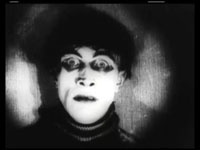
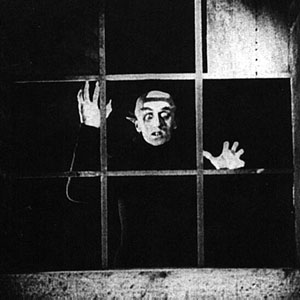
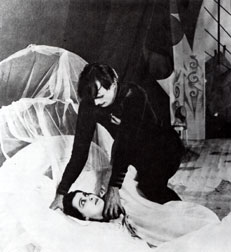
Of course now I recognize the filmic references within the video that escaped me at the time. Now I can’t look at it without thinking of German Expressionists Robert Wiene’s The Cabinet of Dr. Caligari (1920) and F.W. Murnau’s Nosferatu (1922) or even many years later Werner Herzog’s stunning Nosferatu the Vampyre (1979). The dark-rimmed eyes, creeping human-like figure, foreboding death, being repeatedly consumed, and the fear of sleep are all at play with these films and culminate, with all its British goth pop glory, into Lullaby.


On candystripe legs the spiderman comes / Softly through the shadow of the evening sun/ Stealing past the windows of the blissfully dead / Looking for the victim shivering in bed / Searching out fear in the gathering gloom and / Suddenly! / A movement in the corner of the room!


And there is nothing I can do / When I realise with fright / That the spiderman is having me for dinner tonight!

Quietly he laughs and shaking his head / Creeps closer now / Closer to the foot of the bed / And softer than shadow and quicker than flies / His arms are all around me and his tongue in my eyes / “Be still be calm be quiet now my precious boy / Don’t struggle like that or I will only love you more / For it’s much too late to get away or turn on the light / The spiderman is having you for dinner tonight”

And I feel like I’m being eaten / By a thousand million shivering furry holes / And I know that in the morning I will wake up / In the shivering cold / The spiderman is always hungry…

Ghost Stories – Thanks!

Thanks to everyone who came out for the second (but certainly not final) Art of Fear screening!

To say that I was incredibly  honored to show works by artists I admire so much would be an understatement. So thank you to all the artists who have been a part of this conversation-starter on horror and contemporary art: Takeshi Murata, Darren Banks, Jamie Shovlin, My Barbarian, Aida Ruilova, and Marnie Weber. Also to Nitehawk Cinema, who supports experimentation and all things horror as well as all those who spread the word and assisted putting all the files together (when they should have been working on other stuff). You did my first New York project proud.

More soon!

The Art of Fear: Ghost Stories on October 19

The second part of The Art of Fear artist film exhibition is this Wednesday (October 19) in the upstairs lobby at Nitehawk Cinema! The event is free and starts at 7pm with films beginning shortly after – the program will be shown twice. See  you all there!

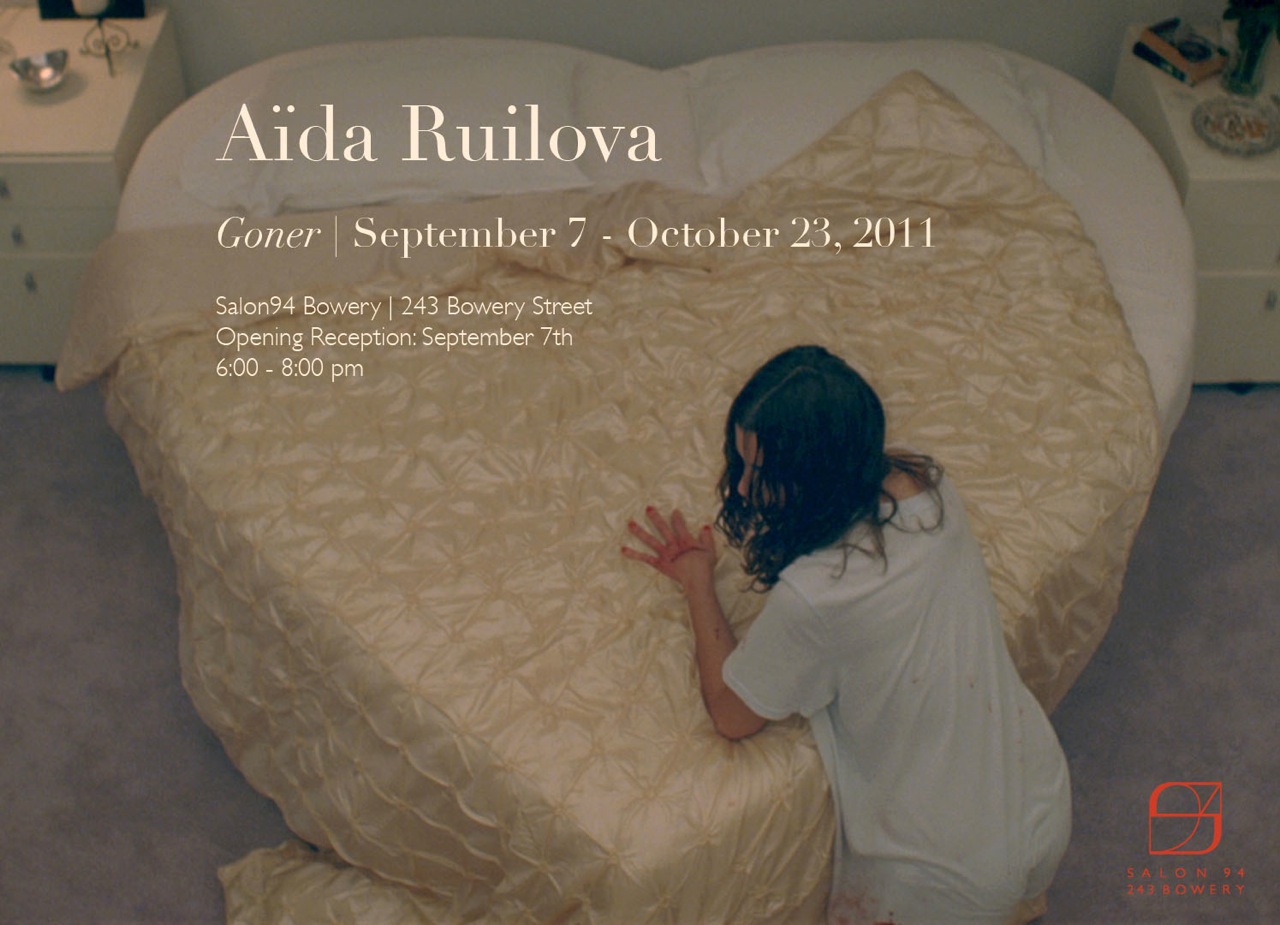
Ghost Stories, the second program of The Art of Fear, features surreal tales of love, life, and death that are brought back from the afterlife in the bizarre and haunting works of My Barbarian (Malik Gaines, Jade Gordon and Alexandro Segade, Los Angeles), Aïda Ruilova (New York), and Marnie Weber (Los Angeles). Horror affect and narrative style are huge influencers in these films with inspiration deriving from Rod Serling’s Night Gallery television series, cult figures like Jean Rollin and Karen Black, and the theatrical monstrous characters from early Hollywood. Importantly, The Art of Fear is showing the New York debut of Marnie Weber’s most recent film, The Eternal Heart (2010).

PROGRAM
My Barbarian – Night Epi$ode: Curatorial Purgatorial (Pilot)
2009, Single channel video, 12 minutes, Color, Sound

Aïda Ruilova – Life Like
2006, Single channel video, 5 minutes, Color, Sound

Aïda Ruilova – Lulu
2007, Single channel video, 5 minutes, Color, Sound

My Barbarian – Night Epi$ode: Yoga Matt and Veronika Phoenix
2009, Single channel video, 13 minutes, Color, Sound

Aïda Ruilova – Meet the Eye
2009, Single channel video, 7 minutes, Color, Sound

Marnie Weber – The Eternal Heart (see trailer below)
2010, Shot on Super 8 and 16mm, digital projection, 28 minutes, Color, Sound

Thoughts on “the Art of Fear”: film viewership and why horror?

The first screening of the two-part The Art of Fear series (which will hopefully become a multi-part expanded series) launched last Wednesday to great success with a collection of works by Takeshi Murata, Darren Banks, and Jamie Shovlin titled Pieces. Thanks to all who came out!

Two important strands of thought came out of this initial program (which was also, incidentally, my first foray into exhibiting artist moving images) that I’d like to explore further both in my own curatorial practice and via writing here on TGWKTM…

The first is in consideration of how artist film programs such as The Art of Fear can or should be presented and viewed. My intention with Pieces was to approach in like a gallery context – no seating, no definitive start/stop time, and flexibility of viewership. Meaning, I wanted to embrace the lobby space at Nitehawk not as a dictatorial cinematic space but rather in a manner in which you might approach a static piece of artwork. I’m very interested in an audience encountering a film in a non-time based way, choosing how much time to spend with the work and how entering in different narrative points can alter both the story-line and the audience’s perception of what he/she is seeing. I also embrace the idea of artist films entering into the cinematic sphere, especially as certain artists, like Ben Rivers, produce feature films. It’s simply a matter of context and consideration.

Still, I was surprised the the audience at The Art of Fear was interested in having seating to watch, in its entirety, a program of non-narrative films. In a way I felt as if my curatorial power had been usurped but, in another, it was exciting to see an interest in giving these works undivided attention. This of course has led me to wonder about the sematics of film programming – should this be called a screening? or an exhibition? Are there ways that we, as producers of exhibitions, can set the tone for how the audience will view the artwork or, ultimately, is it that power inherent in the audience? The next portion of the program/exhibition/screening Ghost Stories with My Barbarian, Aida Ruilova, and Marnie Weber is narrative in nature and appropriate for a proper sit-down affair. So the experiment will continue. And it’s going to be amazing so please don’t miss it, whether you sit, stand, or squat.

The other strand of thought involves the question of “why horror?” which is relevant to both my own curatorial investigation and the implementation of horror characteristics by artists. While this question is being visually represented, addressed, somewhat answered in the series of exhibitions I am doing, I believe that an essay series of why horror is of personal, cultural, and political interest is just as crucial. Stay tuned!

The Art of Fear: artist films inspired by horror cinema

I’m so excited to announce The Art of Feara two-part artist film program I am curating at Nitehawk Cinema in Brooklyn. Featuring moving image works influenced by horror cinema, it is the first manifestation of my research on horror film and contemporary art presented in New York (look out for a major upcoming exhibition in Los Angeles) and I’mthrilled to be working with such truly incredible artists. Please come support artist film, cinema, and horror this October!

The two-part screening features works by Takeshi MurataDarren BanksJaime Shovlin (October 5) and My BarbarianAida RuilovaMarnie Weber (October 19).

View complete program and artist information here. 

Ed Kienholz “Five Car Stud” – on view for the first time in 40 years

Emphasizing the marginal and the forgotten, tackling racism, sex, and war Ed Kienholz (October 23, 1927 – June 10, 1994) approached his artwork much like a horror film director. His tableaus are annihilated spaces, post-apocolyptic scenes in which we, the audience, can peer into the deeps of what the “other” (still so much like us) feels. Loneliness is palpable as the uncanny figures mock us for not having the guts to be as dirty and as real as they are. These are shocking scenes, even for today, and they resonate deep within our sensibilities. He re-created the ugliness of the world in an environment to which we could safely relate.

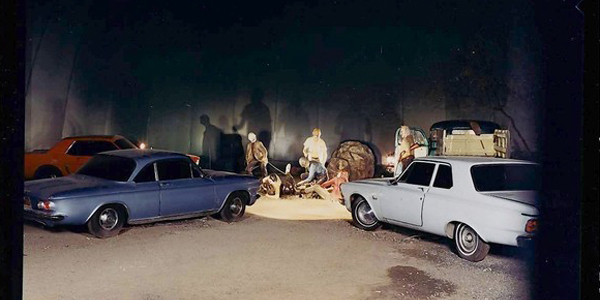
Much of his work has an edge to it but one of his more provocative installations is being re-visited this month in Los Angeles. Kienholz’s infamous Five Car Stud (made somewhere between 1969 and 1972) that depicts a brutally violent racial attack will be seen for the first time in forty years at the Los Angeles County Museum of Art as part of the city-wide Pacific Standard Time event. From the Los Angeles Times:

It is a difficult piece on multiple levels. It is enormous, for one thing: a tableau installation involving nine life-sized figures, five automobiles, several trees and a truckload of dirt. More difficult still is what the piece depicts: a circle of white men, lighted only by the headlights of the circled automobiles, pinning and castrating a lone black man, while a child cowers in one of the cars and a woman — presumably the victim’s companion — huddles and vomits in another.

The white figures are all realistically cast, but for the grotesque rubber masks on each of the men. The black figure’s face is uncannily bifurcated: a clear plastic outer face is frozen in a scream while a darker one within it is “sadly resigned and quiet,” as Kienholz put it in a statement at the time. His torso is made from a rectangular tin filled with black water, in which float letters that spell out a racial slur.

Watch Nancy Reddin Kienholz (his wife and collaborator) install the work:

For more see his galleries: LA Louver and Pace Gallery.

Shop Smart, Shop S-Mart: Evil Dead and Jennifer and Kevin McCoy

Today is the birthday of the amazingly charismatic Bruce Campbell. An icon from 1980s horror cinema, Campbell’s career has been prolific (in addition to tv’s Burn Notice he’s been featured in almost all of Sam Raimi’s films) but he’s firmly cemented in the horror lexicon as ‘Ash’ from the incredibly funny, scary, and entertaining Evil Dead series.

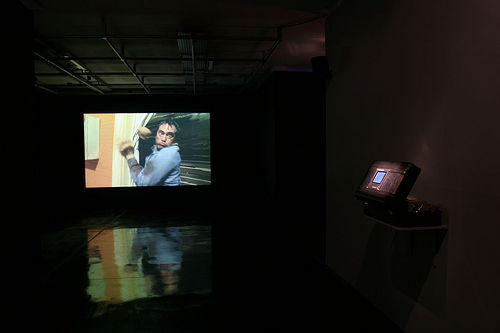
While filmic montage is prevalent amongst those contemporary artists appropriating horror movies, New York based couple and artistic collaborators Jennifer and Kevin McCoy utilize and approach Rami’s Evil Dead 2 (1987) in a very performative way. Inspired by the film that was itself a literal re-make of Evil Dead(1981) – including the same director, plot, and main actor only with a bigger budget – the McCoys’ Horror Chase (2002) is a live computer driven video installation where a series of digitized chase sequences from the film are re-edited and re-presented in real time via the electronics housed in the black suitcase.

Despite the technological inclusion, the work has a tangible architectural and structural element to it as the depicted chase scenes have been laboriously re-constructed by the artists. Replication takes place is many forms. There is the re-made interior of the quintessential ‘cabin in the woods’ in Evil Dead 2 with Kevin McCoy actor Adrian LaTourelle re-enacting Bruce Campbell’s part, the obvious mimic of the movie’s scene/implicit narrative, and then the various random looping supplied by the computers. Of course this re-appropriation is interesting in relation to Evil Dead 2 being a recycled/updated version of the campy original making apparent that Horror Chase uses, re-affirms, and re-projects that compartmentalization in the horror genre by highlighting some of its tropes.

Horror Chase: production design by Roshelle Berliner and shot by Michael McDonough

You can watch Horror Chase online here.