Last Tuesday was a night of celebrating new horror at Nitehawk Cinema and I was thrilled to be a part of it. First, Incognitum Hactenus held a part for the release Living On: Zombies (Vol. 3) with “undead soul” tunes by Dave Tompkins and Jim Shaw’s film The Hole. Then we screened three films I curated (based on video and found footage) by Darren Banks before the New York premiere of Magnolia Picture’s new horror anthology V/H/S. And lastly, we presented Banks’ amazing “tech gone wrong” montage for the after-party. To relive the event, check out the pics…
Category Archives: Horror in art
Living On: Zombies Release Party
The journal I co-edit is having a release party in New York for our latest issue, Living On: Zombies…

INCOGNITUM HACTENUS INVITES YOU TO…
LIVING ON: ZOMBIES RELEASE PARTY
Tuesday, October 2 from 7 – 9pm
Nitehawk Cinema (cafe)
Pre-party for the 9:30pm NY premiere of V/H/S (new horror anthology film released by Magnolia Pictures)
Screening: Jim Shaw’s The Hole (2007)
Spinning: “Undead Soul” by Dave Tompkins
Special horror cocktail: the Corpse Reviver
Stuff: Free digital copies of Living On: Zombies | check out books by contributors
Thanks to Magnolia Pictures, Nitehawk Cinema, Blonde Art Books, Darren Banks, Dave Tompkins, and all of our contributors!
Afterlifers: Walking and Talking
As we’re currently in production for Living On: Zombies (the third volume of Incognitum Hactenus in which we make the position to re-contextualize, consider, and represent the zombie figure), I have zombies on the brain. And this 2004 film Afterlifers: Walking and Talking by Halflifers (artists Torsten Zenas Burns and Anthony M. Discenza) fits the bill, addressing the post-culture life after the pop-culture knowledge of the zombie.
Particularly interesting is their notion of “zombie architecture” or “zombie space” – a existing zone where people and objects “become zombie” – in relation to Shaviro’s term “zombie time” in his “Contagious Allegories” where he says:
The slow meanders of zombie time emerge out of the conventional time of progressive narrative. This strangely empty temporality also corresponds to a new way of looking, a vertiginously passive fascination. The usual relation of audience to protagonist is inverted. Instead of the spectator projecting him-or-herself into the actions unfolding on the screen, an on-screen characters lapses into a quasi-spectatorial position. This is the point at which dread slips into obsession, the moment when unfulfilled threats turn into seductive promises. Fear becomes indistinguishable from an incomprehensible, intense, but objectless craving.
In considering a zombie-space and zombie-time we perhaps might tap into the way in which these narratives fold in on themselves, addressing the fear of the viewer while also basing this fear on an acknowledged fiction. Unable to speak or articulate, the zombie has become the language we use to address the unspeakable: this craving, this need for representation.
The work of Torsten Zenas Burns is currently on view at the Dumbo Arts Center in Brooklyn.
The cabin in the woods: representation and repetition
As I’m writing an essay about the uncanny relationship to Mario Bava’s Planet of the Vampires (1965) and Ridley Scott’s Alien (1979), I’m thinking about the slipages that occur between imitation and homage in creative forms. Where does the impulse come from to manifest a narrative, a style, an atmosphere come from?Where is the boundary border between being on the safe side of homage rather than the evil side of plagiarism? And how does this influence perpetuate the evolvement and dissemination of the horror genre?
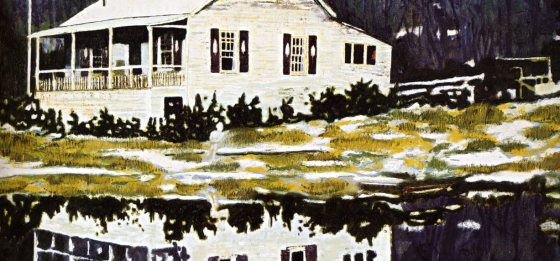
In a collusion of similar thoughts, yesterday I looking at the cabin paintings from the 1990s by Peter Doig. Knowing his interest in horror film, seen in his culling from Friday the 13th (1980) imagery, I’ve tended to draw a correlation to this cabin series and the pervasive use of the isolated cabin in the woods in horror films. The claustrophobia of the forrest, shown frenetically and close up in Doig’s paintings, is situated around the idilic solitude of the house. This notion, of course, tends to explode in horror cinema – man is not safe, not even and especially, in nature.
So as I look to Doig’s “homage/influence” from horror, I noticed that perhaps horror film is producing a mutual admiration. How did I come to think this? Seeing the poster for Drew Goddard’s The Cabin in the Woods (2012) I felt something familiar. There was something about that cabin, mirroring itself, reflection both an above world and a reality below that struck a nerve. Then I remembered Doig’s cabin paintings, his layering on imagery, the spatiality he establishes in his work:
 Peter Doig – Camp Forestia (1996), Oil on canvas
AND THEN…

The similarities between Camp Forestia and The Cabin in the Woods poster suggest that visual art and horror film might just be bouncing ideas (concept and design) off of each other. Intentional or not, this type of intense self-reflexivity means that these ideas about the representation of horror are contagious. My only hope is that there is still room in which to facilitate the production of new generative images and narratives.
Ivan Zulueta – Frank Stein (1972)
Selfishly happy that Ivan Zulueta’s Frank Stein (1972) is back online:
The absorption of the cinematic within Iván Zulueta’s work, Frank Stein and King Kong among them, reacts to the political and social constructs of the 1970s. This is why his version the ‘Frankenstein’ story as subject is so fascinating. Born in the 19th century in a novel by Mary Shelley (Frankenstein 1817), this monstrous tale has been told throughout the decades as a reflection on modern society. In the 1800s, the Frankenstein monster could be read as an allegory on the dangers of scientific explorations or fears of an expanding world. At the dawn of the new decade while the idealism of the 1960s waned, Zulueta’s ‘Frankenstein’ represents the confusion and lapsed innocence of this new world. That Frank Stein is filmed from a television broadcast remarks on the change in media consumption and how its accessibility began to blur the line between information and entertainment. Meaning can seemingly be projected onto this monster in any given era, thereby he perpetually symbolises the recycled, relevant, and rejuvenated spirit of the horror genre.
Josh Azzarella: duration, the familiar, and the cinematic
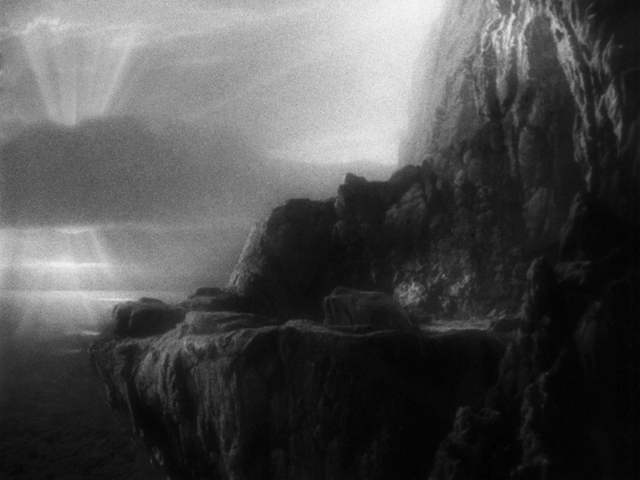 Josh Azzarella is an artist whose moving image works are the result of manipulating known films within popular culture to create an entirely isolated experience. For instance, his breathtakingly immersive Untitled #105 (SFDF) (2009-2011) three-channel installation presses pause on three singular moments within the landscape of King Kong. The work becomes the place where the viewer remains in a perpetual period of waiting for the “monster” to arrive; he never does.
This tension of not-seeing but still knowing expands in Azzarella’s film modification of The Wizard of Oz, Untitled #125 (Hickory) (2009-2011). Admittedly an obsession of his, the familiarity of The Wizard of Oz that is embedded in American culture is profound. From its infamously troublesome production (rumors of suicide, anyone?) to its glorious introduction to technicolor to its popularity through annual television airing, the story of a young girl with dreams who travels to far only to find that what’s important is the love of home is part of America’s narrative. Throughout the world people have seen this film; it’s a universal point of reference.
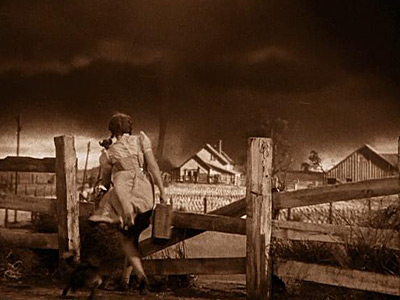 As with Untitled #105 (SFDF) (2009-2011), Untitled #125 (Hickory) makes the familiar obscure. While we cannot detect any development or movement when watching, we are made aware that it is from a 6 1/2 minute excerpt from The Wizard of Oz; encompassing the moment from when the tornado hits until Dorothy emerges into technicolor Oz and meets Glenda the Good Witch. The reason why we cannot see what we know is there is because Azzarella has stretched out cinematic space and time so that this film, his film, is 7200 minutes, approximately the same time of Dorothy’s stay in Oz. Isolating the film to be entirely represented by a single character’s experience, Dorothy, he says:
This work extends a moment of transformative transition (Dorothy’s journey to Oz) to envelop the entire time of her experience. Just as dreams which realistically occur in flashes of seconds in our brains can seem like hours or days, so Dorothy’s hours of unconsciousness take on a five day journey of transformation in Oz.
What Azzarella’s interventionist act does is abstract an image so familiar to us that we can no longer recognize it. The naked eye cannot detect movement. The film becomes unwatchable. And why is this important? Because durational films based on popular cinema (also think of Ivan Zulueta’s Frank Stein and King Kong in the early 1970s along with Douglas Gordon’s 24 hour Psycho and Five Year Drive By in the 1990s) force audiences to re-consider ways of seeing. They challenge what we think we know about narrative structure by inverting the movies we know and love as they morph into something new to critique, consider, and debate. These life of this films actually lives on in these works as both a love letter to the story and provocation regarding the fallacy found in cinema. These artists films reveal and remind us that we see onscreen is never really real.
Watch Untitled #125 (Hickory) Part 1 (preview) here: http://vimeo.com/32951541
Fiona Banner: re-imaging cinema
Joseph Conrad’s novel Heart of Darkness tackles a real horror, one in both the wilds of the jungle and deep inside of man. Imagine, in the eyes of artist Fiona Banner with select designers, if Orson Welles had made the film adaptation in the 1930s through fictionalized posters. The mind wonders and the eye gawks at these stunning representations of a thing that never fully existed. It plays on notions of the unseeable but knowable, a familiar trope in the horror genre.
Orson Welles wrote a screenplay based on Joseph Conrad’s novel Heart of Darkness in the late 1930s. It would have been his first film but it was rejected by the studio RKO, and he went on to make Citizen Kane instead. At the time the script was considered too political, too expensive, and too uncompromising artistically, not to mention narrative parallels with the rise of fascism in Europe. Today other parallels are drawn. – from Artangel’s “A Room for London” program, watch the performance of the script here.
Here are some of my favorite mages from her current exhibition Unboxing: the greatest film never made at 1301PE Gallery in Los Angeles:


The Greatest Film Never Made (Fiona Banner and Name Creative), 2012
Graphite on paper

The Greatest Film Never Made (Fiona Banner and Empire Design), 2012
Graphite on paper
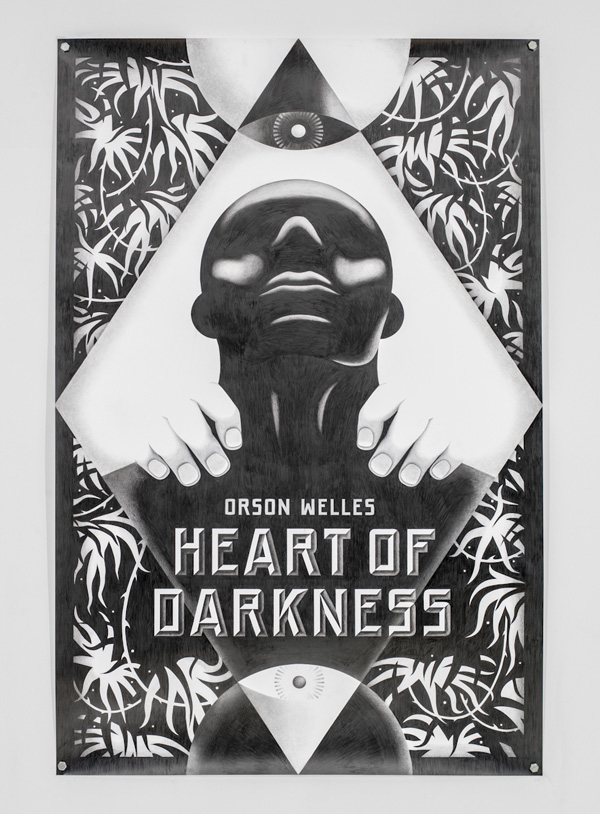 The Greatest Film Never Made (Fiona Banner and La Boca), 2012
Graphite on paper
View more images along with installation images here.
Our world of zombies: Jim Shaw and Evan Calder Williams

I’ve been reading Evan Calder Williams’ book Combined and Uneven Apocalypse: Luciferian Marxism in which he relates capitalism’s most recent fall to the allegorical representation of the post-apocalypse in horror and science-fiction film. Williams proposes we search for new horizons in the face of the end of the world; one where the emergence of new possibilities faces off with humanity’s seemingly repetitive nature. Naturally, the zombie film encompasses a good portion of Williams’ exploration. And when considering his evaluation of the genre’s relationship to a capitalist society, I cannot help but think of The Hole (2007) by Los Angeles artist Jim Shaw.
Shaw’s first fictional feature, The Hole “…appears as an O-ist horror movie. In it, a new female convert to the religion, peering through a hole in her apartment wall, discovers a parallel world where zombies stroll in an ill-defined “somewhere”, beyond which space becomes abstracted.” Here, the space between the living “normal” world and the endless repetition of the continuous living in “zombie” world collapse, meeting through a hole in a wall in a domestic space. The zombies, all men, are dressed in suits aimlessly wandering, slightly bumping into each other. A close up into the zombie nerve center reveals the “brain” is a fuzzy television-like portal (Dani Tull’s soundrack is incredible), providing us an abstracted account of what goes on in the mind of the mindless. The film suggests a parallel world of zombies to our own, prompting the question of how do we look, evaluate, adapt, and change our own end of the world that’s so near by?
To consider this further, provided below is an excerpt of The Hole combined with excerpts from Williams’ book.
http://www.dailymotion.com/video/xfb6nl_the-hole_creation
Combine and Uneven Apocalypse: Luciferian Marxism:
This is particularly of what the figure of the zombie does and its position in the mass culture of capitalism. It thinks how real abstractions work on real bodies, of the nastiest intersections of the law of value and the law of inevitable decay. (page 80)
In this way, zombie films are not about the living dead, at least not in any direct way. They are about the undying living. They are about surplus-life, the new logic of excessive existence: something has given us all too-much-life, an inability to properly die in a system that no longer knows how or when to quit. (page 92)
Following and moving out from Lacan, we could say that anxiety is never about the radically new but rather about the horrible possibility of the same persisting…Anxiety emerges with the creeping realization that there may be no lack, no space in which to move, leaving us crushed by the awful possible certainty of knowing how things are and knowing that they will remain that way. (page 101)
The anxiety proper to zombie films is the deep horror of something not being different, of everyone remaining as limited a category as we know it to be, of the same persisting, of the end of death and lack…People are not consumers because they are scared of change. They are scared of change because they are consumers. (page 103)
It’s about labor. It’s never been about consumerism gone bad, but the lost heritage of the zombie film, the horror from more Haitian origins: of being forced to work, of knowing that “choosing” to sell one’s labor has never been a choice, just a particularly nasty illusion of free will. (page 105)
…the innovation – and perhaps the underlying horror – is not just “how horrible to be killed and brought back to life as a slave” but: what if our past is never forgotten? Not remembered by historians or marked into the very landscape and bodies of the colonies, but smuggled back in, dark knowledge too powerful to be lost and too tempting for capitalism to ignore (page 111)
Image: The Hole zombie stills (2007)
Cry Me a River: Darren Banks’ I’m sure if there were a monster in the midlands we would have seen it on the telly
For the Gods and Monsters issue of Incognitum Hactenus, I wrote the following text on Darren Banks’ 2011 video piece I’m sure if there were a monster in the midlands we would have seen it on the telly. Watch the video here.

Cry Me a River: Darren Banks’ I’m sure if there were a monster in the midlands we would have seen it on the telly
Sweeping aerial shots, panoramic images of rivers and lakes, and close-ups that push outward towards barren landscapes, Darren Banks’ I’m sure if there were a monster in the midlands we would have seen it on the telly shows nearly every possible way of looking and experiencing the forest as a literal outsider. It is an examination of non-places, obscure in their absence of the human, begging the questions: What lurks beneath? Who is hiding in the shadows? Why is this nothingness so frightful? In this world abandoned by people, I’m sure if… becomes a cinematic spectral space in its depiction of the world without us but a site where our fears are still very much present.
The conglomeration of numerous outdoor scenes from horror movies in I’m sure if there were a monster in the midlands we would have seen it on the telly establishes a singular, large-scale, atmospheric landscape; a filmic version of Frankenstein’s monster through sourcing the benign body parts from Twitch of the Death Nerve (1971), The Burning (1981), Antichrist (2009), and The Wicker Man (1973) amongst nearly twenty others. Further referencing horror history, Banks gleans the title from the hospital sequence in John Landis’ An American Werewolf in London (1981) in which the doctor refuses the boy’s claims that a wolf has attacked him saying that if it were true then it would be on television. Banks therefore positions our culture’s submissive reliance on media sources to collectively prove/disprove facts and fictions above our ability to trust our inherent knowledge of the world. Allegorically this gets to the heart of “man” in that desire to rely on our instincts while maintaining to control the sleeping animal/monster buried within each of us (Dr. Jekyll and Mr. Hyde and George A. Romero’s Dead series).
However, any literal representation of the “monster” is denied in Banks’ version. The “telly” is not proving to us that it exists. Instead, the figure of the “monster” is implied strictly through the landscape and through the omission of any human presence or any significant action. These multiple and disparate landscapes are at once peaceful and foreboding, familiar (through the recognition of films) and strange (a world for us, but not with us). Therefore, while we don’t see anything or anyone we can still sense that something is amiss. Whom or what can we trust? Visualizing this liminal boundary between a place of sanctuary and terror through the manipulation of media sources (and Banks does this throughout his body of work) he establishes a productive tension. This tension works precisely because the concealed yet explicit absence constructed through television, film, and music ultimately becomes a revelation of the unrepresented.
I’m sure if there were a monster in the midlands we would have seen it on the telly subscribes to influential producer Val Lewton’s theory that the simplest suggestion of horror onscreen will ignite the audience’s imagination to conjure up something far more horrific than could ever be physically represented. Think of Jacques Tourneur’s Cat People and Steven Spielberg’s Jaws. Like any good old-fashioned horror narrative, Banks’ video relies on editorial selection, suggestion, and sound to cultivate the necessary and desired feeling of dread within the viewers. This visual journey through the “midlands” is a guided one where the framework Banks employs allows us to be privy to this world, experiencing it through his exacting means, but ultimately at a safe distance.
Raed Yassin – Horror is Universal (The End)
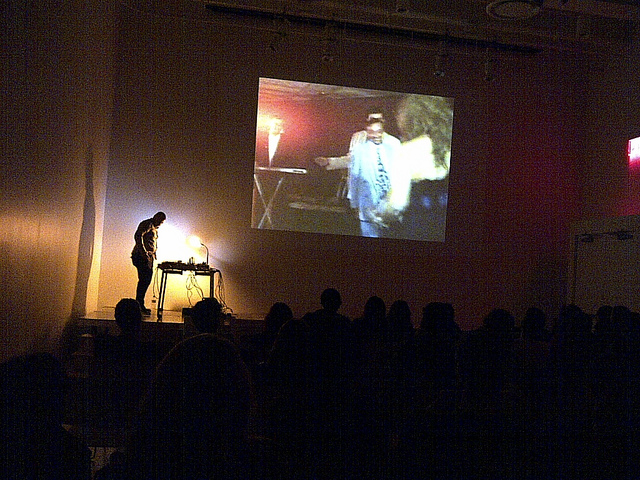
Last month I attended Raed Yassin’s performance and video Horror is Universal (The End), part of the Beirut Art Center’s Museum as Hub at the New Museum. A visual and sonic mash-up of 1970-80s Egyptian B-movie and Arabic music, Horror is Universal (The End) did not so much show the horrific as it did imply that the framework in which we associate horror (tension, camp, atmosphere) can still be constructed with references outside of mainstream U.S. and Europe.
For the last eight years, Raed Yassin has been undergoing a lifelong project of deconstructing Arab popular culture by sampling audio and visual material from TV, radio, pop songs, and feature films. “Horror is Universal” (The End) is considered a milestone in his evolving oeuvre: a multimedia saga performed live by the artist, it involves mixing and rearranging video extracts from dozens of ’80s Egyptian B-movies on screen, while spinning vintage LPs of popular Arabic music and incorporating electronic instrumentation and singing, to create a unique yet disturbing soundtrack progressing towards a chilling finale. It is, in essence, an attempt at fabricating a non-existent genre in twentieth-century Egyptian cinema—horror—by splicing together the viewers’ collective memory of those all too familiar ‘scary moments’ reenacted by the cheap cinematic production of yesteryear.
 THE GIRL WHO KNEW TOO MUCH