Fiona Banner: re-imaging cinema

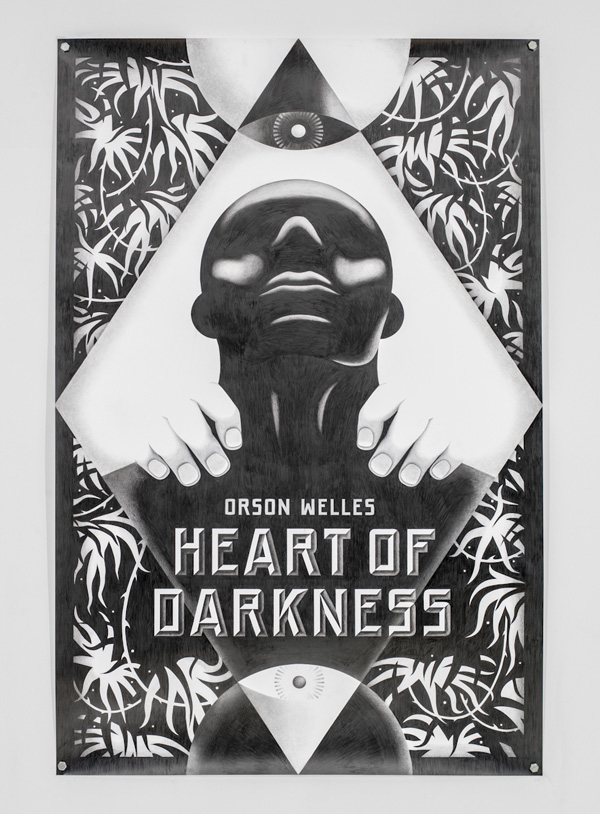
Joseph Conrad’s novel Heart of Darkness tackles a real horror, one in both the wilds of the jungle and deep inside of man. Imagine, in the eyes of artist Fiona Banner with select designers, if Orson Welles had made the film adaptation in the 1930s through fictionalized posters. The mind wonders and the eye gawks at these stunning representations of a thing that never fully existed. It plays on notions of the unseeable but knowable, a familiar trope in the horror genre.

Orson Welles wrote a screenplay based on Joseph Conrad’s novel Heart of Darkness in the late 1930s. It would have been his first film but it was rejected by the studio RKO, and he went on to make Citizen Kane instead. At the time the script was considered too political, too expensive, and too uncompromising artistically, not to mention narrative parallels with the rise of fascism in Europe. Today other parallels are drawn. – from Artangel’s “A Room for London” program, watch the performance of the script here. 

Here are some of my favorite mages from her current exhibition Unboxing: the greatest film never made at 1301PE Gallery in Los Angeles:

The Greatest Film Never Made (Fiona Banner and Name Creative), 2012
Graphite on paper


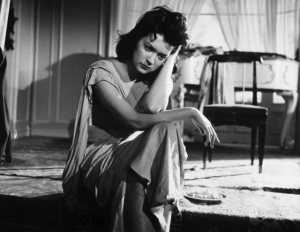
The Greatest Film Never Made (Fiona Banner and Empire Design), 2012
Graphite on paper

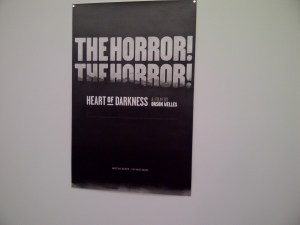
The Greatest Film Never Made (Fiona Banner and La Boca), 2012
Graphite on paper

View more images along with installation images here.

Recent writings on horror films

Below is a link compilation of recent writings on horror films that I’ve published on Nitehawk Cinema’s blog, Hatched (where I’m co-editor). Many of these texts correspond to the monthly VHS screenings I co-curate at Nitehawk. Click each title to read the essay in its entirety. 

The Collective Monstrosity of The Texas Chainsaw Massacre
The Texas Chainsaw Massacre
 is one of a handful of films that punctuate the very life-blood of cinematic history. Intensely brutal with very little reprieve or consideration for the audience, Texas Chainsaw Massacre came out of a rift of a socio-cultural framework, bursting onscreen with the evisceration of the family structure, youth culture, and cultural fragility in a post-Vietnam United States…

VHS Vault: Tobe Hooper’s Eaten Alive
Everything and everyone in Tobe Hooper’s Eaten Alive looks like it/they need a good, long, hard scrub. The dingy dwellings, saturated coloring, and hazy lighting make an atmosphere that mimics each character’s dirtiness (both inside and out) as well as their visceral insanity.  No one here, aside from the little girl and poor pooch, is pure: sex, killing, stealing. Eaten Alive is where vice meets its crocodilian end…

VHS Vault: Flesh for Frankenstein 
Dr. Frankenstein and his monstrous creation (often miscalled “Frankenstein”) have seen many iterations of themselves since Mary Shelley first wrote her gothic novelFrankenstein in 1818. Morphing through mediums of literature, theater, film and then television series, commercials, cereals, etc., the “monster” has become the very essence of re-generation – from his “birth” to his cultural evolvement…

VHS Vault: The Exterminating Angel
Luis Buñuel’s The Exterminating Angel reveals the slow and sudden unraveling of upper society as they experience an isolated apocalypse in their party hosts’ dining room. Like in other post-apocalyptic movie (zombie, nuclear, vampiric), the unwilling residents of this unknown disaster go through stages of discovery, collaboration, segregation, degradation, and death. Only here, there are no explanations and no reasonable revelations. Buñuel’s beautifully surreal depiction of the decline of bourgeoisie civilization remains unsolved, unknowable, and unexplainable…

Our world of zombies: Jim Shaw and Evan Calder Williams

I’ve been reading Evan Calder Williams’ book Combined and Uneven Apocalypse: Luciferian Marxism in which he relates capitalism’s most recent fall to the allegorical representation of the post-apocalypse in horror and science-fiction film. Williams proposes we search for new horizons in the face of the end of the world; one where the emergence of new possibilities faces off with humanity’s seemingly repetitive nature. Naturally, the zombie film encompasses a good portion of Williams’ exploration. And when considering his evaluation of the genre’s relationship to a capitalist society, I cannot help but think of The Hole (2007) by Los Angeles artist Jim Shaw.

Shaw’s first fictional feature, The Hole “…appears as an O-ist horror movie. In it, a new female convert to the religion, peering through a hole in her apartment wall, discovers a parallel world where zombies stroll in an ill-defined “somewhere”, beyond which space becomes abstracted.” Here, the space between the living “normal” world and the endless repetition of the continuous living in “zombie” world collapse, meeting through a hole in a wall in a domestic space. The zombies, all men, are dressed in suits aimlessly wandering, slightly bumping into each other. A close up into the zombie nerve center reveals the “brain” is a fuzzy television-like portal (Dani Tull’s soundrack is incredible), providing us an abstracted account of what goes on in the mind of the mindless. The film suggests a parallel world of zombies to our own, prompting the question of how do we look, evaluate, adapt, and change our own end of the world that’s so near by?

To consider this further, provided below is an excerpt of The Hole combined with excerpts from Williams’ book. 

http://www.dailymotion.com/video/xfb6nl_the-hole_creation

Combine and Uneven Apocalypse: Luciferian Marxism:

This is particularly of what the figure of the zombie does and its position in the mass culture of capitalism. It thinks how real abstractions work on real bodies, of the nastiest intersections of the law of value and the law of inevitable decay. (page 80)

In this way, zombie films are not about the living dead, at least not in any direct way. They are about the undying living. They are about surplus-life, the new logic of excessive existence: something has given us all too-much-life, an inability to properly die in a system that no longer knows how or when to quit. (page 92)

Following and moving out from Lacan, we could say that anxiety is never about the radically new but rather about the horrible possibility of the same persisting…Anxiety emerges with the creeping realization that there may be no lack, no space in which to move, leaving us crushed by the awful possible certainty of knowing how things are and knowing that they will remain that way. (page 101)

The anxiety proper to zombie films is the deep horror of something not being different, of everyone remaining as limited a category as we know it to be, of the same persisting, of the end of death and lack…People are not consumers because they are scared of change. They are scared of change because they are consumers. (page 103)

It’s about labor. It’s never been about consumerism gone bad, but the lost heritage of the zombie film, the horror from more Haitian origins: of being forced to work, of knowing that “choosing” to sell one’s labor has never been a choice, just a particularly nasty illusion of free will. (page 105)

…the innovation – and perhaps the underlying horror – is not just “how horrible to be killed and brought back to life as a slave” but: what if our past is never forgotten? Not remembered by historians or marked into the very landscape and bodies of the colonies, but smuggled back in, dark knowledge too powerful to be lost and too tempting for capitalism to ignore (page 111) 

Image: The Hole zombie stills (2007)

The darkness of Frieze

Going through my camera after Frieze (a substitute for a forgotten pen), I noticed how the artworks I liked share in some serious darkness. This choice is aesthetic shouldn’t be a surprise. 

Fiona Banner and Empire Design – The Greatest Film Never Made (2012)
Graphite on paper
@ Frifth Street Gallery
Welles, real horror, and dream cinema 

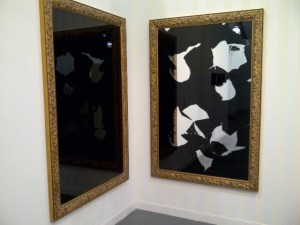
Michelangelo Pistoletto – Two Less, One Black (2011)
Black and silver mirror, golden wood
@ Galleria Continua 
Black abyss, eternal reflection, the unknowable

Gary Simmons – Through the Mist (Ghost…), 2012
Oil on canvas
@ Metro Pictures
Haunting, frenzy, through time

Lari Pitman – How Sweet the Day After (1988)
Acrylic and enamel on panel
@ Regen Projects
Conglomeration of history

Incognitum Hactenus – Call for submissions

OPEN CALL FOR SUBMISSION
Living On: Zombies

Incognitum Hactenus is re-thinking the zombie.

The release of George A. Romero’s Night of the Living Dead in 1968 solidified our cultural awareness of what a zombie was and marked the beginning of the zombie film as a staple of Hollywood storytelling. Now a (regenerative) genre unto itself, the zombie movie invariably sees a band of survivors escaping from hordes of the undead, re-animated corpses limping mindlessly across desolated, post-apocalyptic landscapes that used to be our homes. Defined in part as a response to late capitalism, the zombie has come to represent humanity’s mindless consumerism, as in Romero’s second, and genre defining zombie movie Dawn of the Dead (1978), religious zealotry, the end of civilization, anxiety about our reliance on corporate medicine’s experimentation, 28 Days Later and 28 Weeks Later (2002 & 2007), conservative America’s racism, homophobia or general bigotry and so on.

In the next issue of Incognitum Hactenus – Living On: Zombies – we want to think beyond this narrow category to a beyond, to a realm of post-contemporaneity where the zombie, instead of being a figure of Romantic critique, is seen in a new light. This will be a double-death, the Romantic Zombie dies to make way for the Post-Contemporary Zombie. It is our claim that a rethinking of the zombie in this way produces new languages that can talk about, amongst other things, art beyond the current moment. Post-contemporary art and the Post-Contemporary Zombie stumble hand in hand into a new world. Happy writing.

Open call: if you are interested in contributing to Living On: Zombies please send a 200 word abstract to both editors: tom.trevatt@hotmail.com and caryn@caryncoleman.com. Please note that not all submissions will be accepted for publication.

Cry Me a River: Darren Banks’ I’m sure if there were a monster in the midlands we would have seen it on the telly

For the Gods and Monsters issue of Incognitum Hactenus, I wrote the following text on Darren Banks’ 2011 video piece I’m sure if there were a monster in the midlands we would have seen it on the telly. Watch the video here. 

Cry Me a River: Darren Banks’ I’m sure if there were a monster in the midlands we would have seen it on the telly

Sweeping aerial shots, panoramic images of rivers and lakes, and close-ups that push outward towards barren landscapes, Darren Banks’ I’m sure if there were a monster in the midlands we would have seen it on the telly shows nearly every possible way of looking and experiencing the forest as a literal outsider. It is an examination of non-places, obscure in their absence of the human, begging the questions: What lurks beneath? Who is hiding in the shadows? Why is this nothingness so frightful? In this world abandoned by people, I’m sure if… becomes a cinematic spectral space in its depiction of the world without us but a site where our fears are still very much present.

The conglomeration of numerous outdoor scenes from horror movies in I’m sure if there were a monster in the midlands we would have seen it on the telly establishes a singular, large-scale, atmospheric landscape; a filmic version of Frankenstein’s monster through sourcing the benign body parts from Twitch of the Death Nerve (1971), The Burning (1981), Antichrist (2009), and The Wicker Man (1973) amongst nearly twenty others. Further referencing horror history, Banks gleans the title from the hospital sequence in John Landis’ An American Werewolf in London (1981) in which the doctor refuses the boy’s claims that a wolf has attacked him saying that if it were true then it would be on television. Banks therefore positions our culture’s submissive reliance on media sources to collectively prove/disprove facts and fictions above our ability to trust our inherent knowledge of the world. Allegorically this gets to the heart of “man” in that desire to rely on our instincts while maintaining to control the sleeping animal/monster buried within each of us (Dr. Jekyll and Mr. Hyde and George A. Romero’s Dead series).

However, any literal representation of the “monster” is denied in Banks’ version. The “telly” is not proving to us that it exists. Instead, the figure of the “monster” is implied strictly through the landscape and through the omission of any human presence or any significant action. These multiple and disparate landscapes are at once peaceful and foreboding, familiar (through the recognition of films) and strange (a world for us, but not with us). Therefore, while we don’t see anything or anyone we can still sense that something is amiss. Whom or what can we trust? Visualizing this liminal boundary between a place of sanctuary and terror through the manipulation of media sources (and Banks does this throughout his body of work) he establishes a productive tension. This tension works precisely because the concealed yet explicit absence constructed through television, film, and music ultimately becomes a revelation of the unrepresented.

I’m sure if there were a monster in the midlands we would have seen it on the telly subscribes to influential producer Val Lewton’s theory that the simplest suggestion of horror onscreen will ignite the audience’s imagination to conjure up something far more horrific than could ever be physically represented. Think of Jacques Tourneur’s Cat People and Steven Spielberg’s Jaws. Like any good old-fashioned horror narrative, Banks’ video relies on editorial selection, suggestion, and sound to cultivate the necessary and desired feeling of dread within the viewers. This visual journey through the “midlands” is a guided one where the framework Banks employs allows us to be privy to this world, experiencing it through his exacting means, but ultimately at a safe distance.

Malcolm Le Grice’s “Horror Film 1”

The Henry Moore Institute in Leeds’ United Enemies film screening series explores “how artists in the 1960s and 1970s deployed sculpture in film, as well as using film to rethink sculpture”. As part of this they presented Malcolm Le Grice’s Horror Film 1 (1971) where, once again, we can consider horror film as a structure. Or perhaps even sculpture.

From LUX’s website:

All are superimposed on each other with the projectors aimed from different angles. The superimpositions create a continually changing colour light mix. I interrupt the beam with a series of formal actions creating a complex set of coloured shadows. The final section involves focusing a pair of skeleton hands onto the screen in relationship to my own hands. The intention with this as with my other shadow pieces, is to build a complex visual experience out of simple and readily available aspects of the projection situation. M.L.G. from ‘Real Time/Space’, Art and Artists Dec 1972.

“One of his most simple, most classical, and also most ecstatic pieces”. Jonas Mekas, Village Voice, Oct 11th 1973.

More recent versions of Horror Film 1 have been performed without the final section containing the skeleton hands and with the use of three projectors.

Malcolm Le Grice
Horror Film 1 (1971)
14mins Colour
Performance with slide projector, two film projectors

Raed Yassin – Horror is Universal (The End)

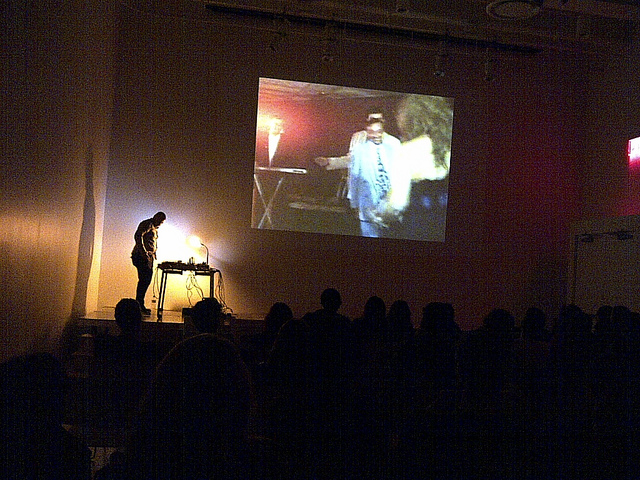
Last month I attended Raed Yassin’s performance and video Horror is Universal (The End), part of the Beirut Art Center’s Museum as Hub at the New Museum. A visual and sonic mash-up of 1970-80s Egyptian B-movie and Arabic music, Horror is Universal (The End) did not so much show the horrific as it did imply that the framework in which we associate horror (tension, camp, atmosphere) can still be constructed with references outside of mainstream U.S. and Europe.

For the last eight years, Raed Yassin has been undergoing a lifelong project of deconstructing Arab popular culture by sampling audio and visual material from TV, radio, pop songs, and feature films. “Horror is Universal” (The End) is considered a milestone in his evolving oeuvre: a multimedia saga performed live by the artist, it involves mixing and rearranging video extracts from dozens of ’80s Egyptian B-movies on screen, while spinning vintage LPs of popular Arabic music and incorporating electronic instrumentation and singing, to create a unique yet disturbing soundtrack progressing towards a chilling finale. It is, in essence, an attempt at fabricating a non-existent genre in twentieth-century Egyptian cinema—horror—by splicing together the viewers’ collective memory of those all too familiar ‘scary moments’ reenacted by the cheap cinematic production of yesteryear.

“Bring Your Daughter to the Slaughter: witchcraft, women, and domesticity in Horror Hotel”

My latest essay for Network Awesome Magazine where I discuss the role of women in relation to historical witchcraft and domesticity in the 1960 Christopher Lee-starring “classic” Horror Hotel. Appropriately, the title is derived from the Iron Maiden song in which the video featured clips from the film.

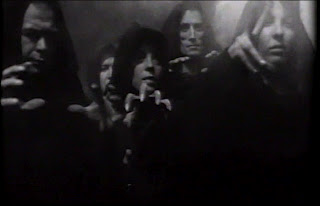
Witchcraft is alive and thriving in the small town of Whitewood in which the atmospheric 1960 film Horror Hotel or City of the Dead (John Llewellyn Moxey) is set. From prosecuting women as witches to exploiting traditional gender roles prescribed to women in the early 1960s (sister, girlfriend, caretaker), Horror Hotel begins in the 17th century with the rather gruesome burning of condemned head-witch Elizabeth Selwyn. This opening scenic depiction of a witch and her relationship with the devil is strikingly similar to Mario Bava’s Mask of Satan/Black Sunday (1960), however this story is deeply rooted within the Puritanical history of the United States and, in particular, the terrifying witch trials that targeted young women in Salem, Massachusetts in 1692. Like Black Sunday but unlike the Salem witch trails, the witches in Horror Hotel are all too real and their devotion to Satan means trouble that spans the centuries.

Obsessed with researching the history of witchcraft in New England for her term paper, college student Nan Barlow (Venetia Stephenson) ventures off to Whitewood per the suggestion of her stoic professor Alan Driscoll (played by the scene-stealing Christopher Lee). Stubborn and strong willed, Nan dismiss the concerns of both her boyfriend and brother on the quest to discover something about Satanic worship that has never been known before. Combined with her somewhat condescending approach to the small town, this pretentious ambition to be a scholarly researcher is the core of her naiveté. Nan’s lack of common sense and the inability to gauge her surroundings ultimately leads her to a bloody sacrificial demise on the infamous Candlemas Eve.

Nan’s journey within Horror Hotel parallels, in some ways, that of Marion Crane (Janet Lee) in Alfred Hitchcock’s seminal thriller, Psycho, that was also released in the 1960. Both narratives exploit gender roles and feature a determined blonde who thinks she knows better than everyone else, striking out on her own, and who ultimately winds up paying for this bull-headedness with her life. Similarly, the audience main identification is with Nan for half of the film – her journey is our journey – as it is with Marion Crane. When each character is brutally killed (both young women are stabbed), the directors make it clear that anyone is fair game for the slaughter.

READ THE REST HERE ON NETWORK AWESOME

Let’s Talk Turkey: Bad Taste and Blood Freak

Had a blast writing this piece on Blood Freak (1972) for Network Awesome’s Thanksgiving weekend program…

To me, bad taste is what entertainment is all about…but one must remember that there is such a thing as good bad taste and bad bad taste…To understand bad taste one must have very good taste. Good bad taste can be creatively nauseating but must, at the same time, appeal to the especially twisted sense of humor, which is anything but universal. – John Waters, Shock Value

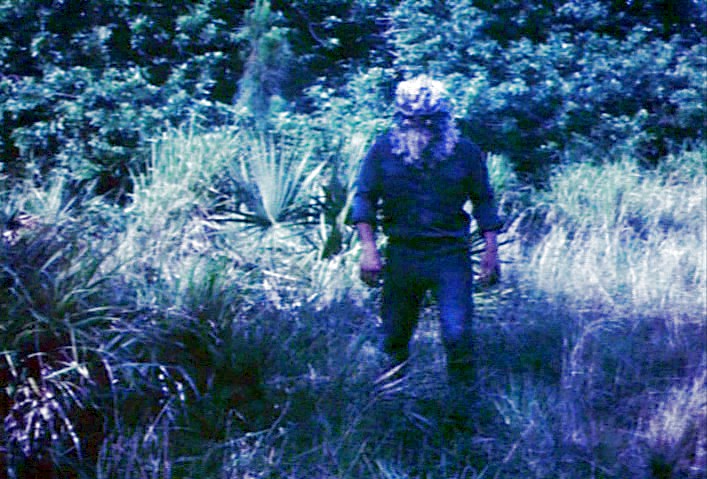
Based on John Waters’ definition of “good” versus “bad” bad taste, it would be fair to say that the 1972 ludicrous quasi-morality tale on consumption (drugs, the bible, turkey, women) Blood Freak (Brad F. Grinter and Steve Hawks) falls into the latter category of bad, really bad, taste. Not that it’s exceptionally gory or gratuitous or offensive but just that it is horribly produced, horrendously acted, and has appalling dialogue. Yet still (!), Blood Freak is damn entertaining. Most likely this is because it fulfills a nostalgic desire to watch one of the worst movies ever made and to gleefully relish in its kitsch factor. Or perhaps the classic tale of a muscle-man-turned-drug-addicted-killer-turkey-man is a story for the ages.

To be completely honest, Blood Freak is a nearly indescribable film that truly must be watched to believe. But before you do, here’s a little breakdown…READ THE REST OF IT ON NETWORK AWESOME