Three Films at Once: Shocking Representation at DAC

Shocking Representation.

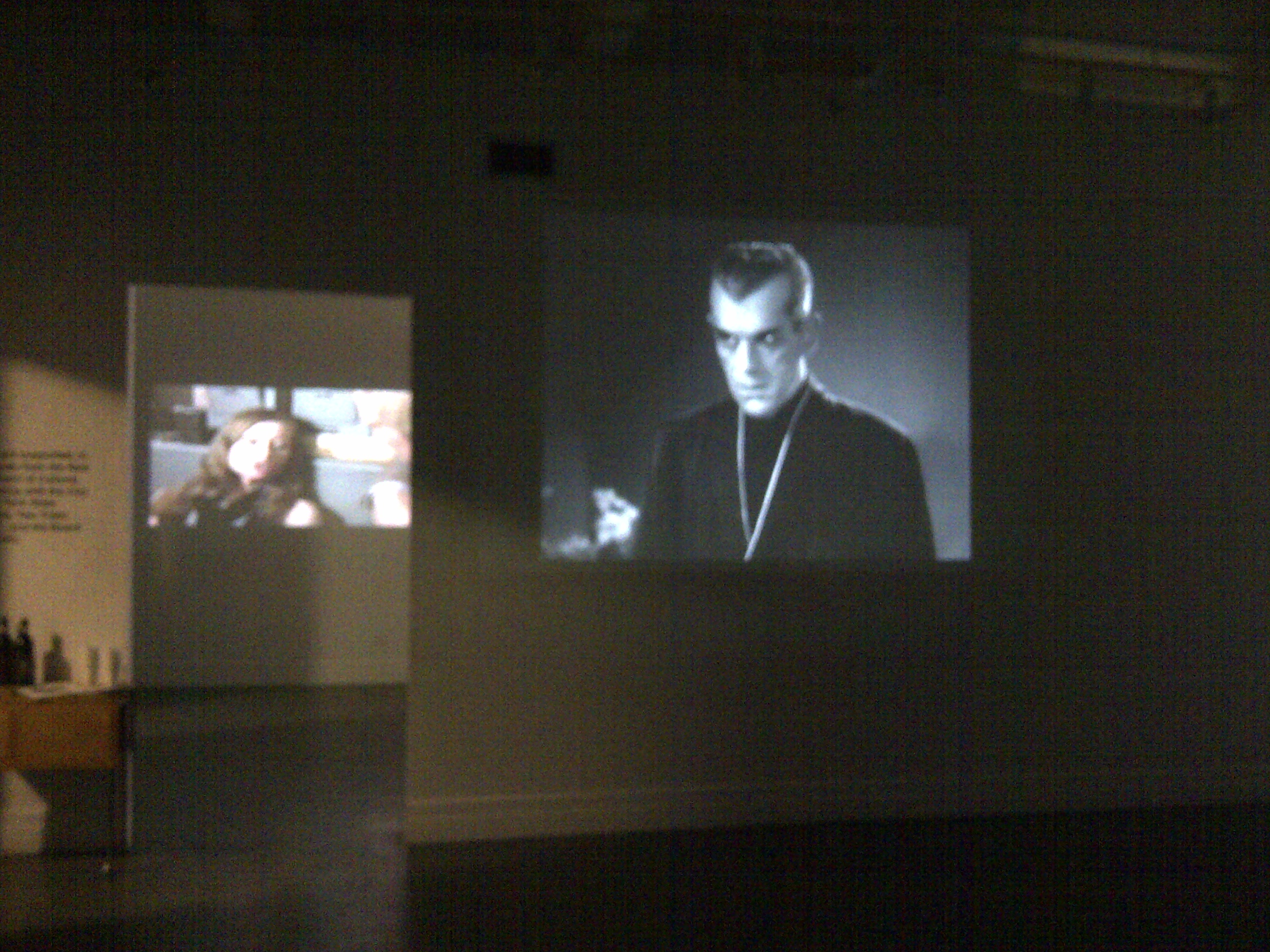
Via invitation from Dumbo Arts Center, on Thursday (September 6) I presented a one-night event in support of my upcoming February exhibition at DA On the Desperate Edge of Now (historical trauma in horror film and contemporary art ) with Heather Cantrell, Folkert de Jong, Marnie Weber, and Joachim Koester.

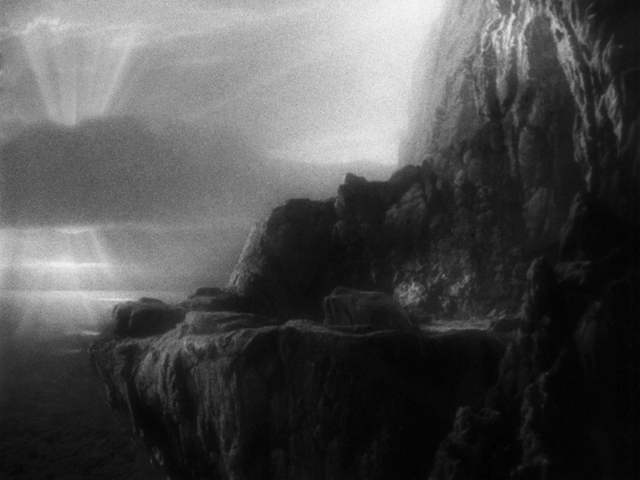
On view was a simultaneous play of three horror films – Edgar G. Ulmer’s The Black Cat (1934), Bob Clark’s Deathdream or Dead of Night (1974), and the documentary The American Nightmare (2000) – merging social, political, and cinematic history into one monstrous audio-visual experience. 
 
The “screening” lasted for three hours during the Dumbo Art Walk. People came in, some stayed, some talked about the impact of these films culturally, others questioned if this was art to be hung on the walls of their home. But mostly, the ghosts of cinema floated on the wall, floating between the past and the future, in-and-out of sync, telling us stories from beyond the grave. 

Behind the knife: horror versus terror

Differentiation by Evan Calder Williams between horror and terror that reflects both a representational turn (in terms of genre) and in real-life manifestations. Horror is repetitive, recyclable, unending, instructive.

Terror is about the threat to life, the knife behind you. Horror, conversely, is about the threat to understanding, of living to see the after-effects of suddenly realizing you were behind the knife all along. In this way, horror is apocalyptic. It confronts us with the symptoms – and with our complicity in reproducing them – and demands that we find new sets of instructions. – Evan Calder Willams, Combined and Uneven Apocalypse, pg. 226.

Afterlifers: Walking and Talking

As we’re currently in production for Living On: Zombies (the third volume of Incognitum Hactenus in which we make the position to re-contextualize, consider, and represent the zombie figure), I have zombies on the brain. And this 2004 film Afterlifers: Walking and Talking by Halflifers (artists Torsten Zenas Burns and Anthony M. Discenza) fits the bill, addressing the post-culture life after the pop-culture knowledge of the zombie. 

Particularly interesting is their notion of “zombie architecture” or “zombie space”  – a existing zone where people and objects “become zombie” – in relation to Shaviro’s term “zombie time” in his “Contagious Allegories” where he says:

The slow meanders of zombie time emerge out of the conventional time of progressive narrative. This strangely empty temporality also corresponds to a new way of looking, a vertiginously passive fascination. The usual relation of audience to protagonist is inverted. Instead of the spectator projecting him-or-herself into the actions unfolding on the screen, an on-screen characters lapses into a quasi-spectatorial position. This is the point at which dread slips into obsession, the moment when unfulfilled threats turn into seductive promises. Fear becomes indistinguishable from an incomprehensible, intense, but objectless craving.

In considering a zombie-space and zombie-time we perhaps might tap into the way in which these narratives fold in on themselves, addressing the fear of the viewer while also basing this fear on an acknowledged fiction. Unable to speak or articulate, the zombie has become the language we use to address the unspeakable: this craving, this need for representation. 

The work of Torsten Zenas Burns is currently on view at the Dumbo Arts Center in Brooklyn.

The cabin in the woods: representation and repetition

As I’m writing an essay about the uncanny relationship to Mario Bava’s Planet of the Vampires (1965) and Ridley Scott’s Alien (1979), I’m thinking about the slipages that occur between imitation and homage in creative forms. Where does the impulse come from to manifest a narrative, a style, an atmosphere come from?Where is the boundary border between being on the safe side of homage rather than the evil side of plagiarism? And how does this influence perpetuate the evolvement and dissemination of the horror genre?

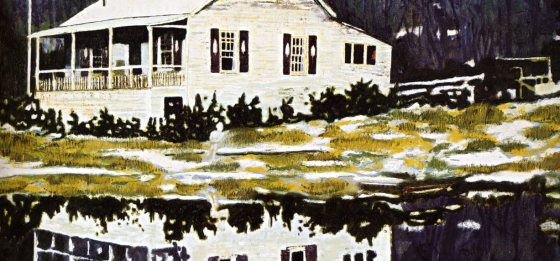
In a collusion of similar thoughts, yesterday I looking at the cabin paintings from the 1990s by Peter Doig. Knowing his interest in horror film, seen in his culling from Friday the 13th (1980) imagery, I’ve tended to draw a correlation to this cabin series and the pervasive use of the isolated cabin in the woods in horror films. The claustrophobia of the forrest, shown frenetically and close up in Doig’s paintings, is situated around the idilic solitude of the house. This notion, of course, tends to explode in horror cinema – man is not safe, not even and especially, in nature. 

So as I look to Doig’s “homage/influence” from horror, I noticed that perhaps horror film is producing a mutual admiration. How did I come to think this? Seeing the poster for Drew Goddard’s The Cabin in the Woods (2012) I felt something familiar. There was something about that cabin, mirroring itself, reflection both an above world and a reality below that struck a nerve. Then I remembered Doig’s cabin paintings, his layering on imagery, the spatiality he establishes in his work:
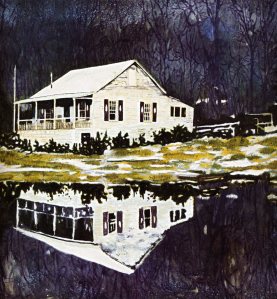
Peter Doig – Camp Forestia (1996), Oil on canvas

AND THEN…

The similarities between Camp Forestia and The Cabin in the Woods poster suggest that visual art and horror film might just be bouncing ideas (concept and design) off of each other. Intentional or not, this type of intense self-reflexivity means that these ideas about the representation of horror are contagious. My only hope is that there is still room in which to facilitate the production of new generative images and narratives. 
Ivan Zulueta – Frank Stein (1972)

Selfishly happy that Ivan Zulueta’s Frank Stein (1972) is back online:

The absorption of the cinematic within Iván Zulueta’s work, Frank Stein and King Kong among them, reacts to the political and social constructs of the 1970s. This is why his version the ‘Frankenstein’ story as subject is so fascinating. Born in the 19th century in a novel by Mary Shelley (Frankenstein 1817), this monstrous tale has been told throughout the decades as a reflection on modern society. In the 1800s, the Frankenstein monster could be read as an allegory on the dangers of scientific explorations or fears of an expanding world. At the dawn of the new decade while the idealism of the 1960s waned, Zulueta’s ‘Frankenstein’ represents the confusion and lapsed innocence of this new world. That Frank Stein is filmed from a television broadcast remarks on the change in media consumption and how its accessibility began to blur the line between information and entertainment. Meaning can seemingly be projected onto this monster in any given era, thereby he perpetually symbolises the recycled, relevant, and rejuvenated spirit of the horror genre.

Future of Film as a Subversive Act

When Amos Vogel (co-founder of the New York Film Festival and Cinema 16) passed away in April at the age of 91, I felt a great loss for culture. Perhaps though, with a re-emergence and re-interest in his legacy, we might now have the chance, with distance, to think about how his actions might inform the way we change and develop the future not just of film but of visual art as well. 

In small ways this is already happening. This essay by Douglas Fogle on the Frieze blog (a must-read remembrance of Mr. Vogel) is part of this start: 

Vogel’s philosophy was that in a democracy it was crucial to offer the public a range of films that would question, enlighten, and enervate with the goal of undermining previous ways of thinking and feeling. Disruption was the path to building new realities and new truths in his mind and his programming rigorously followed this critical methodology throughout his career.

Related: in 2009 LUX initiated a special project at the Zoo Art Fair where they presented artist films that respond to the idea of subversion and the moving image. 

You Killed Me First: Cinema of Transgression

The recent You Killed Me First: Transgression of Cinema exhibition (of 1990s New York filmmakers) at the KW Institute of Contemporary Art in Berlin is perhaps one of the most relevant exhibitions that has happened in recent years. While the -innials in New York attempt to foresee the future, You Killed Me First looks back hard at a group of New York artists who quite literally said fuck you in their life, production, and work. It may not all be good or pretty but frankly, we need more of this in art and film. And if we need to look back to do this, then so be it. This exhibition needs to be in New York and Los Angeles anyway.

We propose…that any film which doesn’t shock isn’t worth looking at. …We propose to go beyond all the limits set or prescribed by taste, morality or any other traditional value system shackling the minds of Men. …There will be blood, shame, pain and ecstasy, the likes of which no one has yet imagined. – Cinema of Transgression Manifesto

Exhibition ‘zine courtesy of Cliff Lauson who said the show was “relevant to my research”. I quite like that others consider sex, violence, blood, and experimental film in relation to me. Win. 

Josh Azzarella: duration, the familiar, and the cinematic

Josh Azzarella is an artist whose moving image works are the result of manipulating known films within popular culture to create an entirely isolated experience. For instance, his breathtakingly immersive Untitled #105 (SFDF) (2009-2011) three-channel installation presses pause on three singular moments within the landscape of King Kong. The work becomes the place where the viewer remains in a perpetual period of waiting for the “monster” to arrive; he never does.

http://vimeo.com/22376593

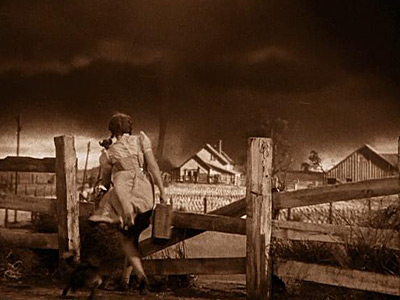
This tension of not-seeing but still knowing expands in Azzarella’s film modification of The Wizard of OzUntitled #125 (Hickory) (2009-2011). Admittedly an obsession of his, the familiarity of The Wizard of Oz that is embedded in American culture is profound. From its infamously troublesome production (rumors of suicide, anyone?) to its glorious introduction to technicolor to its popularity through annual television airing, the story of a young girl with dreams who travels to far only to find that what’s important is the love of home is part of America’s narrative. Throughout the world people have seen this film; it’s a universal point of reference. 

As with Untitled #105 (SFDF) (2009-2011), Untitled #125 (Hickory) makes the familiar obscure. While we cannot detect any development or movement when watching, we are made aware that it is from a 6 1/2 minute excerpt from The Wizard of Oz; encompassing the moment from when the tornado hits until Dorothy emerges into technicolor Oz and meets Glenda the Good Witch. The reason why we cannot see what we know is there is because Azzarella has stretched out cinematic space and time so that this film, his film, is 7200 minutes, approximately the same time of Dorothy’s stay in Oz. Isolating the film to be entirely represented by a single character’s experience, Dorothy, he says:

This work extends a moment of transformative transition (Dorothy’s journey to Oz) to envelop the entire time of her experience. Just as dreams which realistically occur in flashes of seconds in our brains can seem like hours or days, so Dorothy’s hours of unconsciousness take on a five day journey of transformation in Oz.

What Azzarella’s interventionist act does is abstract an image so familiar to us that we can no longer recognize it. The naked eye cannot detect movement. The film becomes unwatchable. And why is this important? Because durational films based on popular cinema (also think of Ivan Zulueta’s Frank Stein and King Kong in the early 1970s along with Douglas Gordon’s 24 hour Psycho and Five Year Drive By in the 1990s) force audiences to re-consider ways of seeing. They challenge what we think we know about narrative structure by inverting the movies we know and love as they morph into something new to critique, consider, and debate. These life of this films actually lives on in these works as both a love letter to the story and provocation regarding the fallacy found in cinema. These artists films reveal and remind us that we see onscreen is never really real. 

Watch Untitled #125 (Hickory) Part 1 (preview) here: http://vimeo.com/32951541