Chris Baldick’s intro to ‘The Oxford Book of Gothic Tales’

In this introductory text for ‘The Oxford Book of Gothic Tales‘, Baldrick establishes his argument for Gothic in literature (I look at how it differs structurally from horror). He historicizes the Gothic and explains its transformations over the years into what we recognize it as today. Therefore he establishes history and defines Gothic:

For the Gothic effect to be attained, a tale should combine a fearful sense of inheritance in a time with a claustrophobic sense of enclosure in space, these two dimensions reinforcing one another to produce an impression of sickening descent into disintegration. p xix

Defines Gothic as three things that inter-relate: 1) tyranny of the past 2) stifles the hopes of the present 3) within dead end physical incarnation.

Old buildings as sites of human decay (mansions).

I ask: so what happens when the horror shift is made away from the Gothic fantasy and moved into our realm of the real, homes and neighborhoods? Horror exists in the (ever) present, gothic looks to the past that has found its way into the present.

Bava on interiors

“I’m especially interested in movies stories that focus on one person: if I could, I would only tell these stories. What interests me is the fear experienced by a person alone in their room. It is then that everything around him starts to move menacingly around, and we realise that the only true ‘monsters’ are the ones we carry in ourselves. Alas, the marketplace demands terrible papier-mâché creatures, or the vampire with his sharp fangs, rising from his casket!”

Profondo Rosso

While I was in Rome last week I had the opportunity to visit Profondo Rosso, a store that features the Dario Argento Horror Museum below. It’s full of monster and alien fun (t-shirts, skulls, dolls) but, most importantly, it houses a great collection of books including a self-published series. I picked up my much coveted ‘Mario Bava: I Mille Volti Della Paura’ and, even though it’s in Italian I’m going to try my hardest to read it. Seems as if any book on Bava, besides the mega book, is in variety of languages, none of them english.

Anyway, the museum itself is full of props from Dario Argento films (like Terror at the Opera), horror oddities, trippy Argento paintings, and a misplaced alien autopsy scene with books that also acts as a book storage space. Narrated by an automatic audio (heavy Italian accent in English). Not so creepy or educational but a fantastic experience just the same.

Highlight of the trip: the signed movie poster from ‘The Bat’ by Vincent Price whom the owner said, ‘oh, Vinnie?’ Sigh.

Horror’s Collective Memory: Gregory Waller ‘Introduction to American Horrors’

“Taking the horror film as our guide we can and should begin to rethink the nature of ‘influence’ and ‘imitation’ and the meaning of ‘genre’ and ‘formula’ in contemporary popular culture – in so doing we inevitably rethink our own understanding of horror as well”

Gregory A. Waller, ‘Introduction’ from American Horrors (1987, University of Illinois Press) reproduced in The Horror Reader.

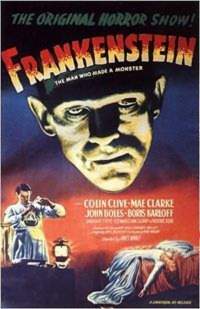
Paul O’Flinn ‘Production and Reproduction: the case of Frankenstein’

An extract of Paul O’Flinn’s ‘Production and Reproduction: the case of Frankenstein’ is featured in The Horror Reader, edited by Ken Gelder.

Having only recently read Mary Shelley’s Frankenstein for the first time I’ve been interested in how this monstrous character has morphed from being a damaged, repulsive, complex revenge-killer into a green, not responsible for his actions, somewhat lovable mute throughout popular culture; even so much as we now collectively associate the monster as “Frankenstein” when that name really belongs to the Doctor. This metamorphosis occurs through a shifting of mediums (from novel to film) and through a change in contemporary social climates; Frankenstein becomes a site of re-production and a mimetic vessel for each new time period. To me, this reflects the continuous and self-generative/reflexive nature of the horror genre itself all manifested in one big monster metaphor.

Notes are after the jump…

Continue reading

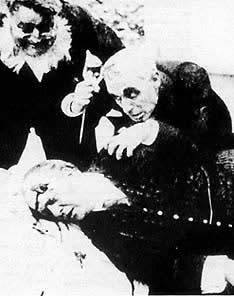
Grand Guignol and Andre le Lord

French theater of horror, depicting the grotesque and the marginal: murderers, criminals, prostitution, and various forms of the ‘other’ from 1897-1962).

From the Grand Guignol website:

It was Maurey who, from 1898 to 1914, turned the Theatre du Grand-Guignol into a house of horror. He measured the success of a play by the number of people who fainted during its performance, and, to attract publicity, hired a house doctor to treat the more fainthearted spectators. It was also Maurey who discovered the novelist and playwright Andre de Lorde–“the Prince of Terror.” Under the influence of de Lorde (who collaborated on several plays with his therapist, the experimental psychologist Alfred Binet), insanity became the Grand-Guignolesque theme par excellence. At a time when insanity was just beginning to be scientifically studied and individual cases catalogued, the Grand-Guignol repertoire explored countless manias and ‘special tastes’: Andre de Lorde and Leo Marches’s L’Homme de la Nuit (The Man of the Night), for example, presented a necrophiliac, who strangely resembled Sergeant Bertrand, a man sentenced in 1849 for violating tombs and mutilating corpses. L’Horrible Passion (The Horrible Passion), by Andre de Lorde and Henri Bauche, depicted a young nanny who strangled the children in her care. (Like Metenier, de Lorde was often a target of censorship, particularly in England where scheduled touring productions of two of his plays were canceled by the Lord Chamberlain’s censors. The theater of the time, which delighted in vaudeville and bourgeois settings, could not abide the sight of blood or corpses on stage.)

Andre de Lord(1869-1942), the “Prince of Fear” (Prince de la Terrerur): French playwright, the main author of the Grand Guignol plays from 1901-1926. He wrote 150 plays, all of them devoted mainly to the exploitation of terror and insanity, and a few novels. For plays the subject matter of which concerned mental illness he sometimes collaborated with psychologist Alfred Binet, the developer of IQ testing.

At the Telephone play can be read here. Book on Grand Guignol here.

‘Shocking Representation’ notes

Shocking Representation: Historical Trauma, National Cinema, and the Modern Horror Film‘ by Adam Lowenstein

Just finished this book yesterday (9 January 2010). It discusses through film examples how historical trauma is reflected in the allegorical moment in film narrative where the past collides with the present in the eyes of the spectator. It moves away from a modernist reading of trauma as being a proper way to work though and towards a more post-modern/realist reading previously thought to be unhealthy. It establishes a conflation between ‘art genre’ and ‘horror genre’ in regards to trauma representation in cinema (how even art films tend towards the spectacle, how can it not, when showing something horrific). The author ‘shifts cinema’s relation to history from compensation to confrontation.’

Continue reading