 Following up my recent posting on Peter Doig and Friday the 13th are thoughts on the artist films Terror (2006) and Alice (2010) by UK artist Ben Rivers.
In addition to focusing on Alice from Friday the 13th and her status as the ultimate final girl (which I will get to later on), Ben Rivers uses the archive of horror cinema as a modifiable object. While the basis for his films is usually self-shot and original, Terror and Alice are his “love letters’ to horror. Sourced entirely from the “giallo” and “slasher” sub-genre (1970-80s) they include Lucio Fulci’s The Beyond, John Carpenter’s Halloween, Dario Argento’s Susperia, and dozens more. By establishing a dialogical relationship between his own work and these movies through montage, Rivers carefully negotiates this particular portion of horror history and by fluently speaking the language of horror cinema he conflates the past with the present to create a new process of looking. This makes for future genre possibilities in what Sergei Einsenstein termed an “intellectual montage” (proposing that a new idea can emerge from a sequence of shots unintended by the original footage). For Rivers this new emergent idea directly involves the audience.
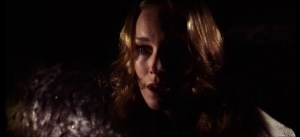 The chosen scenes in Terror build upon a structural frame of familiarity through a progressive sequence that increases in intensity and absorbs the viewer in its rhythm. Rivers’ filmic montage (and homage) to the influential “giallo” and “slasher” movies inverses storylines and audience participation and exemplifies Steven Shaviro’s ‘zombie time’ terminology in his essay Contagious Allegories: George Romero:
‘the slow meanders of zombie time emerge out of the paralysis of the conventional time of progressive narrative. This strangely empty temporality also corresponds to a new way of looking, a vertiginously passive fascination. The usual relation of audience to protagonist is inverted’ (1993, 99).
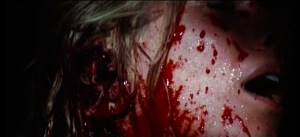 Rivers establishes linearity by editing similar scenes together: houses in the fog, people calling out for each other, the mysterious opening of doors, shots of keys, and even bits of comedy. Each sequence builds incrementally, simultaneously acknowledging that the audience knows these are “only movies” but still provoking some serious unease. For those who recognize the sources, the suspense becomes palpable and the alternating tension between this conglomeration of references continues just until the moment when the one questions whether or not the violent resolution will ever come. Then Rivers provides a brilliant release with the most fantastic eruption of surplus gore; a bloody violent collage that is completely satisfying and totally thrilling.
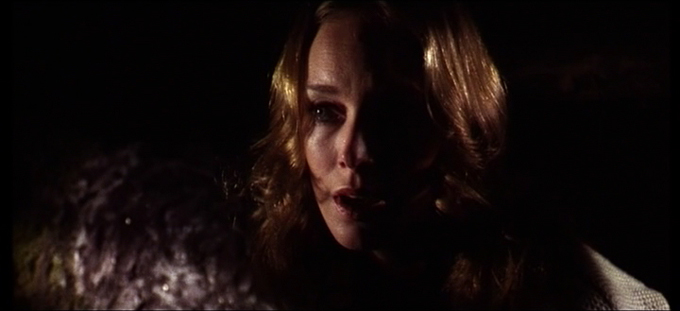
Relying on the audience’s knowledge and/or non-knowledge of horror films, Rivers acknowledges that the viewer’s familiarity with the movies determines meaning for Terror and Alice. This is most evident in his new film Alice, a heavily edited piece focusing solely on the main character and “Final Girl” from Friday the 13th.
 As with Peter Doig’s Canoe Lake (1997-98), Echo Lake (1999), and Friday the 13th (1998), Rivers has completely omitted any visual expression of the life-threatening encounters Alice endures. What we see is Alice making coffee, putting on her coat, lounging in a canoe on the lake; a rhythmic succession of the benign moments that surround the unseen moments when she is fighting for her life. Those unaware of Friday the 13th could find this a little bit boring but understanding the filmic source makes the friction between what we see and what we know explode brilliantly onscreen. Still, it’s significant that the exclusion of the scary stuff has not pacified the situation – the audience is aware of the narrative tension and feels it when viewing the works.
Rivers’ films purposefully identify with an audience’s relationship to watching a horror movie. A fan himself, Rivers incorporates this passion for the genre into other works containing his own footage, House (2007) and Origin of the Species (2008). He extends his interest onscreen, acknowledging the audience and their expectations of what a “good” horror film should be.
As mentioned in Peter Doig – Friday the 13th, Alice plays into critical debates surrounding feminism in horror movies specifically addressing slasher films where the lone survivor is usually a female who is, generally, victorious over her male counterparts (monster and fellow victims). Carol J. Clover dubbed her the “Final Girl” and while her definition is tenuous at best (I think that the unique differences in each film make such solidified terms near impossible), this “Final Girl” has an enduring legacy in horror that can provide us a framework in which to consider gender roles in society throughout the decades. Friday the 13th is a particularly interesting example because not only is the lone survivor female but the killer is as well (it isn’t until the sequels that Jason becomes the monster). It’s a battle between motherly devotion and the perceived loose morals of teenagers.
Rivers views Alice as the ultimate “Final Girl” and utilizes this process of identification as a structure to creates a contemporary version of the same story. His editing might suggest we question whether women are now safer in society. Have women become more integrated and better shielded from unknown horrors? Or is the perception of equality and safety an illusion – is the past still there, lurking in the background, waiting to grab hold?
Ben Rivers recently exhibited his new film Slow Action at Matt’s Gallery in London and Picture This in Bristol. I have previously written about Rivers for LUX and his film Terror was screened last fall during The Real Horror Symposium.
 Earlier I mentioned Jamie Shovlin’s Hiker Meat project. In the same slasher film vein, here is an image of Shovlin’s Index (Pieces A) that explicitly references that bloodiest movie about body parts, Pieces (Juan Piquer Simon, 1982). The image used is taken from the trailer.
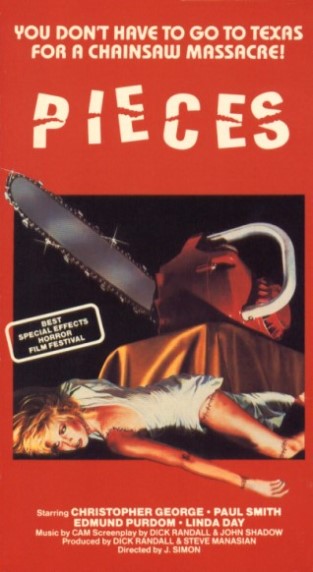 In addition to Index (Pieces A) I’ve also included the classic and clever poster for the film.




 THE GIRL WHO KNEW TOO MUCH