The Dark Room: spectral space of photography and film in Alexander Nicolas Gehring’s Messages from the Darkroom and Michael Powell’s Peeping Tom

The Dark Room: spectral space of photography and film in Alexander Nicolas Gehring’s Messages from the Darkroom and Michael Powell’s Peeping Tom is an essay I wrote for the Brighton Photo Fringe Open ’11 exhibition (November 18 – December 18) as a contributing Guest Curator.

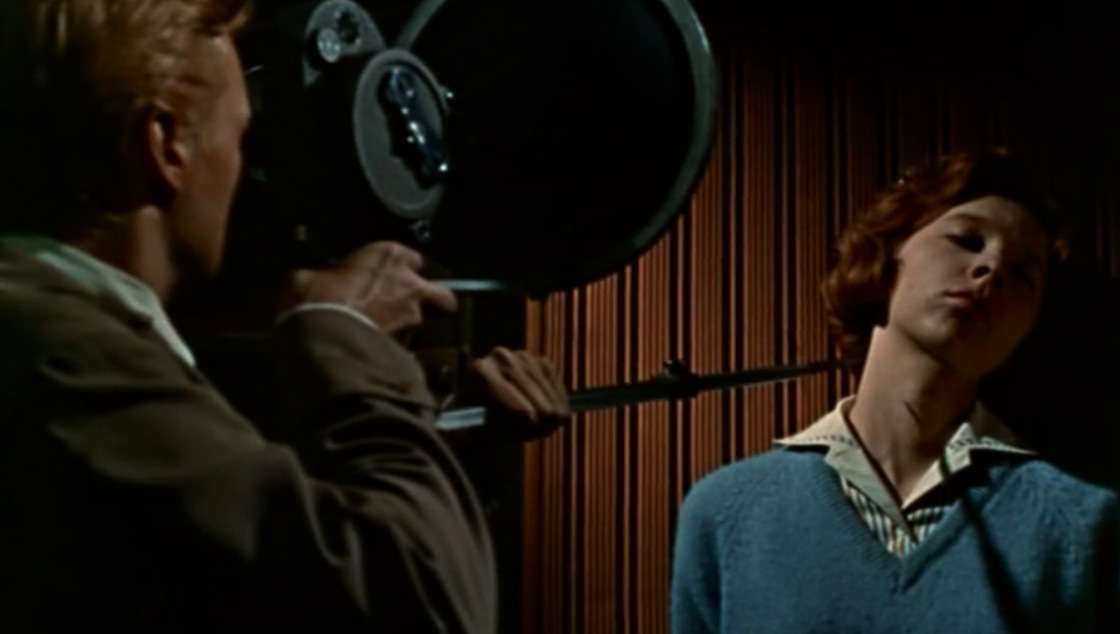
It is profoundly seductive to believe that photography can be an evidentiary medium of a realm beyond our mortal coil. Even more provocative is the idea of photography, and subsequently film, as a tool to facilitate our voyeuristic desire to see the invisible (fleeting moments, ghostly visions, and even intense fear). In his series Messages from the Darkroom, Alexander Nicolas Gehring taps into photography’s psychological strangeness by positioning its construct and production as spectral sites. This depiction of the camera as an object to channel, capture, and visualize deathly moments, as well as its function in fulfilling our desires to bear witness, was explicitly explored in Michael Powell’s controversial, and equally luscious film, Peeping Tom (1960).

What interests me is Gehring and Powell’s shared urge to confront the past via photographic means and how their work comments on what Martin Scorsese declared [in a 2010 interview with Mark Kermode celebrating the 50th anniversary of Peeping Tom] as our “morbid urge to gaze”. This cultural gaze has evolved in the decades since the release of Peeping Tom, with its nearly prophetic social commentary, into something that is at once more familiar and disturbing in our contemporary world. With this “morbid urge to gaze” in mind, Messages from the Darkroom and Peeping Tom fundamentally comment on the attempt to visualize and record the ultimate gaze: that of death. The very foundation of the photographic medium aims to preserve aspects of memory, life, and experience in relation (and perhaps in reaction) to this very personal and profound moment we will all experience. Channeled through the lens of the camera, and re-born in the haunted space of the darkroom, the spirits contained and preserved within these images have been called forth by the artist/photographer/filmmaker/mad scientist.

Based on the historical usage of photography by scientists and occult practitioners to capture the presence of ghosts in “spirit photography”, Alexander Nicolas Gehring’s Messages from the Darkroom brings to light how space, specifically the room where film is processed, functions as a site for the spectral. This series conflates the notion of “medium” in photography in that the camera produces a physical medium (a photographic image) and acts as a spiritual medium (a channel between the living and non-living). Here the camera is medium in literal form, producing a representation of what some believe to be objective documentation of ghosts, becoming a bridge between the corporeal and spiritual worlds. Still, what is most interesting about Gehring’s photographs is not the evoked image itself but the concept of a spectral site, a place where the dead are re-born and re-placed back into the land of the living.

Now revered as a British new wave classic, Michael Powell’s career-ending Peeping Tom treads similar waters in its fetishization of camera objects, the haunted space of the darkroom, voyeuristic eye, and the distinct presence of the dead. The film shows how the torturous childhood of Mark Lewis continuously haunts his adult state of mind, compelling him to use his camera as a recording device and lethal weapon. In glorious Eastman colour, the aesthetic of Peeping Tom – the visualization of the darkroom as two-toned, red and black, dark and shadowy, warm and clinical – is most noticeable in Gehring’s photographs Medium and Light Phenomenon. The camera in these works is captured as a self-contained medium and as a sculptural object. As Powell suggests by alternating viewpoints between Mark’s “special” camera with the another “outside” lens, Gehring’s confrontational camera is also shown through the unrepresented lens (an autonomous camera that functions as the audience point-of-view).

In the cellar, darkness prevails both day and night, and even when we are carrying a lighted candle, we see shadows dancing on the dark walls. Gaston Bachelard – The Poetics of Space

The darkroom (connoting the laboratory, dungeon, cellar, etc.) is a space of process and discovery. Gehring’s darkroom becomes the place of the séance. Referencing the photographic documentation of paranormal activity by notable early twentieth century German psychic researcher, Albert Freiherr von Schrenck-Notzing, Messages from the Darkroom focuses on the dead returning and co-mingling with the living via photographic representation. This darkroom references an arena of scientific research where new technology is used to capture the unseen, in this case ghosts, in an attempt to be in closer contact with an extension of human existence. The darkroom and cinematic space in Peeping Tom acts as a dual place of sanctuary and fear. In this room, Mark returns to the site of his own psychological abuse by processing and consuming the films he makes by murdering women. With each repetitive viewing, these victims are repeatedly brought back to life, made to watch their own death, and be killed again.

Of course, this is the very nature of the filmic/photographic medium itself, a sensitized form capturing a specified series of events in time that can be replayed in perpetuity. As time and space collapse, that which is depicted onscreen never truly fades; always existing as it was at that very moment it was captured, frozen forever on celluloid. Furthermore, our current moment is one where the medium of film is in the process of becoming obsolete. In the wake of the quality, ease, and accessibility of digital technology, there appears to be little use for analog outside the realm of nostalgia. A near living object itself (film curator Henri Langlois firmly believed that nitrate film had to be used/exercised in order to stay alive), film now finds itself in a ghostly space within the digital realm.
Alexander Nicolas Gehring and Michael Powell are seduced by the psychic camera as evidence but wary of its ability to produce accurate visual records. Gehring engages in an obsession to document the afterlife while Powell challenges the perversity of documenting all aspects of our lives. They contest the “all knowing” camera eye because they also consider what happens outside of the frame; photographic representation inherently lays on the liminal boundary between fact and fiction. The foundation of the darkroom is what grounds these layers of suggested ghostly presence within the photographic “medium”. Itself in danger of becoming a thing of the past, this dark room provides the spectral space in which we can conjure up the unseen and indulge, repeatedly, in our collective and cultural morbid desire to gaze.

“Evil Dead II” essay on Network Awesome

This Halloween I contributed to Network Awesome’s Horror-Punk Weekend extravaganza with the text: Theatre of Blood: Sam Raimi’s Evil Dead II

Sam Raimi’s Evil Dead II (1987) is a cinematic resurrection of the director’s earlier film Evil Dead(1981). It can be dangerous territory when an artist is given license to go back and adapt their own work but in re-appropriating his own film, Raimi, much more Georges Méliès than John Carpenter, reclaims an originality within the genre during a time of over-used horror movie conventions.

And that’s just the beginning! Click on the link above to read the whole thing including musings on architecture, Gaston Bachelard, and the video nasty.

Incognitum Hactenus: new journal on art, horror, and philosophy

I am thrilled to announce that the first issue of the new quarterly journal Incognitum Hactenus (edited by Tom Trevatt and myself) is now available! Download it here.

Incognitum Hactenus is a new quarterly journal featuring writing on art, horror, and philosophy. Conceived as an ongoing investigation into each sphere and its crossovers, the journal publishes new work by leading international scholars, artists, filmmakers, curators, musicians, and designers. With a focused interest in that which finds an affiliation with horrific contemporaneity and the exposure to radical thought, Incognitum Hactenum reveals the twisting of contingency (that which comes from outside) as it produces new monstrosities. We aim to tear asunder the fleshy belly of the established and expected.

Volume 1.1 “Real Horror” of Incognitum Hactenum includes texts and artwork by Amanda Beech, Simon Clark, Carl Neville, Ben Rivers, Steven Shaviro, and Ben Woodard that were produced in conjunction with The Real Horror Symposium last October in London.

Please visit the website to download the first issue and to learn about the journal.

We hope that you enjoy and participate in these new strains of discussion as we celebrate the present, past, and future of art, horror, and philosophy!

Network Awesome Essay on “A Bucket of Blood”

Life is an obscure hobo bumming a ride on the omnibus of art – Maxwell H. Brock

My first essay for Network Awesome Magazine went up this week. It’s a re-do on a little ditty about Roger Corman’s A Bucket of Blood where I discuss sculpture, failure, the art world, murder, humor, and Deleuze. You know, the usual.

Read: Who Says the Art World Isn’t Scary: Roger Corman’s Classic A Bucket of Blood

Halloween Lullaby: how the Cure shaped my love for horror

“On candy-striped legs, the spiderman comes…”

Because I’m always thinking about “why horror?” for a generation of artists, filmmakers, and cultural production, I often ask myself, why horror? I mean, how did I get into this mess in the first place? While there are many layers in answering that question, amongst them being the magical lure many of these films have, actually pinpointing my obsession with horror aesthetics and narratives has come down to this…The Cure’s video for Lullaby.

Twenty-two years after its release, The Cure’s Disintegration (released May 1989) is not only one of the best albums of the late 20th century but also a formative influence in my life. I vividly remember watching The Cure’s music videos, ranging from the earlier and silly Love Cats to the love lorn Love Song to the powerful Fascination Street featured on Disintegration, on MTV with such intensity. Their goth allure appealed greatly (and still does) to my inner depressive and most likely also cemented my enduring love for England and black eyeliner. After recently re-watching The Cure’s Lullaby video, directed by Tim Pope, a flood of memories rushed back and I realized that even before my first horror film scared the pants off me (Halloween 5),  Lullaby was where it all began.

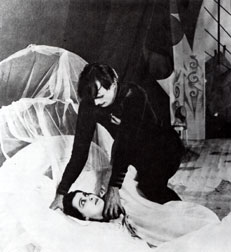
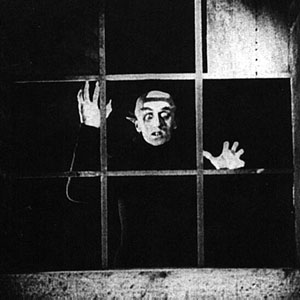
Of course now I recognize the filmic references within the video that escaped me at the time. Now I can’t look at it without thinking of German Expressionists Robert Wiene’s The Cabinet of Dr. Caligari (1920) and F.W. Murnau’s Nosferatu (1922) or even many years later Werner Herzog’s stunning Nosferatu the Vampyre (1979). The dark-rimmed eyes, creeping human-like figure, foreboding death, being repeatedly consumed, and the fear of sleep are all at play with these films and culminate, with all its British goth pop glory, into Lullaby.


On candystripe legs the spiderman comes / Softly through the shadow of the evening sun/ Stealing past the windows of the blissfully dead / Looking for the victim shivering in bed / Searching out fear in the gathering gloom and / Suddenly! / A movement in the corner of the room!


And there is nothing I can do / When I realise with fright / That the spiderman is having me for dinner tonight!

Quietly he laughs and shaking his head / Creeps closer now / Closer to the foot of the bed / And softer than shadow and quicker than flies / His arms are all around me and his tongue in my eyes / “Be still be calm be quiet now my precious boy / Don’t struggle like that or I will only love you more / For it’s much too late to get away or turn on the light / The spiderman is having you for dinner tonight”

And I feel like I’m being eaten / By a thousand million shivering furry holes / And I know that in the morning I will wake up / In the shivering cold / The spiderman is always hungry…

Now on Network Awesome: The Burning and A Bucket of Blood

Two essays of mine have landed on the fabulous Network AwesomeThe Burning (horror film and 1980s politics) and A Bucket of Blood (satirical horror and the art world). Check them out:

What Makes a Man Start Fires: 1980s American Culture and The Burning
Through the lens of a campfire horror tale, Tony Maylam’s slasher classic The Burning (1981) begins with a prank gone wrong and ends with a series of revengeful murders. Gleaning from a culturally volatile period in America history, The Burning visually manifests displaced youth in the most gratuitous manner. It perpetuates, capitalizes, and exploits the fear that the unknown can happen to any one…read the rest and watch the film here.

Who Says the Art World Isn’t Scary?: Roger Corman’s Classic, A Bucket of Blood
If there’s a better satirical film on the art world than A Bucket of Blood (1959) then I certainly haven’t seen it (note: John Waters’ Pecker comes close). This playful jab at the beatnik artist types of the 1950s easily translates into the ridiculousness of contemporary art. Reportedly made by “King of the B-movies” Roger Corman for a mere $50k, A Bucket of Blood is a thoughtful and provoking look at the beginning of modern art as cultural phenomenon. It has a lot in common with the 1953 version of House of Wax (André De Toth) in its representation of the frustrated and revengeful artist, however, it moves beyond the artist as “individual” to cleverly mimic — and mock — the capriciousness of the art world as a whole…read the rest and watch the movie here

Ghost Stories – Thanks!

Thanks to everyone who came out for the second (but certainly not final) Art of Fear screening!

To say that I was incredibly  honored to show works by artists I admire so much would be an understatement. So thank you to all the artists who have been a part of this conversation-starter on horror and contemporary art: Takeshi Murata, Darren Banks, Jamie Shovlin, My Barbarian, Aida Ruilova, and Marnie Weber. Also to Nitehawk Cinema, who supports experimentation and all things horror as well as all those who spread the word and assisted putting all the files together (when they should have been working on other stuff). You did my first New York project proud.

More soon!

Sinister Seven: Interview with Rue Morgue

It’s pretty darn exciting that The Art of Fear has initiated the conversation about horror film and contemporary art by visualizing some of the connections between the two. Realizing that there are three somewhat diverse components – cinema, horror, and art that all have the audience as a base commonality – there is obviously an interesting road ahead in discussing these influences with each community. This is one of the reasons why I was thrilled to answer some questions coming from the horror-realm by Rue Morgue (the other is that I think they do an intelligent take on horror). It talks a bit about the film program, other projects, and why myself and certain artists found an obsession with horror films.

I’ve included excerpt below but read the whole thing here:

For many of us, these exhibits are a very different way to approach the horror genre. Can you help me wrap my head around exactly what’s going on here?

The fact that The Art of Fear and other related projects are a different approach to horror is what interests me the most. I view the horror genre as evolving over time, through different cultural and political periods, absorbing the contemporary climate. Some elements to the genre stay while others change and I think that by including visual artists into the equation, we can start to see how pervasive and influential horror, particularly horror film, is on other mediums.

The Art of Fear: Ghost Stories on October 19

The second part of The Art of Fear artist film exhibition is this Wednesday (October 19) in the upstairs lobby at Nitehawk Cinema! The event is free and starts at 7pm with films beginning shortly after – the program will be shown twice. See  you all there!

Ghost Stories, the second program of The Art of Fear, features surreal tales of love, life, and death that are brought back from the afterlife in the bizarre and haunting works of My Barbarian (Malik Gaines, Jade Gordon and Alexandro Segade, Los Angeles), Aïda Ruilova (New York), and Marnie Weber (Los Angeles). Horror affect and narrative style are huge influencers in these films with inspiration deriving from Rod Serling’s Night Gallery television series, cult figures like Jean Rollin and Karen Black, and the theatrical monstrous characters from early Hollywood. Importantly, The Art of Fear is showing the New York debut of Marnie Weber’s most recent film, The Eternal Heart (2010).

PROGRAM
My Barbarian – Night Epi$ode: Curatorial Purgatorial (Pilot)
2009, Single channel video, 12 minutes, Color, Sound

Aïda Ruilova – Life Like
2006, Single channel video, 5 minutes, Color, Sound

Aïda Ruilova – Lulu
2007, Single channel video, 5 minutes, Color, Sound

My Barbarian – Night Epi$ode: Yoga Matt and Veronika Phoenix
2009, Single channel video, 13 minutes, Color, Sound

Aïda Ruilova – Meet the Eye
2009, Single channel video, 7 minutes, Color, Sound

Marnie Weber – The Eternal Heart (see trailer below)
2010, Shot on Super 8 and 16mm, digital projection, 28 minutes, Color, Sound

Critical Halloween

Criticality finds its place in Halloween.

I live Halloween 24/7/365. And yet the act of dressing up on October 31 simply doesn’t do it for me. It hasn’t ever, really.

Still, I appreciate a good effort and I think I might have a hard time finding an event as clever/hilarious/yet critical than the Storefront for Art & Architecture’s Critical Halloween. Sure there are horror films being screened city-wide in celebration of all things scary but where else can one find a “costume architecture party devoted to the most feared ghost of architectural production: BANALITY”.

They even provide inspiration.