Marnie Weber – The Night of Forevermore

If it is said that Hieronymus Bosch draws with his brush, then Marnie Weber films with her sculptures.

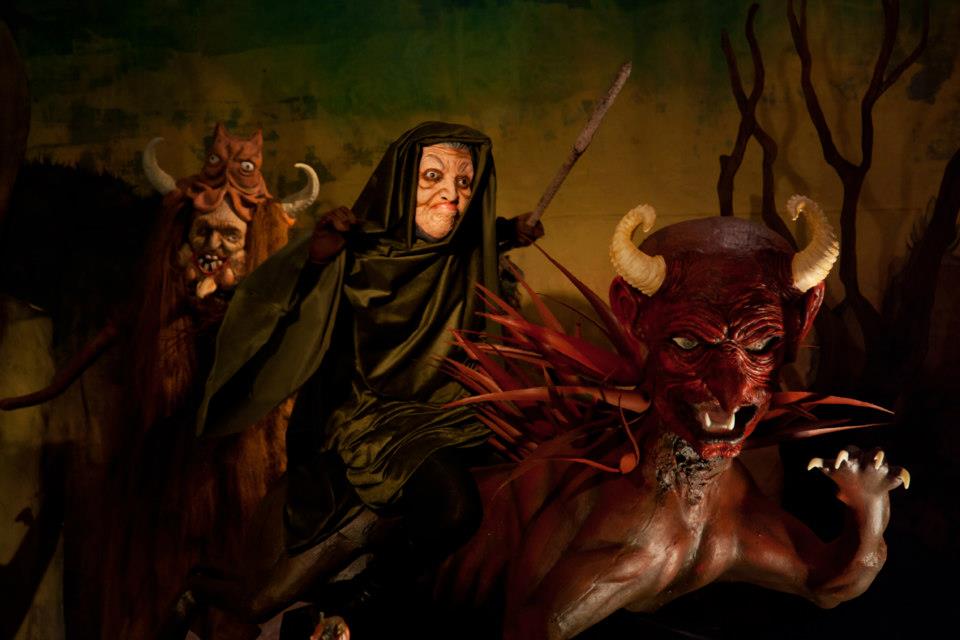
Marnie Weber’s The Night of Forevermore is a static space housing monsters, demons, witches, human-animal hybrids; all of which come alive with slow, repetitive gestures and sound. It’s a Hieronymous Bosch painting brought to life, a haunting world with creatures familiar and strange, each with their own woe, purpose, and revenge. Bosch’s paintings are infamously crowded, layered with forms of life and death co-mingling in this liminal boundary between heaven and hell. It is an area of foretold ghosts. And retained within the picture plain and filmic frame, Weber’s animated sculpture remain spread across the entire tableau but firmly placed on an individual stage.
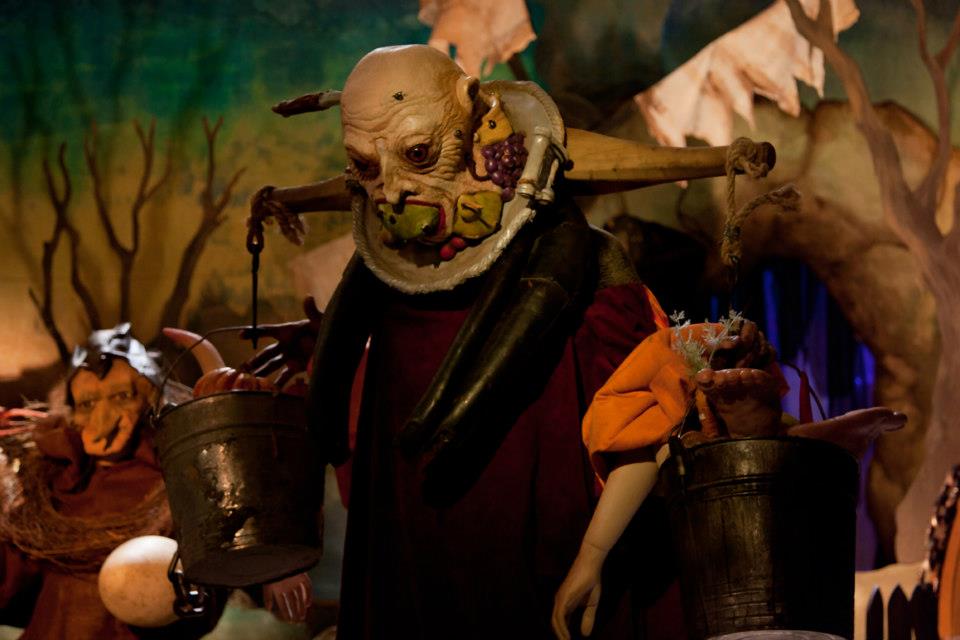
Of course, the activating power that elevates the concept of a painting into a moving image in The Night of Forevermore is the camera itself. Through the all-seeing eye of Weber’s lens, the viewer is shown this world of dreams and nightmares beginning with a static shot where movement begins individually, slowly, and then all at once. This overview pans away, purposefully, to show the action and the function of each creature – the musician, the crying pig, the riding witch, the executioner – giving the audience privileged mobility. It’s the opposite of Bosch’s chaotic evocation of confusion where our eyes dart maniacally across the surface. Weber’s calculated pacing lends the bizarre, gruesome, and monstrous scene an elevated other worldly aura. The strangeness becomes tactile.

Weber’s films themselves are like dreams, with images floating from space to scene in non-linear time as her representational figures suggest eternal ramifications for questionable deeds. The protagonist in The Night of Forevermore is a young and innocent girl (played by Weber’s own daughter, Colette Rose Shaw) shown her own dreamlike/nightmarish journey to escape the darkness. She is the only one with the freedom to move, her ability traverse through these alternate realms only being because she is still fighting the evil damnation the witch (played by Weber) has subjected her to. Hers is an unexpected reality, confronting a devilish figure, escaping the witch’s clutches, waking up in strange alternate universes. Similar to the horror film heroine (aka the Final Girl), her experience is a visualize metaphor living through life into adulthood. The Night of Forevermore is a late 15th century morality tale made contemporary through the influence of moviemaking.

However, as is typical with Weber’s tales, her monsters are not safely relegated to the spiritual (film) world. Instead, the gallery space functions as a portal through which Weber brings forth these beings through objects. The painting and collage on wood works (a first) provide a literal weight to what I’ve always associated as her unique version of film stills. Furthering the narratives in the film and withholding the freedom of movement the film provides, these collage pieces segues perfectly into the sculptural versions of select characters. Haunting us with their presence, the old witch sits still in a rocking chair while watching us watch the film, a bed of fruitless trees lurk nearby. One almost expects them to begin moving, just a twitch, as the film has shown us that even paintings, even creatures in the night, can come alive, seek us out, and steal our souls.

Marnie Weber’s The Night of Forevermore at Marc Jancou Gallery (New York, September 13 – November 3, 2012) 
Open Call for Submission: Historical Trauma

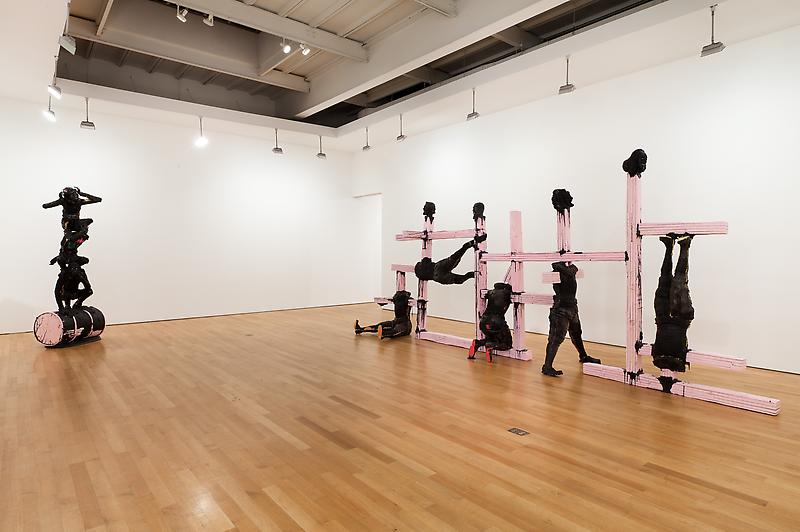
The fourth issue of Incognitum Hactenus will be published in connection with my exhibition On the Desperate Edge of Now at Dumbo Arts Center (New York) in Feburary 2013. There will be an online version and printed catalogue version of this issue. We are seeking contributions that deal with ghosts, history, the cinematic, cultural memory, historical trauma, and the conflation of time.

On the Desperate Edge of Now explores historical trauma, collective cultural experience, and personal memory as represented in contemporary visual art and horror film. Titled after the first episode of British filmmaker Adam Curtis’ 1994 BBC documentary The Living DeadOn the Desperate Edge of Now positions the construction of memory as a coping mechanism for both the individual and an international public. Expanding the notion of “horror” to include a more philosophical context of understanding the world, this exhibition employs horror cinema as a structural guide to locate the ever-present now. Through an adoption of Gilles Deleuze and Henri Bergson’s notion of the now as an “ever shifting amalgam of past, present, and future”, On the Desperate Edge of Now aims to evoke a haunting at DUMBO Arts Center in February 2013. Artists: Heather Cantrell, Folkert de Jong, Joachim Koester, and Marnie Weber.

Open call: if you are interested in contributing to On the Desperate Edge of Now please send a 200 word abstract to both editors: tom.trevatt@hotmail.com and caryn@caryncoleman.com. Please note that not all submissions will be accepted for publication.

Image: Folkert de Jong, Operation Harmony (2008)

Living On: Zombies Release Party

The journal I co-edit is having a release party in New York for our latest issue, Living On: Zombies

INCOGNITUM HACTENUS INVITES YOU TO…

LIVING ON: ZOMBIES RELEASE PARTY
Tuesday, October 2 from 7 – 9pm
Nitehawk Cinema (cafe)

Pre-party for the 9:30pm NY premiere of V/H/S (new horror anthology film released by Magnolia Pictures)

Screening: Jim Shaw’s The Hole (2007)
Spinning: “Undead Soul” by Dave Tompkins

Special horror cocktail: the Corpse Reviver
Stuff: Free digital copies of Living On: Zombies | check out books by contributors 

Thanks to Magnolia PicturesNitehawk CinemaBlonde Art BooksDarren BanksDave Tompkins, and all of our contributors!

Three Films at Once: Shocking Representation at DAC

Shocking Representation.

Via invitation from Dumbo Arts Center, on Thursday (September 6) I presented a one-night event in support of my upcoming February exhibition at DA On the Desperate Edge of Now (historical trauma in horror film and contemporary art ) with Heather Cantrell, Folkert de Jong, Marnie Weber, and Joachim Koester.

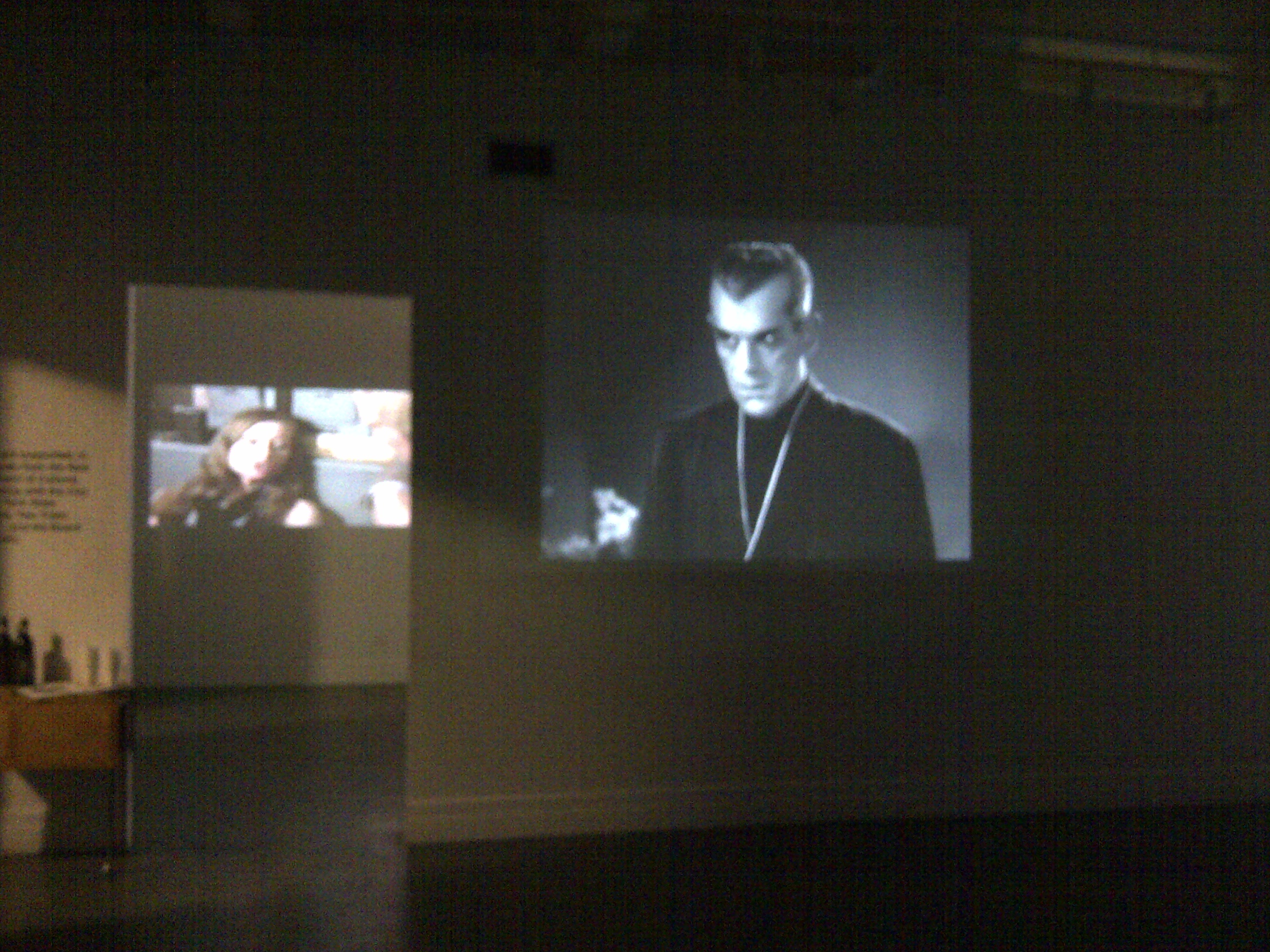
On view was a simultaneous play of three horror films – Edgar G. Ulmer’s The Black Cat (1934), Bob Clark’s Deathdream or Dead of Night (1974), and the documentary The American Nightmare (2000) – merging social, political, and cinematic history into one monstrous audio-visual experience. 
 
The “screening” lasted for three hours during the Dumbo Art Walk. People came in, some stayed, some talked about the impact of these films culturally, others questioned if this was art to be hung on the walls of their home. But mostly, the ghosts of cinema floated on the wall, floating between the past and the future, in-and-out of sync, telling us stories from beyond the grave. 

You Killed Me First: Cinema of Transgression

The recent You Killed Me First: Transgression of Cinema exhibition (of 1990s New York filmmakers) at the KW Institute of Contemporary Art in Berlin is perhaps one of the most relevant exhibitions that has happened in recent years. While the -innials in New York attempt to foresee the future, You Killed Me First looks back hard at a group of New York artists who quite literally said fuck you in their life, production, and work. It may not all be good or pretty but frankly, we need more of this in art and film. And if we need to look back to do this, then so be it. This exhibition needs to be in New York and Los Angeles anyway.

We propose…that any film which doesn’t shock isn’t worth looking at. …We propose to go beyond all the limits set or prescribed by taste, morality or any other traditional value system shackling the minds of Men. …There will be blood, shame, pain and ecstasy, the likes of which no one has yet imagined. – Cinema of Transgression Manifesto

Exhibition ‘zine courtesy of Cliff Lauson who said the show was “relevant to my research”. I quite like that others consider sex, violence, blood, and experimental film in relation to me. Win. 

Fiona Banner: re-imaging cinema

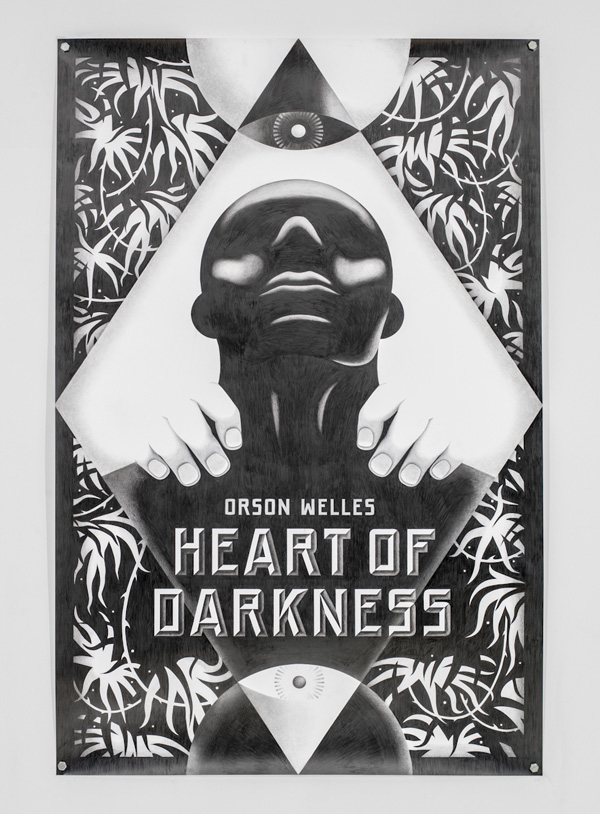
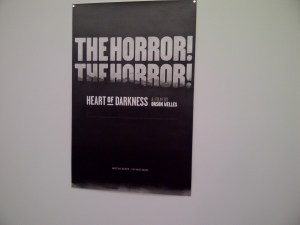
Joseph Conrad’s novel Heart of Darkness tackles a real horror, one in both the wilds of the jungle and deep inside of man. Imagine, in the eyes of artist Fiona Banner with select designers, if Orson Welles had made the film adaptation in the 1930s through fictionalized posters. The mind wonders and the eye gawks at these stunning representations of a thing that never fully existed. It plays on notions of the unseeable but knowable, a familiar trope in the horror genre.

Orson Welles wrote a screenplay based on Joseph Conrad’s novel Heart of Darkness in the late 1930s. It would have been his first film but it was rejected by the studio RKO, and he went on to make Citizen Kane instead. At the time the script was considered too political, too expensive, and too uncompromising artistically, not to mention narrative parallels with the rise of fascism in Europe. Today other parallels are drawn. – from Artangel’s “A Room for London” program, watch the performance of the script here. 

Here are some of my favorite mages from her current exhibition Unboxing: the greatest film never made at 1301PE Gallery in Los Angeles:

The Greatest Film Never Made (Fiona Banner and Name Creative), 2012
Graphite on paper


The Greatest Film Never Made (Fiona Banner and Empire Design), 2012
Graphite on paper

The Greatest Film Never Made (Fiona Banner and La Boca), 2012
Graphite on paper

View more images along with installation images here.

The darkness of Frieze

Going through my camera after Frieze (a substitute for a forgotten pen), I noticed how the artworks I liked share in some serious darkness. This choice is aesthetic shouldn’t be a surprise. 

Fiona Banner and Empire Design – The Greatest Film Never Made (2012)
Graphite on paper
@ Frifth Street Gallery
Welles, real horror, and dream cinema 

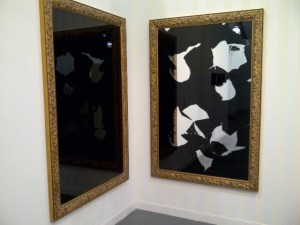
Michelangelo Pistoletto – Two Less, One Black (2011)
Black and silver mirror, golden wood
@ Galleria Continua 
Black abyss, eternal reflection, the unknowable

Gary Simmons – Through the Mist (Ghost…), 2012
Oil on canvas
@ Metro Pictures
Haunting, frenzy, through time

Lari Pitman – How Sweet the Day After (1988)
Acrylic and enamel on panel
@ Regen Projects
Conglomeration of history

Malcolm Le Grice’s “Horror Film 1”

The Henry Moore Institute in Leeds’ United Enemies film screening series explores “how artists in the 1960s and 1970s deployed sculpture in film, as well as using film to rethink sculpture”. As part of this they presented Malcolm Le Grice’s Horror Film 1 (1971) where, once again, we can consider horror film as a structure. Or perhaps even sculpture.

From LUX’s website:

All are superimposed on each other with the projectors aimed from different angles. The superimpositions create a continually changing colour light mix. I interrupt the beam with a series of formal actions creating a complex set of coloured shadows. The final section involves focusing a pair of skeleton hands onto the screen in relationship to my own hands. The intention with this as with my other shadow pieces, is to build a complex visual experience out of simple and readily available aspects of the projection situation. M.L.G. from ‘Real Time/Space’, Art and Artists Dec 1972.

“One of his most simple, most classical, and also most ecstatic pieces”. Jonas Mekas, Village Voice, Oct 11th 1973.

More recent versions of Horror Film 1 have been performed without the final section containing the skeleton hands and with the use of three projectors.

Malcolm Le Grice
Horror Film 1 (1971)
14mins Colour
Performance with slide projector, two film projectors

Raed Yassin – Horror is Universal (The End)

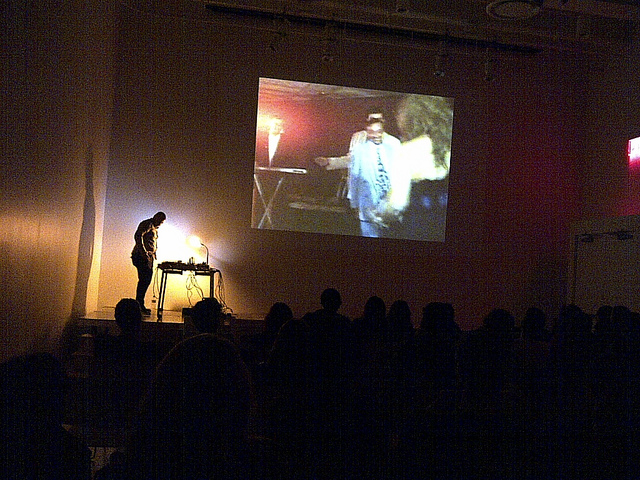
Last month I attended Raed Yassin’s performance and video Horror is Universal (The End), part of the Beirut Art Center’s Museum as Hub at the New Museum. A visual and sonic mash-up of 1970-80s Egyptian B-movie and Arabic music, Horror is Universal (The End) did not so much show the horrific as it did imply that the framework in which we associate horror (tension, camp, atmosphere) can still be constructed with references outside of mainstream U.S. and Europe.

For the last eight years, Raed Yassin has been undergoing a lifelong project of deconstructing Arab popular culture by sampling audio and visual material from TV, radio, pop songs, and feature films. “Horror is Universal” (The End) is considered a milestone in his evolving oeuvre: a multimedia saga performed live by the artist, it involves mixing and rearranging video extracts from dozens of ’80s Egyptian B-movies on screen, while spinning vintage LPs of popular Arabic music and incorporating electronic instrumentation and singing, to create a unique yet disturbing soundtrack progressing towards a chilling finale. It is, in essence, an attempt at fabricating a non-existent genre in twentieth-century Egyptian cinema—horror—by splicing together the viewers’ collective memory of those all too familiar ‘scary moments’ reenacted by the cheap cinematic production of yesteryear.

Ghost Stories – Thanks!

Thanks to everyone who came out for the second (but certainly not final) Art of Fear screening!

To say that I was incredibly  honored to show works by artists I admire so much would be an understatement. So thank you to all the artists who have been a part of this conversation-starter on horror and contemporary art: Takeshi Murata, Darren Banks, Jamie Shovlin, My Barbarian, Aida Ruilova, and Marnie Weber. Also to Nitehawk Cinema, who supports experimentation and all things horror as well as all those who spread the word and assisted putting all the files together (when they should have been working on other stuff). You did my first New York project proud.

More soon!