 If it is said that Hieronymus Bosch draws with his brush, then Marnie Weber films with her sculptures.
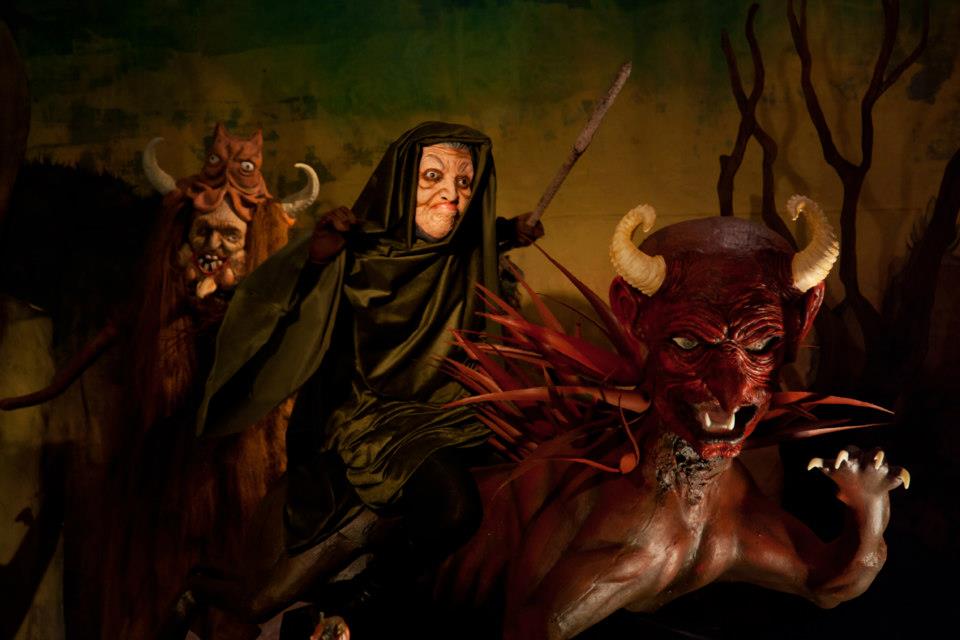
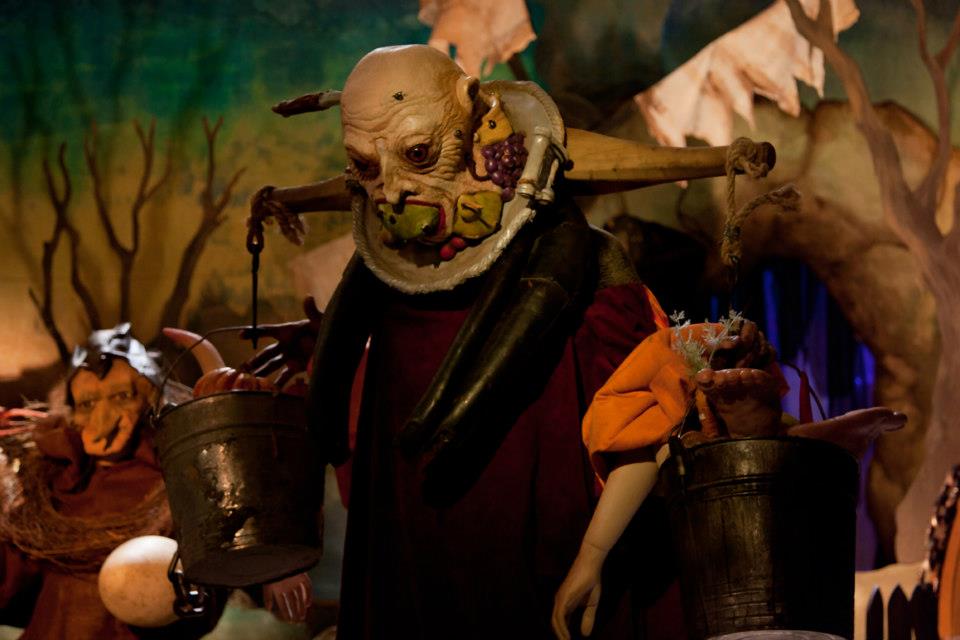
Marnie Weber’s The Night of Forevermore is a static space housing monsters, demons, witches, human-animal hybrids; all of which come alive with slow, repetitive gestures and sound. It’s a Hieronymous Bosch painting brought to life, a haunting world with creatures familiar and strange, each with their own woe, purpose, and revenge. Bosch’s paintings are infamously crowded, layered with forms of life and death co-mingling in this liminal boundary between heaven and hell. It is an area of foretold ghosts. And retained within the picture plain and filmic frame, Weber’s animated sculpture remain spread across the entire tableau but firmly placed on an individual stage.
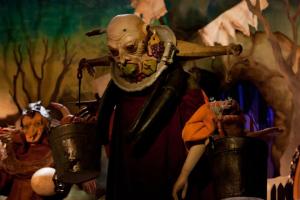 Of course, the activating power that elevates the concept of a painting into a moving image in The Night of Forevermore is the camera itself. Through the all-seeing eye of Weber’s lens, the viewer is shown this world of dreams and nightmares beginning with a static shot where movement begins individually, slowly, and then all at once. This overview pans away, purposefully, to show the action and the function of each creature – the musician, the crying pig, the riding witch, the executioner – giving the audience privileged mobility. It’s the opposite of Bosch’s chaotic evocation of confusion where our eyes dart maniacally across the surface. Weber’s calculated pacing lends the bizarre, gruesome, and monstrous scene an elevated other worldly aura. The strangeness becomes tactile.
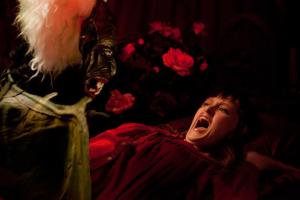 Weber’s films themselves are like dreams, with images floating from space to scene in non-linear time as her representational figures suggest eternal ramifications for questionable deeds. The protagonist in The Night of Forevermore is a young and innocent girl (played by Weber’s own daughter, Colette Rose Shaw) shown her own dreamlike/nightmarish journey to escape the darkness. She is the only one with the freedom to move, her ability traverse through these alternate realms only being because she is still fighting the evil damnation the witch (played by Weber) has subjected her to. Hers is an unexpected reality, confronting a devilish figure, escaping the witch’s clutches, waking up in strange alternate universes. Similar to the horror film heroine (aka the Final Girl), her experience is a visualize metaphor living through life into adulthood. The Night of Forevermore is a late 15th century morality tale made contemporary through the influence of moviemaking.
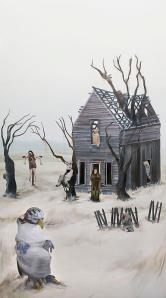 However, as is typical with Weber’s tales, her monsters are not safely relegated to the spiritual (film) world. Instead, the gallery space functions as a portal through which Weber brings forth these beings through objects. The painting and collage on wood works (a first) provide a literal weight to what I’ve always associated as her unique version of film stills. Furthering the narratives in the film and withholding the freedom of movement the film provides, these collage pieces segues perfectly into the sculptural versions of select characters. Haunting us with their presence, the old witch sits still in a rocking chair while watching us watch the film, a bed of fruitless trees lurk nearby. One almost expects them to begin moving, just a twitch, as the film has shown us that even paintings, even creatures in the night, can come alive, seek us out, and steal our souls.
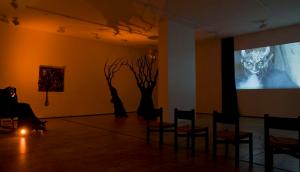 Marnie Weber’s The Night of Forevermore at Marc Jancou Gallery (New York, September 13 – November 3, 2012)






 THE GIRL WHO KNEW TOO MUCH