The Art of Fear: The Picture of Dorian Gray

In The Picture of Dorian Gray – a young man’s debauchery and vice manifests in his portrait after his wish to remain young is mysteriously granted.

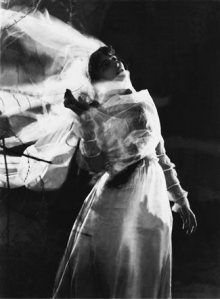
We’re starting off The Art of Fear with one of my personal favorites and one of the strongest examples of art in horror cinema, Albert Lewin’s The Picture of Dorian Gray (1945). It’s based on Oscar Wilde’s delicious 1891 novel of the same name and, with some small variations, stays pretty true to the original narrative.[1] On that note, I want to clarify that this discussion is on the 1945 film version so any deviations and changes from the literary language or subsequent remakes are not considered.

The story goes like this: Dorian Gray is a young man so distraught after realizing that his portrait, painted by friend Basil Hallward, would always exist in a beautiful youthful moment while he would eventually age and whither that he manages to magically transmit the residue from his ‘lust for life’ experiences onto this painting. Meaning that the painting would bare the brunt of these actions, turning ugly and old while Dorian remained the same. His decades-long reign of the 19th century’s version of ‘sex, drugs, and rock-n-roll’ (and murder) leads him down many regretful paths. He tortures himself by viewing each of the portrait’s new evil transformations but revels in his cheating of death. It’s only until a young woman believes in his goodness that he, rather forcibly, expels his history from the painting back onto himself and dies a hideous old man.

Continue reading

The Art of Fear – an introduction

The Art of Fear is a writing series on horror cinema’s prolific usage of art as the focal point of fear.

I’m happy to announce the launch of a new writing feature on The Girl Who Knew Too Much called The Art of Fear. Titled in homage to Vincent Price’s BBC radio programme The Price of Fear and subsequent biography, The Art of Fear focuses on horror cinema’s prolific usage of art as the focal point of fear. Below is an introduction, in the very simplest of terms, to what I hope will become a lively, thought-provoking, and entertaining discussion on two of my favorite things: art and horror.

That horror films frequently feature artwork is not a startling revelation but this noticing this brought my individual obsessions with horror and art together, kick-starting my research on horror’s influence on contemporary artists. Now, by delving into arts role in horror I can further map out connections between the two. It also raises significant questions: Why is it that painting and sculpture can easily incorporate into horror narratives? What is it about art and artists that adapt so readily into the horrific? And since visual art and cinema are two different ways in which to tell a story, how can the collation of the two in the context of the horror genre, establish a more in-depth visual and narrative experience?

Here I’ll address these questions through a discussion of films such as Picture of Dorian Gray, House of Usher, Daughters of Satan as well as the television series Night Gallery in the terms of how artwork is used as the motivating force of horror. I’ll also be looking at how the conservation and preservation of art is an integral part of apocalyptic films like The Omega Man, I am Legend, and Children of Men. This ongoing process becomes more profound and fun with each new discovery I make and I hope it’ll be the same for you!

The plan is to publish an entry for The Art of Fear each week until the series concludes (if it ever does) but, of course, this may vary from time-to-time. First up will be… Albert Lewin’s Picture of Dorian Gray (1945).

Featured so far:

The Art of Fear: Picture of Dorian Gray
The Art of Fear: The Fall of the House of Usher

Image: Rod Serling introducing an episode of Night Gallery where the artwork told the story.

Jean Rollin and Aïda Ruilova

On 15 December legendary French ‘erotic horror’ (read: vampires and lesbians) director Jean Rollin passed away at the age of 72. In memorandum, I am posting an excerpt of my writing on artist Aïda Ruilova and her use of Rollin in her artist films.

Aïda Ruilova is interested in cult relationships associated with horror film, using the appeal of the underground and insider fandom as an alluring edge to her works. Her narrative film Meet the Eye (2009) cast cult queen Karen Black and legendary punk artist Raymond Pettibon but her literal incorporation of lesbian vampire director Jean Rollin in tuning (2001) and life like (2006) is Ruilova’s pinnacle of reflexivity. Here imitation slips into an homage to Rollin, locating points of desire as she also do by festishising the objects of Carlo Mollino in Endings (2007).

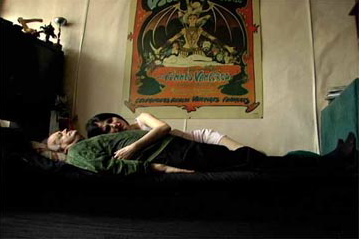
As in Roman Polanski’s Rosemary’s Baby, Ruilova shifts horror away from representing the ‘other’ and marks it pointedly back onto our selves. Her films and videos reveal a different side to horror, one that uses the genre as a vehicle to express the agony of being close to others and to your self. Her single channel installation tuning consists of an image of the artist holding hands with cult director Jean Rollin in his Parisian home. In a little over one minute this blurry picture quickly jerks in and out of focus. Repeatedly looped action and scored to Sonic Youth’s Confusion is Sex (1993), Ruilova creates a jarring experience for the viewer. Tuning entices a close watch but never quite permits audience projection into the action.

Years later, her video life like revisits Rollin as a character once again in his apartment. In it he has died and a woman baring close resemblance to Ruilova paces the room and caresses his body. Like a lot of her work, life like features a series of tightly composed scenes that collapse the distance between the onscreen action and the audience to create an appropriately intimate and personal space, seductively calling loyalty and love into question.

She bravely exposes herself by weaving into her narratives themes of love, loss, confusion, pain, and obsession. Through this collusion of herself and horror historical figures she establishes a dialogical relationship with the past and uses it to construct a new path for the genre.

Video clip from life like (2006) – image still above

Gregory Crewdson’s ‘Santuary’

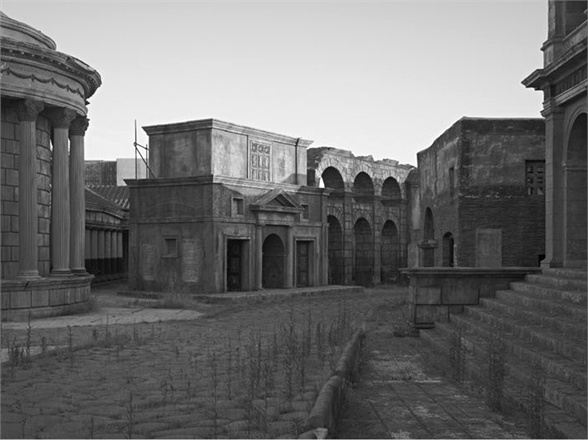
The haunting photographs of Cinecittà in Gregory Crewdson’s Sanctuary (at White Cube Mason’s Yard until 8 January 2011)

Gregory Crewdon’s Sanctuary is all about revelation. His previous bodies of work like Beneath the Roses showed fantastical representations of the everyday, people and places of a hyper-real nature. Knowing that these were elaborately constructed scenarios and that the image itself was a result of intense artistic labour was part of the fun. Santuary strips the theatricality way down but still advances Crewdson’s interest in the collision of fact and the fictionalized through the black-and-white photographs of Cinecittà.

Briefly Cinecittà (the city of cinema) is the Italian cinema studio built by Mussolini in 1937 that has been the site of countless film treasures from both Italy and America throughout the decades. Still operable today after an upgrade in the 80s, Crewdson captures the almost apocalyptic ruins of this anonymous international cityscape. Dario Argento considers Cinecittà to be a ‘mythic zone’ and Santuary captures this weight of this sentiment. For instance, Untitled 9 has a boat, dilapidated bleechers, and an ornamental frame set in the foreground in the abandoned cityscape. If this isn’t the stuff of dreams, I’m not sure what is.

With forty-one photographs, Santuary recalls the seriality of the Becher’s industrial documentation and with each successive photo one can almost hear ‘Marcello’ being called from La Dolce Vita or witness Elizabeth Taylor snogging Richard Burton during Cleopatra. For a cinephile, these projections of grandeur can be inserted onto such haunting and desolate images. It’s because Crewdson reveals the guts of the whole operation (i.e. what our film fantasies are made of) at a respectable distance that the audience is allowed this wonderful space in which to project. These photographs are brilliant in their simplicity and surprisingly luscious in detail. They are very much about what architectural spaces mean to us, particularly when they are in ruin. Ambiguous by design, Cinecittà is a blank canvas for narrative and Sanctuary quietly brings to mind what remains in our memory, in history, and in fantasy.

What is real in movie making anyway or in art making either for that matter? They are only representations of things/places/people and, in still images like photography and painting, just a chosen frozen moment of the narrative is depicted. Crewdson repeatedly reveals the structure stills of Cinecittà in Santuary (scaffolding erected onto ‘Roman’ buildings and the backs of interior walls) and its place within the real world (apartment buildings dwell domestically in the background). Make no mistake, this is not present day glamour but as much of an authentic representation as we’ll get of the inauthentic.

Ebert’s non-list of horror films

Back in October Roger Ebert made an non-list of ten horror films with the fortunate stipulation that they must all be viewable online and for free. So lucky for us he made a convenient watching “list” of some of the most captivating films related to horror cinema. Granted, some of these are only termed horror in retrospect but still established within the cannon, influential to horror filmmakers and audiences alike. And who doesn’t like a little House of Usher action?

The Third Man by Carol Reed
The Beauty and the Beast by Jean Cocteau
Frankenstein by James Whale
Detour by Edgar G. Ulmer
The Fall of the House of Usher by Jean Epstein
M by Frtiz Lang
Nosferatu by F. W. Murnau
The Cabinet of Dr. Caligari by Robert Weine
Un Chein Andalou by Luis Bunuel and Salvador Dali
Dracula by Tod Browning

Marnie Weber Interview

My interview with the amazing Marnie Weber featured on Lux.

Marnie Weber creates fantastical worlds that, quite frankly, I want to live in or, at the very least, pay a visit. Her atmospheres are an aesthetic mash up of Victorian, 1970s commune, and gritty punk filled with the kind of unsettling creatures that would scare the pants off you if they weren’t somehow totally endearing. Indeed, there is something very magical and intangible about her film, collages, and installations. Weber expresses the theatricality of old Hollywood, bringing forth our own nostalgic tendencies through the expression of death and dreamscapes. Her images are touching, luscious, and melancholic; reflecting another world placed firmly within our own.

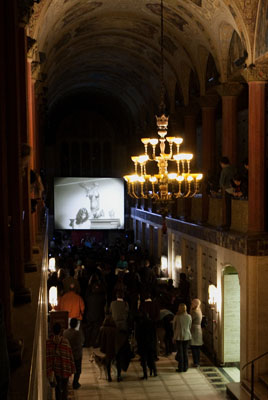
For the past six years, Marnie Weber has woven together fictional narratives about the post-mortem adventures of the Spirit Girls, taking us on their bizarre and uncanny journey through the afterlife. Earlier this month at the Mountain View Cemetery & Mausoleum in Altadena, California, Weber put an end to their perpetual mourning and opened up a new avenue for exploration. Eternity Forever, presented by West of Rome Public Art, was inaugurated with a funeral processional and the debut screening of Weber’s film The Eternal Heart where the Spirit Girls, in their last performance, played the live score. This exhibition, which also features a new series of collages, represents the death and re-birth of Weber’s ongoing relationship with her monstrous characters.

CONTINUE READING ON LUX’S WEBSITE

Image: crowd at the Eternity Forever opening.  Courtesy of Marnie Weber and West of Rome.

Get on the Band-wagon: Darren Banks’ mobile cinema

Project essay for Darren Banks’ Palace Band-Wagon at FIAC 2010. Read my interview with Banks on Lux.

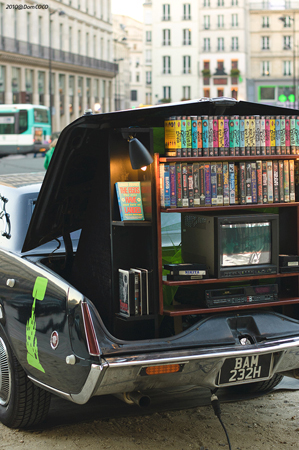
Parked in the Cour Carrée entrance of FIAC 2010, Darren Banks’ (UK) temporary horror cinema Palace Band-Wagon brings heyday of the videocassette back to life. This is the ‘mobile cinema’ version of The Palace Collection, an evolving installation that negotiates collective horror history, effects of new technology, modes of distribution, and ideas on the collection. Housed in a 1970 Cadillac Eldorado that comes equipped with a television and a VCR, the public can choose continuous screenings of horror video classics such asEvil DeadBrain Damage, and The Hills Have Eyes from Bank’s personal collection. This video collection consists of films distributed by Britain’s infamous Palace Pictures in the 1980s and have been tirelessly procured by Banks from Ebay, boot fairs, and charity shops.

Continue reading

Recent art writings on the Modernist

October art reviews on the Modernist

Oscar Tuazon on the Modernist: Oscar Tuazon’s solo exhibition Sex contains a body of work that re-purposes the functionality of once operational objects into, well, something else. In some ways the work is destroyed, its original intention thwarted. But mainly, Tuazon’s intervention and de-construction of things like his bed, a mirror, and photographs establish a new meaning for these objects…

Move: Choreographing You on the Modernist: The Hayward Gallery’s Move: Choreographing You delivers exactly what the title promises – the audience becomes the players, moving in, on, around, and through a myriad of (mostly) participatory artworks. The traditional relationship between the performers and the audience completely collapses as our hands-on experience not only takes center stage but also quite literally activates the work…

‘Made in China: Ai Wei Wei at Tate Modern’ on the Modernst: The week of art insanity that invariably surrounds the Frieze Art Fair began by walking through a sea of sunflower seeds for Tate Modern’s latest commission in The Unilever Series, Ai Weiwei’s Sunflower Seeds

Ignatiy Vishnevetsky’s review of Survival of the Dead

Ignatiy Vishnevetsky’s review of George Romero’s Survival of the Dead. The first paragraph is beautiful:

Romero’s horror set-ups are never about the terrifying situation and always about the trouble the characters get into by trying to solve it or escape it; if Carpenter’s horror is based on inevitability / powerlessness in the face of true horror (meaning: the value of horror in defining human limitations), Romero’s is based on how easily complications could have been averted by someone with a different personality or with fewer prejudices (meaning: the value of horror in defining human shortcomings). Therefore, it is impossible to separate Romero’s situations from his characters (see also: Season of the WitchKnightriders), and so it wouldn’t really be right to call Survival of the Dead a movie about an island full of zombies; it is, in Romero tradition, a movie about a group of hard-headed individuals and how this island of zombies they come upon is organized, ruled and dealt with.