Friday the 13th: Peter Doig

Furthering the topic of women in horror film as it extends into contemporary art is a discussion on Friday the 13th’s main character Alice in the work of Peter Doig and Ben Rivers. As artists both Doig and Rivers touch upon the famous horror heroine’s status as the ultimate slasher ‘Final Girl’ who Carol Clover describes as, ‘…intelligent, watchful, level headed; the first character to sense something amiss…the only one, in other words, whose perspective approaches our own privileged understanding of the situation’ (Clover 1987, 79). As our portal into the action and into narrative meaning, she is the character with whom the audience most identifies because we have shared in her suffering and she, like us, remains alive.
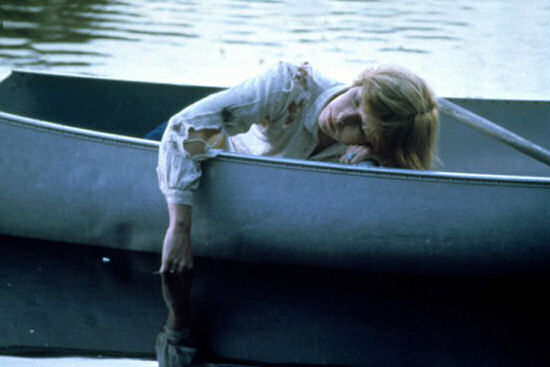
Peter Doig is well known for his usage of photographic, film, and cultural as image references. What makes his explicit crediting of Friday the 13th in his painting series that includes Canoe Lake and Echo Lake is that it marks the only time he has openly credited a filmic source. Despite this, the influence film has on him creatively is obvious (his ongoing commitment to the Studio Film Club in Trinidad is evidence) and a stylistic composition of horror films can be read throughout much of Doig’s work. For instance, he invests in the unknown with his cabin series Cabin Essence (1993-4), Concrete Cabin (1991-2), and Concrete Cabin II (1992). Architecturally the ‘house’, haunted or otherwise, is prevalent in horror but it is particularly the isolated cabin in the woods often used as a trope; The Old Dark House (Whale, 1932), Evil
Dead
(Rami, 1981), Cabin Fever (Roth, 2002), and The Strangers (Bertino, 2008) are but a few examples. The woods themselves are generally areas of the unknown and produce fear in imagining what kind of people inhabit them. Equally Doig’s Hitch Hiker (1989-90) contains an aimless sense of unease and feelings of solitude, calling to mind The Hitcher (Harmon, 1986) and Steven Spielberg’s Duel (1971).

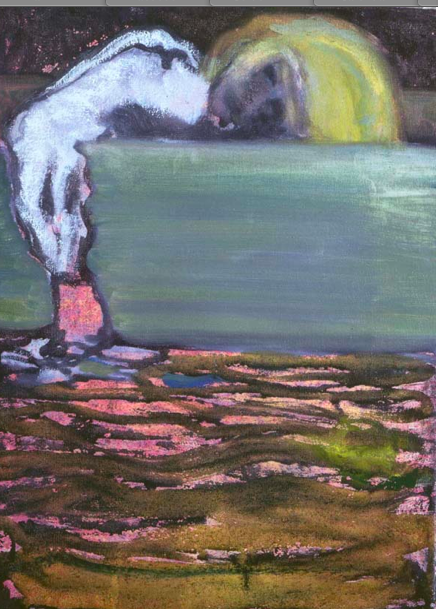
What connects a seemingly miscast Doig to horror cinema is the incredible spatiality created between the captured in-between moment and the conflated relationship between the audience and the scene. Peter Doig encapsulates the entirety of meaning into one image in his works inspired by the camp-counselor killing classic, Friday the 13th. Formally he uses paint to construct this insertive space with linear divisions on the canvas, compiling multiple layers of memories and stories. This reflective image becomes the area where the viewer can insert him/herself and his/her stories into the picture.
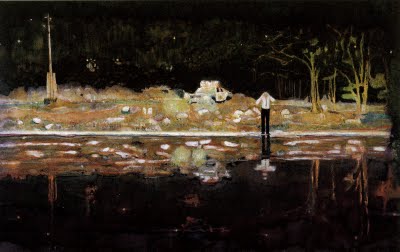
Specifically in Echo Lake and Canoe Lake he delineates the crucial point in Friday the 13th when what appears to be resolved is anything but. With these paintings he creates alternate points of view: in Canoe Lake we look onto Alice safely in her canoe but in Echo Lake are viewpoint is through Alice’s eyes, looking onto the policemen on the shore. Viewed in relation to each other, this is similar to different cuts used in film where the audience is simultaneously the eyes of the killer, the victim, and the outsider. Importantly with Doig, who may or may not intend to completely tell the heroine Alice’s tale, he never privileges the audience with resulting action. Instead, he evokes her storyline as a device to hold all tension. By never moving forward or backwards, the girl and the audience are forever held in to this singular moment. It is a beautifully evocative way to frame anticipation and anxiety that will never be released.

Images (top to bottom)
Peter Doig – Canoe Lake (1997-98), oil on canvas
Film still from Friday the 13th (Cunningham, 1980)
Peter Doig – Friday the 13th (1999), oil on linen
Peter Doig – Echo Lake (1998), oil on canvas

Burnt Offerings: Gary Simmons and Karen Black

As a precursor to their Bloody Women panel discussion tomorrow night, the ICA London asked the Twitter-verse to name our favorite horror ladies (mine: Barbara Steele, Dara Nicoladi, Karen Black), and it sparked thoughts on how the role of the women and even the “Final Girl”often directly manifests in artists’ work too.

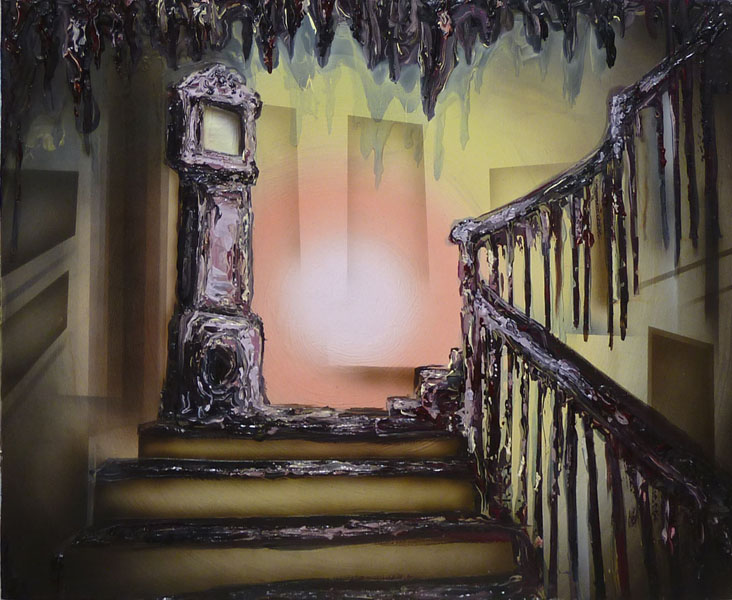
Take Gary Simmons frenetic paintings in his 2010 exhibition Midnight Matinee where images from the Texas Chainsaw MassacrePsychoAmityville Horror, and Burnt Offerings referenced familiar architectural places found in horror films: the house, the gas station, and the cinema. Interestingly the paintings themselves mimic filmstrips, a further collision of art and film. And if you’re wondering how this relates to women…

I’m just beginning research on the role of architecture in visual art stemming from a direct relationship to horror cinema (think of the aforementioned Simmons, Mike Nelson, etc). Amongst other structural functions such as spatiality and establishing a sense of unease within the familiar, the house/home in horror films challenges the forced and/or changing ideas of domesticity throughout the decades. One example of this is also one of the films Simmons references, Burnt Offerings (1976) starring my horror heroine Karen Black. The movie is about a young family who takes care of a mysterious house one summer to escape the city however they wind up as literal house food. The house kills most of family, save Black’s character, who is gradually yet forcibly absorbed into the house becoming its official “mother” and caretaker. The film can be read as a reaction to second wave of feminism in the United States, a return back to traditional and fundamental women/mother/Victorian ideals.

Simmon’s usage of the Burnt Offerings house facade reinforces the notion that we (i.e. the audience, viewer, or visitor) can never really judge a book by its cover; that what lurks behind the front door to an old house or behind the cinema screen curtain can be an unexpected yet real horror. His blurred reflection of the house establishes a visual tension that reminds us that physical and mental ‘interiors’ are infinitely complicated and that there can be a serious danger in the projected appearance of perfection.

Images:
Gary Simmons Burnt Grid, 2010 – Pigment and charcoal on paper – 12 panels
Still of Karen Black in Burnt Offerings (Dan Curtis, 1976)
Gary Simmons Between Offerings, 2010 – Pigment, oil paint and cold wax on canvas

Tick Tock: Christian Marclay’s “The Clock” at BAS7

Brief writing on Christian Marclay’s The Clock (2010) as seen in the British Art Show 7 (currently on view at the Hayward Gallery).

Christian Marclay’s The Clock is so much more than an awareness of literal time. Certainly, the onscreen images constantly remind us that we’re in the here and in the now. In the theatre we become weighted in this moment through the succession of each passing minute flickering before us. Something occurs beyond this explicit notion of the clock ticking however, something that extends out of the undercurrent theme of death and waiting. What unfolds is an idea of time as a (pop)cultural marker and reference point for the viewer that gives The Clock its pulse.

The Clock is a 24-hour single channel video that includes thousands of scenes from film and television (silent era to the very recent) that reference the time, each minute that passes on screen in the same minute passing for us in the audience. Fragmented time becomes a synchronized event. It’s a powerful and enjoyable experience to watch briefly our favorite movies, bask in recognizing certain actors (Vincent Price, Peter Falk!), episodes, and places; Marclay’s fluidity in joining these scenes definitely makes for highbrow channel surfing sensation. Because of this, a question is posed: is it our familiarity with these references that signifies the true relationship to time in The Clock? In thirty, fifty, eighty years from now viewers will view The Clock as its own frozen moment in time without any filmic sources of that particular future time? Will the work become pastiche or evolve in meaning?

Time is very much a universal construct and personal experience, changing as we get older and our life evolves. Boredom, love, hate, youth, excitement, all effect our perception of how long or short any given period of time feels to us. In this way, I would think of The Clock as being eternally temporal. A post-modern composition of familiar faces, places, and films that itself will change in its meaning throughout the decades, always with the grounding reminder of finitude, to become an object to be absorbed by future artists, watchers, and nostalgic revelers.


Horror films and art museums

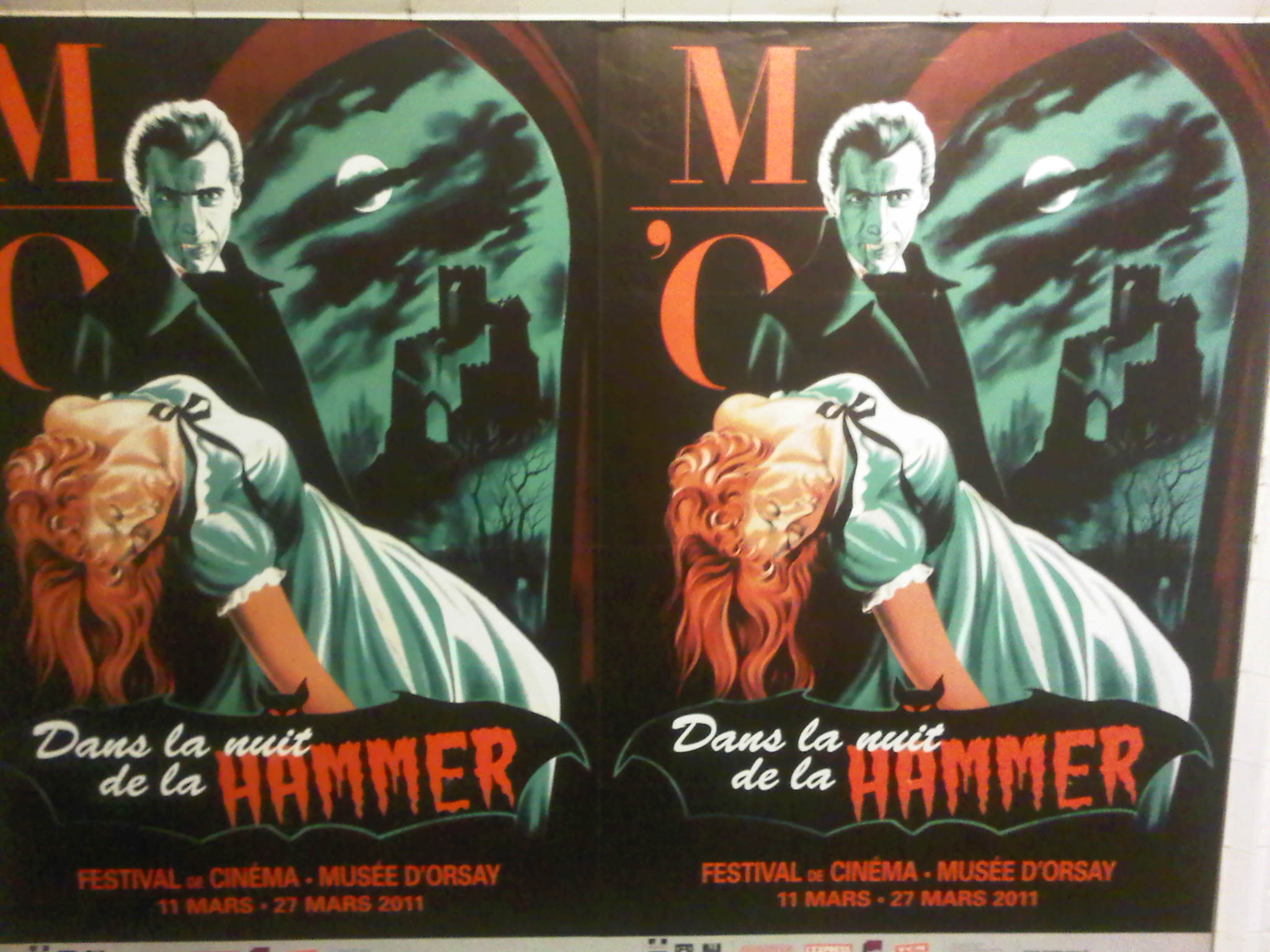
Early this week a friend of mine sent me this photo he had taken of a street poster in Paris for the Musée d’Orsay’s In the Night of Hammer (a two-week screening series of classic Hammer Horror films) and it got me thinking about how horror cinema often finds itself situated in an art institution. Romero’s Night of the Living Dead (1968) founds critical stature in the United States after a screening at the Museum of Museum Art, an institution who has shown the film throughout the decades and who acquired a print for their collection in 1980. Recently it’s become noticeable that in London there have been frequent showing of horror films in galleries. Inspired to dig a little deeper as I explore the relationship between horror and art, I’ve compiled a [growing] list of non-Halloween related horror screenings in art and film institutions (after the jump):

Continue reading

The Art of Fear: Bluebeard

In Edgard G. Ulmer’s brilliant and beautiful film Bluebeard (1944), artist Gaston Morrell deals with the failure of finding pure beauty in his paintings by killing his muses. The Art of Fear on the artistic practice of a serial killer…

A spectacularly dark mixture of noir and horror, much like Ulmer’s previous film The Black Cat (1934), Bluebeard is a revenge story. John Carradine plays Gaston Morrell (aka “Bluebeard”) in one of his rare leading male roles, an artist so scarred by the revelation that his ultimate muse is a “loathsome creative” that he kills her. This woman, whom he had rescued and nursed back to health after an accident, was the source of what he believed to be his greatest achievement in painting. After her murder, Gaston becomes fundamentally broken. Unable to escape the pain she had inflicted, whomever else he painted turned into a representation of her…and so he killed them too. She continually haunted him, controlling his downward spiral in artistic practice, ability to love, and mental stability.

Continue reading

Brendan Flanagan

I’m really interested when filmic influences, particularly horror cinema and B-movies, manifest themselves into static images. The paintings of Canadian artist Brendan Flanagan are a recent discovery. The works are architectural, structured, and extremely painterly. Culled from film, photographic, and archival images they are set within a cultural framework yet still quite unsettling.

See his Sightlines solo exhibition that just closed at Thierry Goldberg in New York.

Image: Landing, 2010 – 0il and acrylic on board – 20 x 25 inches (Courtesy of Thierry Goldberg)


Eyes Without a Face: Gillian Wearing and Marnie Weber

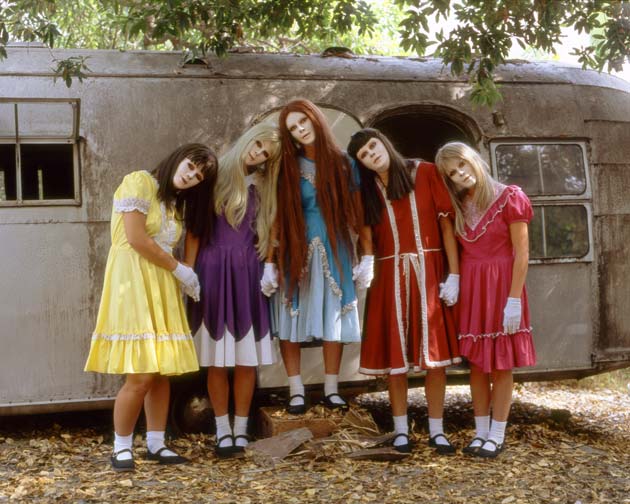
Last night I watched George Franju’s Les yeux sans visage / Eyes Without a Face (1960) on the big screen (thanks BFI) and was struck by how the aesthetics of Christiane Genessier’s mask resonated so strongly in relation to the work of Gillian Wearing and Marnie Weber. There is clearly an in-depth exploration waiting on how the mask functions in horror cinema and art, particularly in relation to women and identity. In the meantime, here are some images:

Final scene in which Christiane Genessier has set things ‘right

Still of the Spirit Girls from Marnie Weber’s Sing Me a Western Song (2007)

Christiane calling her fiance.

Gillian Wearing’s Self Portrait at Three Years Old (2003)

Mike Nelson

Mike Nelson scares me. His installations are claustrophobic and isolating and while no one thing in the elaborately constructed spaces is particularly frightening (clown masks aside), it’s the immediate convergence of all the things that produces an overwhelming intense experience. And I can’t get enough.

I feel like I shouldn’t be in one of Nelson’s rooms, touching and opening doors, searching my way through the maze (not in the literal dark but the tension is just the same). The sense of something being off is palpable and yet, during this feeling of disorientation, I feel totally within my element. Like a good horror film, I feel both displaced and engrossed, enjoying not knowing my way and appreciating the sensory overload provided to me. Indeed, Nelson’s work has a lot in common with the aesthetics and structure of horror cinema such as his employment of architecture and interiors, particularly in the usage of a succession of rooms.

In her essay on Nelson’s Coral Reef (owned by Tate and recently on display at Tate Britain), Helen Delaney says: “Nelson’s use of suggested, open-ended narratives is influenced by filmmakers Sergei Parajanov and Dario Argento, whose ambient, non-linear films present tableaux that absorb and envelop the viewer. The movement from one room to another produces a kind of filmic ‘cut’ between one scene and the next, allowing narrative possibilities to proliferate without coalescing into anything fixed. It triggers a growing sense of unease.”

I could only wander, stop, and stare when encountering his Studio Apparatus for Camden Arts Centre… (1998/2010) at Camden Arts Centre’s now closed exhibition Never the Same River (Possible Futures, Probable Pasts). Consisting of three rooms (dirty entrance walkway and a small reception/office room that led to the larger backyard object extravaganza. In an attempt to focus, record, and re-live the experience I just wrote down all I thought I saw: selection of motorcycle helmets with raccoon takes; slices of science fiction mags; fake flames; slouched body with paper bag head; log fire with face shield, fur, gas cans, wood planks and concreted blocks; space constellations of hubcaps, wire, and balls; latters; antlers; Mickey Mouse with devil antlers; chicken wire; humming radio; fabric mountains; the list goes on.

Each new work I encounter of Nelson’s is a new adventure. I have a long road of discovery ahead when it comes to his work and I’m looking forward to the journey.

Mike Nelson will be representing Britain at the 54th Venice Biennale this summer. Image is from Camden Arts Centre, courtesy of the artist.

Film influences: David Noonan

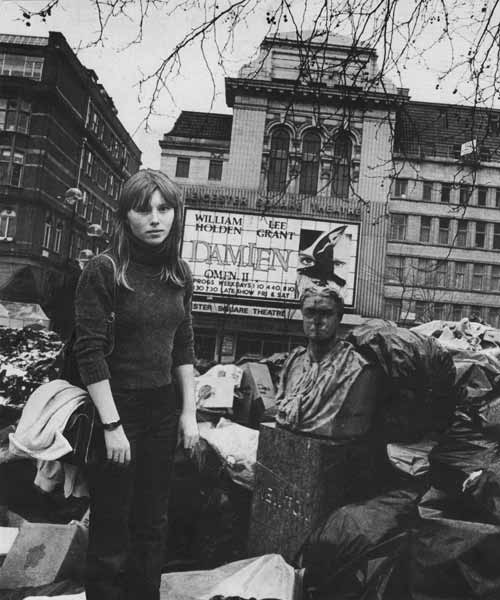
In Frieze’s October 2006 Life in Film London-based artist David Noonan discusses, amongst others, two influential horror films: Susperia and Toby Dammit (which is certainly one of the most surreal and insane Poe adaptations in cinema). Noonan’s screenprints are filmic in themselves. A collage of images from movies, books, and magazines, they are haunting impressions of a scene that vibrate with a sense of performative movement. See his most recent exhibition at David Kordansky Gallery in Los Angeles.

In Suspiria (1977), directed by Dario Argento, an American ballerina enrols in an exclusive ballet school in Germany and becomes embroiled in a witches’ coven bent on chaos and destruction. The art direction is astonishing and overshadows the acting; the film is saturated in a very unnatural palette, which heightens its sense of unreality, right down to the wallpaper designs by Escher. The baroque, flamboyant soundtrack is by the Italian Prog Rock band Goblin and is a masterpiece in itself. The murders are theatrical and balletic; the film is like a violent opera.

Federico Fellinis’ short film Toby Dammit (1968) is part of the trilogy, ‘Histoires Extraordinaire’, also known as ‘Spirits of the Dead’ after a short story by Edgar Allen Poe. The film is complete with Fellini’s trademark references, from circuses to paparazzi, stardom, kitsch and glamour. The film stars Terrence Stamp at his finest: an alcoholic, self destructive thespian lured to Rome to appear in a television show by the promise of a Ferrari – in other words a Faustian pact. Fellini conjures an extraordinary, creepy atmosphere, and Stamp’s crazed, decadent performance makes it all the more powerful.

Image: Leicester Square, 2005, Archival inkjet on paper from paper collage (not one of the more filmic works but one of my favorites)