Simon Clark is an artist/writer/musician living and working in London. He is currently working on a practice-based PhD at Goldsmiths College. The provisional title is The Kiss of the Dead; Towards an Undead Sublimation of Melancholia.
Simon Clark is an artist/writer/musician living and working in London. He is currently working on a practice-based PhD at Goldsmiths College. The provisional title is The Kiss of the Dead; Towards an Undead Sublimation of Melancholia.
Horror’s not dead! Long musing on American Horror Film: The Genre at the Turn of the Millennium…
American Horror Film: The Genre at the Turn of the Millennium (edited by Stefen Hantke) is a provocation on the status of American horror cinema through discussing and analyzing films and trends from the last decade. I’d been anxious to read this anthology after reading Hantke’s essay Academic Film Criticism, the Rhetoric of Crisis, and the Current State of American Horror Cinema: Thoughts on Canonicity and Academic Anxiety. Split into three sections – 1) Bloody America: Critical Reassessments of the Trans/-national and of Graphic Violence; 2) The Usual Suspects: Trends and Transformations in the Subgenres of American Horror Film; 3) Look Back in Horror: Managing the Canon of American Horror Film – it’s a breath of much-needed fresh air, relocating academic focus from the 1960/70s into the present.
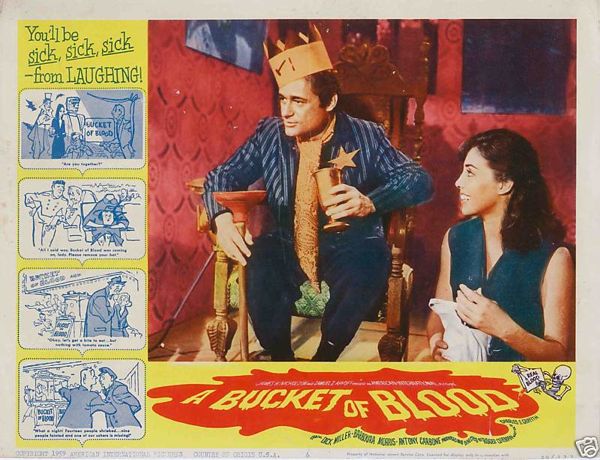 Who says the art world isn’t scary? The Art of Fear takes on Roger Corman’s classic A Bucket of Blood.
If there’s a better satirical film on the art world than A Bucket of Blood (1959) then I certainly haven’t seen it (Pecker and Untitled come close-ish). Corman’s hilarious jab at the beatnik artist types of the 1950s easily translates into the ridiculousness of today’s contemporary art world. Though made by the ‘King of B-movies’ and reportedly made for a mere $50k, A Bucket of Blood is a thoughtful and provoking look at the beginning of contemporary art as cultural phenomenon. It owes a lot to House of Wax in its relationship to revenge and the frustrating experience of creating artwork whether the artist is deformed as in House of Wax or without talent as in A Bucket of Blood. However, it quite cleverly mimics the capriciousness of the art world. As Sarah Thornton writes in her enthnographic study Seven Days in the Art World, ‘It’s [the contemporary art world] structured around nebulous and often contradictory hierarchies of fame, credibility, imagined historical importance, institutional affiliation, education, perceived intelligence, wealth, and attributes such as the size of one’s collection.’[1] More than fifty years after its release, the satire in A Bucket of Blood is still relevant and relatable.
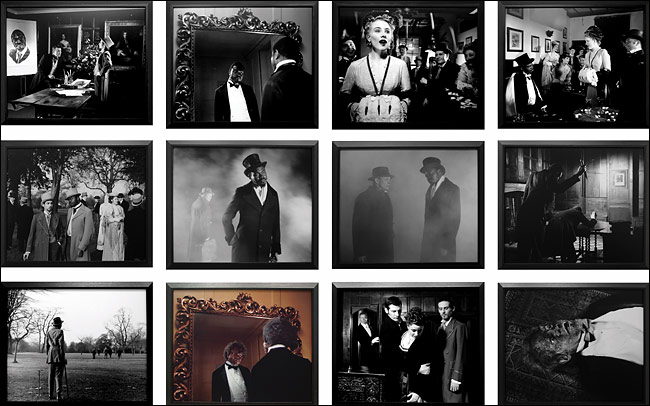
Horror narratives are cyclical and often self-reflective – evolving from literature to theatre to film and, as I express here on the blog, onto artwork. Bouncing along and between these different mediums means horror continues to generate its relevance and influence. To show how this is true, take my recent Art of Fear discussion about how artwork functioned within the horror of The Picture of Dorian Gray. In 2001, British born Nigerian artist Yinka Shonibare produced Dorian Gray, his first photographic series in which he assumes the lead role. Here, much as in the book and film, Shonibare uses this story as a commentary on Victorian (and contemporary) values of class.
Another stellar example of this is experimental filmmaker Ivan Zulueta’s Frank Stein (1972) which I hope to discuss more in length here soon.
Family portraits in The Fall of the House of Usher encapsulate the Usher’s ‘plague of evil’.
 The second film for The Art of Fear is Roger Corman’s vibrant The Fall of the House of Usher or House of Usher (1960) starring the estimable Vincent Price. Like The Picture of Dorian Gray the film adapts a literary classic, Edgar Allen Poe’s short story of the same name published in 1839. It is the first of eight movies Corman would use Poe, sometimes adding a little H.P. Lovecraft into the mix, and besides The Masque of the Red Death it is the best of the bunch. Paintings actually factor in many of the Corman/Price/Poe movies – remember the watchful painting of the ‘dead’ wife in The Pit and the Pendulum (1961) and the looming ancestral portrait in The Haunted Palace (1963). Considering Corman’s original A Bucket of Blood (next feature on AOF), perhaps he has an art fetish!
 In The Picture of Dorian Gray – a young man’s debauchery and vice manifests in his portrait after his wish to remain young is mysteriously granted.
We’re starting off The Art of Fear with one of my personal favorites and one of the strongest examples of art in horror cinema, Albert Lewin’s The Picture of Dorian Gray (1945). It’s based on Oscar Wilde’s delicious 1891 novel of the same name and, with some small variations, stays pretty true to the original narrative.[1] On that note, I want to clarify that this discussion is on the 1945 film version so any deviations and changes from the literary language or subsequent remakes are not considered.
The story goes like this: Dorian Gray is a young man so distraught after realizing that his portrait, painted by friend Basil Hallward, would always exist in a beautiful youthful moment while he would eventually age and whither that he manages to magically transmit the residue from his ‘lust for life’ experiences onto this painting. Meaning that the painting would bare the brunt of these actions, turning ugly and old while Dorian remained the same. His decades-long reign of the 19th century’s version of ‘sex, drugs, and rock-n-roll’ (and murder) leads him down many regretful paths. He tortures himself by viewing each of the portrait’s new evil transformations but revels in his cheating of death. It’s only until a young woman believes in his goodness that he, rather forcibly, expels his history from the painting back onto himself and dies a hideous old man.
 The Art of Fear is a writing series on horror cinema’s prolific usage of art as the focal point of fear.
I’m happy to announce the launch of a new writing feature on The Girl Who Knew Too Much called The Art of Fear. Titled in homage to Vincent Price’s BBC radio programme The Price of Fear and subsequent biography, The Art of Fear focuses on horror cinema’s prolific usage of art as the focal point of fear. Below is an introduction, in the very simplest of terms, to what I hope will become a lively, thought-provoking, and entertaining discussion on two of my favorite things: art and horror.
That horror films frequently feature artwork is not a startling revelation but this noticing this brought my individual obsessions with horror and art together, kick-starting my research on horror’s influence on contemporary artists. Now, by delving into arts role in horror I can further map out connections between the two. It also raises significant questions: Why is it that painting and sculpture can easily incorporate into horror narratives? What is it about art and artists that adapt so readily into the horrific? And since visual art and cinema are two different ways in which to tell a story, how can the collation of the two in the context of the horror genre, establish a more in-depth visual and narrative experience?
Here I’ll address these questions through a discussion of films such as Picture of Dorian Gray, House of Usher, Daughters of Satan as well as the television series Night Gallery in the terms of how artwork is used as the motivating force of horror. I’ll also be looking at how the conservation and preservation of art is an integral part of apocalyptic films like The Omega Man, I am Legend, and Children of Men. This ongoing process becomes more profound and fun with each new discovery I make and I hope it’ll be the same for you!
The plan is to publish an entry for The Art of Fear each week until the series concludes (if it ever does) but, of course, this may vary from time-to-time. First up will be… Albert Lewin’s Picture of Dorian Gray (1945).
Featured so far:
The Art of Fear: Picture of Dorian Gray
The Art of Fear: The Fall of the House of Usher
Image: Rod Serling introducing an episode of Night Gallery where the artwork told the story.
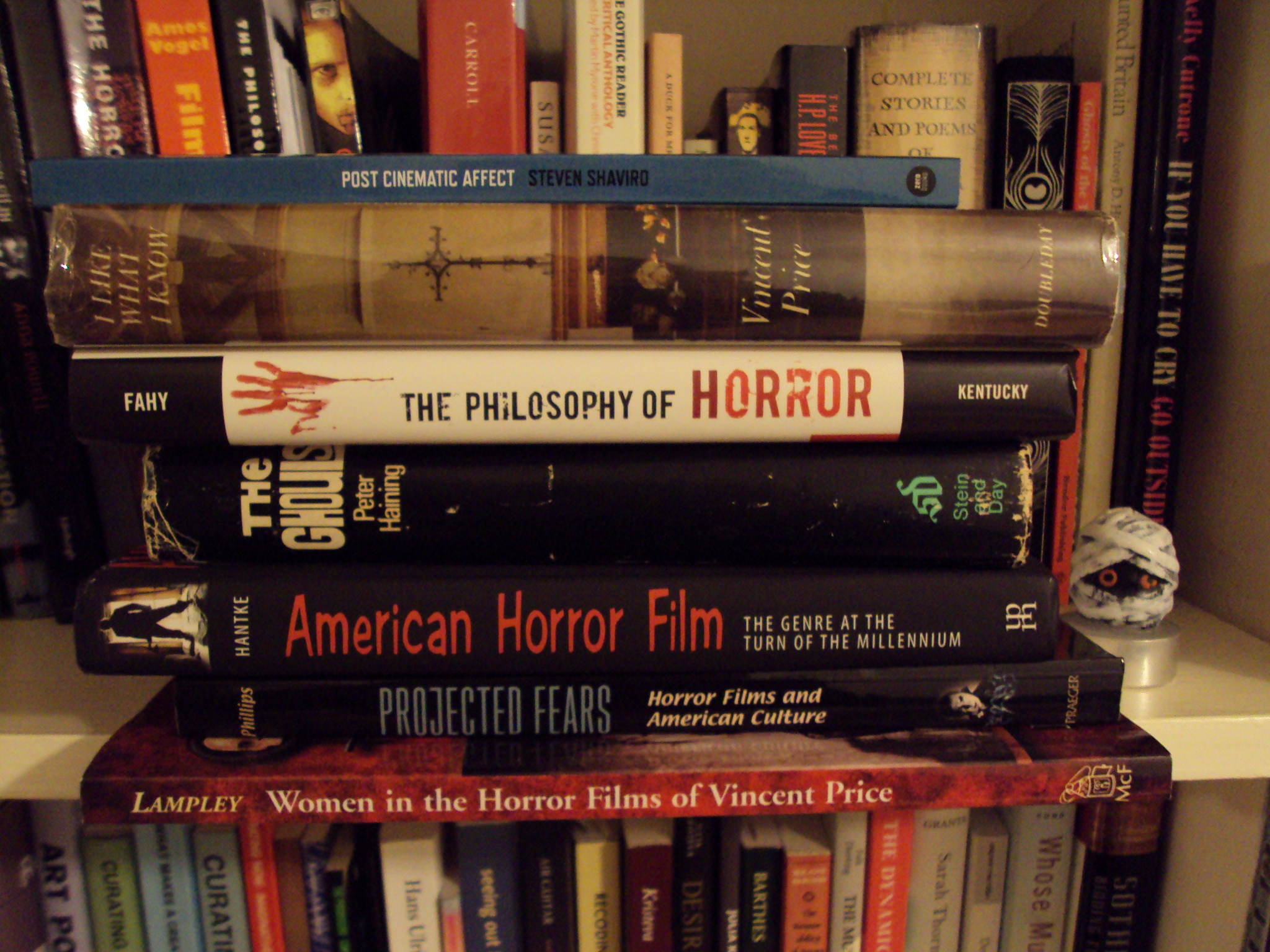
Beginning the new year with this book medley of new essay anthologies and old-time favorites (I mean, does it get any better Vincent Price writing about his life in art?). Happy new year in horror business 2011!
 THE GIRL WHO KNEW TOO MUCH